Btw-eetjes deel 13
€ 44,00
Dit boek vormt intussen al het dertiende in de reeks succesrijke handboeken Btw-eetjes. Het is geen klassiek btw-handboek. Dit dertiende deel bevat opnieuw een aantal in de praktijk voorkomende btw-problemen waarop het antwoord niet onmiddellijk te vinden is in een klassiek btw-handboek.
Het gaat om praktische vragen waarmee elke boekhouder, accountant of advocaat in zijn fiscale praktijk vroeg of laat geconfronteerd wordt. Het gaat daarbij soms om schijnbaar eenvoudige vragen maar waarop men toch vaak het antwoord schuldig blijkt te zijn of twijfelt.
Deze Btw-eetjes werden zoals in de vorige delen op een bondige en aantrekkelijke wijze weergegeven waardoor u snel vindt wat u zoekt.
Het antwoord op de vraag wordt telkens bondig en klaar geformuleerd zonder aan inhoudelijke kwaliteit en volledigheid in te boeten.
Stefan Ruysschaert heeft een economische vooropleiding genoten (UGent). Hij is adviseur bij de Federale Overheidsdienst Financiën. Hij is auteur van talrijke bijdragen op fiscaal vlak in toonaangevende tijdschriften en boeken. Hij is o.a. redactielid van Fiscalnet en het Tijdschrift Huur. Hij is professor aan de faculteit Economie van de UGent, vakgroep Accountancy, bedrijfsfinanciering en fiscaliteit waar hij het vak btw doceert en is (plaatsvervangend) lid van de stagecommissie van het BIBF. Hij is ook gastdocent aan de Fiscale Hogeschool (Odisee).
Het gaat om praktische vragen waarmee elke boekhouder, accountant of advocaat in zijn fiscale praktijk vroeg of laat geconfronteerd wordt. Het gaat daarbij soms om schijnbaar eenvoudige vragen maar waarop men toch vaak het antwoord schuldig blijkt te zijn of twijfelt.
Deze Btw-eetjes werden zoals in de vorige delen op een bondige en aantrekkelijke wijze weergegeven waardoor u snel vindt wat u zoekt.
Het antwoord op de vraag wordt telkens bondig en klaar geformuleerd zonder aan inhoudelijke kwaliteit en volledigheid in te boeten.
Stefan Ruysschaert heeft een economische vooropleiding genoten (UGent). Hij is adviseur bij de Federale Overheidsdienst Financiën. Hij is auteur van talrijke bijdragen op fiscaal vlak in toonaangevende tijdschriften en boeken. Hij is o.a. redactielid van Fiscalnet en het Tijdschrift Huur. Hij is professor aan de faculteit Economie van de UGent, vakgroep Accountancy, bedrijfsfinanciering en fiscaliteit waar hij het vak btw doceert en is (plaatsvervangend) lid van de stagecommissie van het BIBF. Hij is ook gastdocent aan de Fiscale Hogeschool (Odisee).
Btw-eetjes deel 13
€ 44,00
Dit boek vormt intussen al het dertiende in de reeks succesrijke handboeken Btw-eetjes. Het is geen klassiek btw-handboek. Dit dertiende deel bevat opnieuw een aantal in de praktijk voorkomende btw-problemen waarop het antwoord niet onmiddellijk te vinden is in een klassiek btw-handboek.
Het gaat om praktische vragen waarmee elke boekhouder, accountant of advocaat in zijn fiscale praktijk vroeg of laat geconfronteerd wordt. Het gaat daarbij soms om schijnbaar eenvoudige vragen maar waarop men toch vaak het antwoord schuldig blijkt te zijn of twijfelt.
Deze Btw-eetjes werden zoals in de vorige delen op een bondige en aantrekkelijke wijze weergegeven waardoor u snel vindt wat u zoekt.
Het antwoord op de vraag wordt telkens bondig en klaar geformuleerd zonder aan inhoudelijke kwaliteit en volledigheid in te boeten.
Stefan Ruysschaert heeft een economische vooropleiding genoten (UGent). Hij is adviseur bij de Federale Overheidsdienst Financiën. Hij is auteur van talrijke bijdragen op fiscaal vlak in toonaangevende tijdschriften en boeken. Hij is o.a. redactielid van Fiscalnet en het Tijdschrift Huur. Hij is professor aan de faculteit Economie van de UGent, vakgroep Accountancy, bedrijfsfinanciering en fiscaliteit waar hij het vak btw doceert en is (plaatsvervangend) lid van de stagecommissie van het BIBF. Hij is ook gastdocent aan de Fiscale Hogeschool (Odisee).
Het gaat om praktische vragen waarmee elke boekhouder, accountant of advocaat in zijn fiscale praktijk vroeg of laat geconfronteerd wordt. Het gaat daarbij soms om schijnbaar eenvoudige vragen maar waarop men toch vaak het antwoord schuldig blijkt te zijn of twijfelt.
Deze Btw-eetjes werden zoals in de vorige delen op een bondige en aantrekkelijke wijze weergegeven waardoor u snel vindt wat u zoekt.
Het antwoord op de vraag wordt telkens bondig en klaar geformuleerd zonder aan inhoudelijke kwaliteit en volledigheid in te boeten.
Stefan Ruysschaert heeft een economische vooropleiding genoten (UGent). Hij is adviseur bij de Federale Overheidsdienst Financiën. Hij is auteur van talrijke bijdragen op fiscaal vlak in toonaangevende tijdschriften en boeken. Hij is o.a. redactielid van Fiscalnet en het Tijdschrift Huur. Hij is professor aan de faculteit Economie van de UGent, vakgroep Accountancy, bedrijfsfinanciering en fiscaliteit waar hij het vak btw doceert en is (plaatsvervangend) lid van de stagecommissie van het BIBF. Hij is ook gastdocent aan de Fiscale Hogeschool (Odisee).
Zaken doen met het buitenland. 2e herziene uitgave.
€ 39,00
Zakendoen met het buitenland brengt heel wat btw-verplichtingen
met zich mee. Dit boek behandelt aan de hand van voorbeelden de
meest in de praktijk voorkomende transacties met het buitenland.
Het gaat hierbij in de eerste plaats om het intracommunautair
handelsverkeer van gewone goederen maar ook de invoer en uitvoer
komen aan bod.
In het kader van het zaken doen met het buitenland blijkt de contractuele relatie van het vervoer van belang te zijn. Dit is van belang bij het bewijs van de vrijstelling bij intracommunautaire leveringen en uitvoer en in het kader van verkopen op afstand maar ook bij (vereenvoudigd) driehoeksverkeer en andere vormen van kettingverkopen zoals bij intracommunautaire leveringen met installatie of montage.
Vanaf 1 januari 2020 is er meer rechtszekerheid ingevoerd inzake het bewijs bij intracommunautaire leveringen en ook op de vlak van kettingverkopen werden wettelijke vermoedens ingevoerd die bepalen in welke relatie het vervoer (en dus de vrijstelling) moet geplaatst worden als de “tussenhandelaar” voor het vervoer instaat.
Als er geen btw wordt aangerekend omdat de handeling is vrijgesteld of omdat er verlegging van de heffing is, wordt verwezen naar de toepasselijke bepalingen van de Richtlijn 2006/112/EG of het W.BTW. Dit is van belang voor een correcte facturering en rapportering.
Het boek bevat de voor de praktijk relevante rechtspraak van het Hof van Justitie inzake deze materie. Maar vooral, het boek staat bol van de praktijkvoorbeelden.
Stefan Ruysschaert is adviseur bij de FOD Financiën. Hij doceert het vak btw aan de UGent en is gastdocent aan de Fiscale Hogeschool (Odisee).
In het kader van het zaken doen met het buitenland blijkt de contractuele relatie van het vervoer van belang te zijn. Dit is van belang bij het bewijs van de vrijstelling bij intracommunautaire leveringen en uitvoer en in het kader van verkopen op afstand maar ook bij (vereenvoudigd) driehoeksverkeer en andere vormen van kettingverkopen zoals bij intracommunautaire leveringen met installatie of montage.
Vanaf 1 januari 2020 is er meer rechtszekerheid ingevoerd inzake het bewijs bij intracommunautaire leveringen en ook op de vlak van kettingverkopen werden wettelijke vermoedens ingevoerd die bepalen in welke relatie het vervoer (en dus de vrijstelling) moet geplaatst worden als de “tussenhandelaar” voor het vervoer instaat.
Als er geen btw wordt aangerekend omdat de handeling is vrijgesteld of omdat er verlegging van de heffing is, wordt verwezen naar de toepasselijke bepalingen van de Richtlijn 2006/112/EG of het W.BTW. Dit is van belang voor een correcte facturering en rapportering.
Het boek bevat de voor de praktijk relevante rechtspraak van het Hof van Justitie inzake deze materie. Maar vooral, het boek staat bol van de praktijkvoorbeelden.
Stefan Ruysschaert is adviseur bij de FOD Financiën. Hij doceert het vak btw aan de UGent en is gastdocent aan de Fiscale Hogeschool (Odisee).
Zaken doen met het buitenland. 2e herziene uitgave.
€ 39,00
Zakendoen met het buitenland brengt heel wat btw-verplichtingen
met zich mee. Dit boek behandelt aan de hand van voorbeelden de
meest in de praktijk voorkomende transacties met het buitenland.
Het gaat hierbij in de eerste plaats om het intracommunautair
handelsverkeer van gewone goederen maar ook de invoer en uitvoer
komen aan bod.
In het kader van het zaken doen met het buitenland blijkt de contractuele relatie van het vervoer van belang te zijn. Dit is van belang bij het bewijs van de vrijstelling bij intracommunautaire leveringen en uitvoer en in het kader van verkopen op afstand maar ook bij (vereenvoudigd) driehoeksverkeer en andere vormen van kettingverkopen zoals bij intracommunautaire leveringen met installatie of montage.
Vanaf 1 januari 2020 is er meer rechtszekerheid ingevoerd inzake het bewijs bij intracommunautaire leveringen en ook op de vlak van kettingverkopen werden wettelijke vermoedens ingevoerd die bepalen in welke relatie het vervoer (en dus de vrijstelling) moet geplaatst worden als de “tussenhandelaar” voor het vervoer instaat.
Als er geen btw wordt aangerekend omdat de handeling is vrijgesteld of omdat er verlegging van de heffing is, wordt verwezen naar de toepasselijke bepalingen van de Richtlijn 2006/112/EG of het W.BTW. Dit is van belang voor een correcte facturering en rapportering.
Het boek bevat de voor de praktijk relevante rechtspraak van het Hof van Justitie inzake deze materie. Maar vooral, het boek staat bol van de praktijkvoorbeelden.
Stefan Ruysschaert is adviseur bij de FOD Financiën. Hij doceert het vak btw aan de UGent en is gastdocent aan de Fiscale Hogeschool (Odisee).
In het kader van het zaken doen met het buitenland blijkt de contractuele relatie van het vervoer van belang te zijn. Dit is van belang bij het bewijs van de vrijstelling bij intracommunautaire leveringen en uitvoer en in het kader van verkopen op afstand maar ook bij (vereenvoudigd) driehoeksverkeer en andere vormen van kettingverkopen zoals bij intracommunautaire leveringen met installatie of montage.
Vanaf 1 januari 2020 is er meer rechtszekerheid ingevoerd inzake het bewijs bij intracommunautaire leveringen en ook op de vlak van kettingverkopen werden wettelijke vermoedens ingevoerd die bepalen in welke relatie het vervoer (en dus de vrijstelling) moet geplaatst worden als de “tussenhandelaar” voor het vervoer instaat.
Als er geen btw wordt aangerekend omdat de handeling is vrijgesteld of omdat er verlegging van de heffing is, wordt verwezen naar de toepasselijke bepalingen van de Richtlijn 2006/112/EG of het W.BTW. Dit is van belang voor een correcte facturering en rapportering.
Het boek bevat de voor de praktijk relevante rechtspraak van het Hof van Justitie inzake deze materie. Maar vooral, het boek staat bol van de praktijkvoorbeelden.
Stefan Ruysschaert is adviseur bij de FOD Financiën. Hij doceert het vak btw aan de UGent en is gastdocent aan de Fiscale Hogeschool (Odisee).
Geen voorraad
RIDP2019 Vol.90 / Subscription – Revue Internationale de Droit Penal / 2 Issues + Password
€ 85,00
This subscription gives you the two issues of RIDP 2019 Vol.90 in print and an online acces to these same issues with a personal password.
On the first issue of RIDP 2019 Vol.90
This issue is part of the fourth milestone on the way to the 20th AIDP World Congress dedicated to ‘Criminal Justice and Corporate Business’. It contains an introduction and a selection of national reports for the International Colloquium for Section III on ‘Prevention, Investigation, and Sanctioning of Economic Crime’, organized by the Max Planck Institute for Foreign and International Criminal Law in Freiburg from 18 to 20 June 2018. The present issue is published simultaneously with issue 2 of Volume 90, featuring the additional colloquium reports on alternative regimes for controlling economic crime and the limits of human rights protection. The publication of the general report and the recommendations of the colloquium will follow. The background of the Freiburg colloquium was the evolution towards a new architecture for economic crime control, in which criminal law is increasingly amended and affected by alternative prevention, investigation, and sanctioning regimes (such as administrative criminal law, civil asset forfeiture, and private compliance regimes). The colloquium has analysed, compared, and evaluated such alternative control regimes, focusing on their practicability and their human rights safeguards, in view of developing recommendations for an improved comprehensive economic crime policy. The multi-level comparative methodological approach underlying the colloquium consisted of a comparison of a wide range of national and international legal orders and a functional comparison of the different criminal and alternative legal regimes within and across these legal orders.
On the first issue of RIDP 2019 Vol.90
This issue is part of the fourth milestone on the way to the 20th AIDP World Congress dedicated to ‘Criminal Justice and Corporate Business’. It contains an introduction and a selection of national reports for the International Colloquium for Section III on ‘Prevention, Investigation, and Sanctioning of Economic Crime’, organized by the Max Planck Institute for Foreign and International Criminal Law in Freiburg from 18 to 20 June 2018. The present issue is published simultaneously with issue 2 of Volume 90, featuring the additional colloquium reports on alternative regimes for controlling economic crime and the limits of human rights protection. The publication of the general report and the recommendations of the colloquium will follow. The background of the Freiburg colloquium was the evolution towards a new architecture for economic crime control, in which criminal law is increasingly amended and affected by alternative prevention, investigation, and sanctioning regimes (such as administrative criminal law, civil asset forfeiture, and private compliance regimes). The colloquium has analysed, compared, and evaluated such alternative control regimes, focusing on their practicability and their human rights safeguards, in view of developing recommendations for an improved comprehensive economic crime policy. The multi-level comparative methodological approach underlying the colloquium consisted of a comparison of a wide range of national and international legal orders and a functional comparison of the different criminal and alternative legal regimes within and across these legal orders.
Geen voorraad
RIDP2019 Vol.90 / Subscription – Revue Internationale de Droit Penal / 2 Issues + Password
€ 85,00
This subscription gives you the two issues of RIDP 2019 Vol.90 in print and an online acces to these same issues with a personal password.
On the first issue of RIDP 2019 Vol.90
This issue is part of the fourth milestone on the way to the 20th AIDP World Congress dedicated to ‘Criminal Justice and Corporate Business’. It contains an introduction and a selection of national reports for the International Colloquium for Section III on ‘Prevention, Investigation, and Sanctioning of Economic Crime’, organized by the Max Planck Institute for Foreign and International Criminal Law in Freiburg from 18 to 20 June 2018. The present issue is published simultaneously with issue 2 of Volume 90, featuring the additional colloquium reports on alternative regimes for controlling economic crime and the limits of human rights protection. The publication of the general report and the recommendations of the colloquium will follow. The background of the Freiburg colloquium was the evolution towards a new architecture for economic crime control, in which criminal law is increasingly amended and affected by alternative prevention, investigation, and sanctioning regimes (such as administrative criminal law, civil asset forfeiture, and private compliance regimes). The colloquium has analysed, compared, and evaluated such alternative control regimes, focusing on their practicability and their human rights safeguards, in view of developing recommendations for an improved comprehensive economic crime policy. The multi-level comparative methodological approach underlying the colloquium consisted of a comparison of a wide range of national and international legal orders and a functional comparison of the different criminal and alternative legal regimes within and across these legal orders.
On the first issue of RIDP 2019 Vol.90
This issue is part of the fourth milestone on the way to the 20th AIDP World Congress dedicated to ‘Criminal Justice and Corporate Business’. It contains an introduction and a selection of national reports for the International Colloquium for Section III on ‘Prevention, Investigation, and Sanctioning of Economic Crime’, organized by the Max Planck Institute for Foreign and International Criminal Law in Freiburg from 18 to 20 June 2018. The present issue is published simultaneously with issue 2 of Volume 90, featuring the additional colloquium reports on alternative regimes for controlling economic crime and the limits of human rights protection. The publication of the general report and the recommendations of the colloquium will follow. The background of the Freiburg colloquium was the evolution towards a new architecture for economic crime control, in which criminal law is increasingly amended and affected by alternative prevention, investigation, and sanctioning regimes (such as administrative criminal law, civil asset forfeiture, and private compliance regimes). The colloquium has analysed, compared, and evaluated such alternative control regimes, focusing on their practicability and their human rights safeguards, in view of developing recommendations for an improved comprehensive economic crime policy. The multi-level comparative methodological approach underlying the colloquium consisted of a comparison of a wide range of national and international legal orders and a functional comparison of the different criminal and alternative legal regimes within and across these legal orders.
Geen voorraad
RIDP2019 Vol.90 / Subscription – Revue Internationale de Droit Penal / 2 Issues + IP-addres
€ 180,00
This subscription gives you the two issues of RIDP 2019 Vol.90 in print and an online acces to these same issues on your IP-address (for institutions).
On the first issue of RIDP 2019 Vol.90
This issue is part of the fourth milestone on the way to the 20th AIDP World Congress dedicated to ‘Criminal Justice and Corporate Business’. It contains an introduction and a selection of national reports for the International Colloquium for Section III on ‘Prevention, Investigation, and Sanctioning of Economic Crime’, organized by the Max Planck Institute for Foreign and International Criminal Law in Freiburg from 18 to 20 June 2018. The present issue is published simultaneously with issue 2 of Volume 90, featuring the additional colloquium reports on alternative regimes for controlling economic crime and the limits of human rights protection. The publication of the general report and the recommendations of the colloquium will follow. The background of the Freiburg colloquium was the evolution towards a new architecture for economic crime control, in which criminal law is increasingly amended and affected by alternative prevention, investigation, and sanctioning regimes (such as administrative criminal law, civil asset forfeiture, and private compliance regimes). The colloquium has analysed, compared, and evaluated such alternative control regimes, focusing on their practicability and their human rights safeguards, in view of developing recommendations for an improved comprehensive economic crime policy. The multi-level comparative methodological approach underlying the colloquium consisted of a comparison of a wide range of national and international legal orders and a functional comparison of the different criminal and alternative legal regimes within and across these legal orders.
On the second Issue of RIDP 2019 Vol.90
This issue is part of the fourth milestone on the way to the 20th AIDP World Congress dedicated to ‘Criminal Justice and Corporate Business’. It contains the reports on alternative regimes for controlling economic crime and the limits of human rights protection for the International Colloquium for Section III on ‘Prevention, Investigation, and Sanctioning of Economic Crime’, organized by the Max Planck Institute for Foreign and International Criminal Law in Freiburg from 18 to 20 June 2018. The present issue is published simultaneously with issue 1 of Volume 90, featuring an introduction and a selection of national reports. The publication of the general report and the recommendations of the colloquium will follow.
The background of the Freiburg colloquium was the evolution towards a new architecture for economic crime control, in which criminal law is increasingly amended and affected by alternative prevention, investigation, and sanctioning regimes (such as administrative criminal law, civil asset forfeiture, and private compliance regimes). The colloquium has analysed, compared, and evaluated such alternative control regimes, focusing on their practicability and their human rights safeguards, in view of developing recommendations for an improved comprehensive economic crime policy. The multi-level comparative methodological approach underlying the colloquium consisted of a comparison of a wide range of national and international legal orders and a functional comparison of the different criminal and alternative legal regimes within and across these legal orders.
On the first issue of RIDP 2019 Vol.90
This issue is part of the fourth milestone on the way to the 20th AIDP World Congress dedicated to ‘Criminal Justice and Corporate Business’. It contains an introduction and a selection of national reports for the International Colloquium for Section III on ‘Prevention, Investigation, and Sanctioning of Economic Crime’, organized by the Max Planck Institute for Foreign and International Criminal Law in Freiburg from 18 to 20 June 2018. The present issue is published simultaneously with issue 2 of Volume 90, featuring the additional colloquium reports on alternative regimes for controlling economic crime and the limits of human rights protection. The publication of the general report and the recommendations of the colloquium will follow. The background of the Freiburg colloquium was the evolution towards a new architecture for economic crime control, in which criminal law is increasingly amended and affected by alternative prevention, investigation, and sanctioning regimes (such as administrative criminal law, civil asset forfeiture, and private compliance regimes). The colloquium has analysed, compared, and evaluated such alternative control regimes, focusing on their practicability and their human rights safeguards, in view of developing recommendations for an improved comprehensive economic crime policy. The multi-level comparative methodological approach underlying the colloquium consisted of a comparison of a wide range of national and international legal orders and a functional comparison of the different criminal and alternative legal regimes within and across these legal orders.
On the second Issue of RIDP 2019 Vol.90
This issue is part of the fourth milestone on the way to the 20th AIDP World Congress dedicated to ‘Criminal Justice and Corporate Business’. It contains the reports on alternative regimes for controlling economic crime and the limits of human rights protection for the International Colloquium for Section III on ‘Prevention, Investigation, and Sanctioning of Economic Crime’, organized by the Max Planck Institute for Foreign and International Criminal Law in Freiburg from 18 to 20 June 2018. The present issue is published simultaneously with issue 1 of Volume 90, featuring an introduction and a selection of national reports. The publication of the general report and the recommendations of the colloquium will follow.
The background of the Freiburg colloquium was the evolution towards a new architecture for economic crime control, in which criminal law is increasingly amended and affected by alternative prevention, investigation, and sanctioning regimes (such as administrative criminal law, civil asset forfeiture, and private compliance regimes). The colloquium has analysed, compared, and evaluated such alternative control regimes, focusing on their practicability and their human rights safeguards, in view of developing recommendations for an improved comprehensive economic crime policy. The multi-level comparative methodological approach underlying the colloquium consisted of a comparison of a wide range of national and international legal orders and a functional comparison of the different criminal and alternative legal regimes within and across these legal orders.
Geen voorraad
RIDP2019 Vol.90 / Subscription – Revue Internationale de Droit Penal / 2 Issues + IP-addres
€ 180,00
This subscription gives you the two issues of RIDP 2019 Vol.90 in print and an online acces to these same issues on your IP-address (for institutions).
On the first issue of RIDP 2019 Vol.90
This issue is part of the fourth milestone on the way to the 20th AIDP World Congress dedicated to ‘Criminal Justice and Corporate Business’. It contains an introduction and a selection of national reports for the International Colloquium for Section III on ‘Prevention, Investigation, and Sanctioning of Economic Crime’, organized by the Max Planck Institute for Foreign and International Criminal Law in Freiburg from 18 to 20 June 2018. The present issue is published simultaneously with issue 2 of Volume 90, featuring the additional colloquium reports on alternative regimes for controlling economic crime and the limits of human rights protection. The publication of the general report and the recommendations of the colloquium will follow. The background of the Freiburg colloquium was the evolution towards a new architecture for economic crime control, in which criminal law is increasingly amended and affected by alternative prevention, investigation, and sanctioning regimes (such as administrative criminal law, civil asset forfeiture, and private compliance regimes). The colloquium has analysed, compared, and evaluated such alternative control regimes, focusing on their practicability and their human rights safeguards, in view of developing recommendations for an improved comprehensive economic crime policy. The multi-level comparative methodological approach underlying the colloquium consisted of a comparison of a wide range of national and international legal orders and a functional comparison of the different criminal and alternative legal regimes within and across these legal orders.
On the second Issue of RIDP 2019 Vol.90
This issue is part of the fourth milestone on the way to the 20th AIDP World Congress dedicated to ‘Criminal Justice and Corporate Business’. It contains the reports on alternative regimes for controlling economic crime and the limits of human rights protection for the International Colloquium for Section III on ‘Prevention, Investigation, and Sanctioning of Economic Crime’, organized by the Max Planck Institute for Foreign and International Criminal Law in Freiburg from 18 to 20 June 2018. The present issue is published simultaneously with issue 1 of Volume 90, featuring an introduction and a selection of national reports. The publication of the general report and the recommendations of the colloquium will follow.
The background of the Freiburg colloquium was the evolution towards a new architecture for economic crime control, in which criminal law is increasingly amended and affected by alternative prevention, investigation, and sanctioning regimes (such as administrative criminal law, civil asset forfeiture, and private compliance regimes). The colloquium has analysed, compared, and evaluated such alternative control regimes, focusing on their practicability and their human rights safeguards, in view of developing recommendations for an improved comprehensive economic crime policy. The multi-level comparative methodological approach underlying the colloquium consisted of a comparison of a wide range of national and international legal orders and a functional comparison of the different criminal and alternative legal regimes within and across these legal orders.
On the first issue of RIDP 2019 Vol.90
This issue is part of the fourth milestone on the way to the 20th AIDP World Congress dedicated to ‘Criminal Justice and Corporate Business’. It contains an introduction and a selection of national reports for the International Colloquium for Section III on ‘Prevention, Investigation, and Sanctioning of Economic Crime’, organized by the Max Planck Institute for Foreign and International Criminal Law in Freiburg from 18 to 20 June 2018. The present issue is published simultaneously with issue 2 of Volume 90, featuring the additional colloquium reports on alternative regimes for controlling economic crime and the limits of human rights protection. The publication of the general report and the recommendations of the colloquium will follow. The background of the Freiburg colloquium was the evolution towards a new architecture for economic crime control, in which criminal law is increasingly amended and affected by alternative prevention, investigation, and sanctioning regimes (such as administrative criminal law, civil asset forfeiture, and private compliance regimes). The colloquium has analysed, compared, and evaluated such alternative control regimes, focusing on their practicability and their human rights safeguards, in view of developing recommendations for an improved comprehensive economic crime policy. The multi-level comparative methodological approach underlying the colloquium consisted of a comparison of a wide range of national and international legal orders and a functional comparison of the different criminal and alternative legal regimes within and across these legal orders.
On the second Issue of RIDP 2019 Vol.90
This issue is part of the fourth milestone on the way to the 20th AIDP World Congress dedicated to ‘Criminal Justice and Corporate Business’. It contains the reports on alternative regimes for controlling economic crime and the limits of human rights protection for the International Colloquium for Section III on ‘Prevention, Investigation, and Sanctioning of Economic Crime’, organized by the Max Planck Institute for Foreign and International Criminal Law in Freiburg from 18 to 20 June 2018. The present issue is published simultaneously with issue 1 of Volume 90, featuring an introduction and a selection of national reports. The publication of the general report and the recommendations of the colloquium will follow.
The background of the Freiburg colloquium was the evolution towards a new architecture for economic crime control, in which criminal law is increasingly amended and affected by alternative prevention, investigation, and sanctioning regimes (such as administrative criminal law, civil asset forfeiture, and private compliance regimes). The colloquium has analysed, compared, and evaluated such alternative control regimes, focusing on their practicability and their human rights safeguards, in view of developing recommendations for an improved comprehensive economic crime policy. The multi-level comparative methodological approach underlying the colloquium consisted of a comparison of a wide range of national and international legal orders and a functional comparison of the different criminal and alternative legal regimes within and across these legal orders.
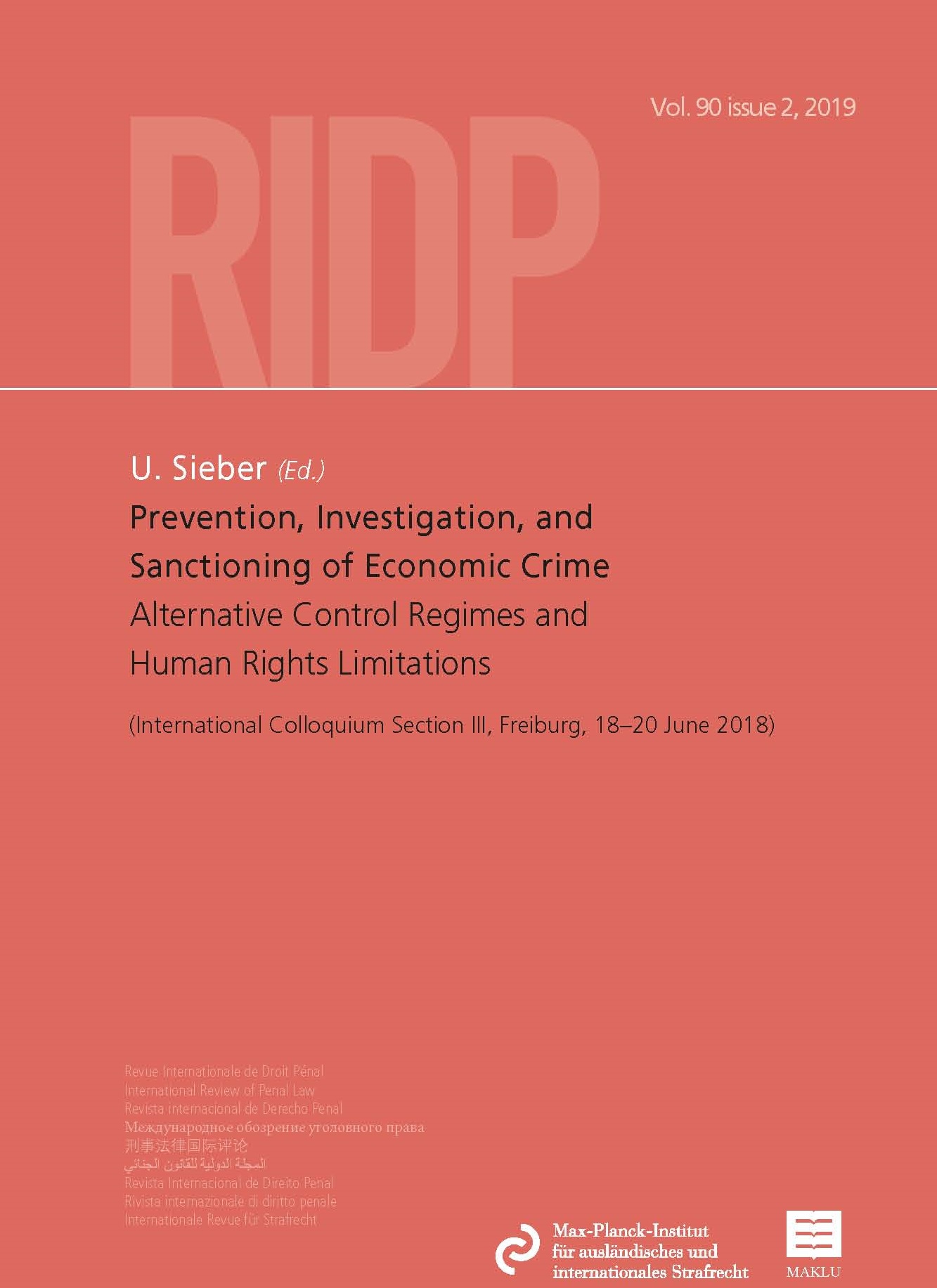
RIDP2019Vol90/iss2-Prevention, investigation, and sanctioning of economic crime. Alternative control regimes and human rights limitations
€ 70,00
This issue is part of the fourth milestone on the way to the 20th AIDP World
Congress dedicated to ‘Criminal Justice and Corporate Business’. It contains the
reports on alternative regimes for controlling economic crime and the limits
of human rights protection for the International Colloquium for Section III on
‘Prevention, Investigation, and Sanctioning of Economic Crime’, organized by the
Max Planck Institute for Foreign and International Criminal Law in Freiburg from
18 to 20 June 2018. The present issue is published simultaneously with issue 1 of
Volume 90, featuring an introduction and a selection of national reports. The
publication of the general report and the recommendations of the colloquium
will follow.
The background of the Freiburg colloquium was the evolution towards a new architecture for economic crime control, in which criminal law is increasingly amended and affected by alternative prevention, investigation, and sanctioning regimes (such as administrative criminal law, civil asset forfeiture, and private compliance regimes). The colloquium has analysed, compared, and evaluated such alternative control regimes, focusing on their practicability and their human rights safeguards, in view of developing recommendations for an improved comprehensive economic crime policy. The multi-level comparative methodological approach underlying the colloquium consisted of a comparison of a wide range of national and international legal orders and a functional comparison of the different criminal and alternative legal regimes within and across these legal orders.
Ulrich Sieber, Professor of Criminal Law, is director at the Max Planck Institute for Foreign and International Criminal Law. His main areas of research encompass the changing face of complex crime, criminal law, and legal policy in today’s global risk and information society. Major project areas include organized crime, terrorism, economic crime, and cybercrime, as well as comparative law, security law, European criminal law, and international criminal law.
The background of the Freiburg colloquium was the evolution towards a new architecture for economic crime control, in which criminal law is increasingly amended and affected by alternative prevention, investigation, and sanctioning regimes (such as administrative criminal law, civil asset forfeiture, and private compliance regimes). The colloquium has analysed, compared, and evaluated such alternative control regimes, focusing on their practicability and their human rights safeguards, in view of developing recommendations for an improved comprehensive economic crime policy. The multi-level comparative methodological approach underlying the colloquium consisted of a comparison of a wide range of national and international legal orders and a functional comparison of the different criminal and alternative legal regimes within and across these legal orders.
Ulrich Sieber, Professor of Criminal Law, is director at the Max Planck Institute for Foreign and International Criminal Law. His main areas of research encompass the changing face of complex crime, criminal law, and legal policy in today’s global risk and information society. Major project areas include organized crime, terrorism, economic crime, and cybercrime, as well as comparative law, security law, European criminal law, and international criminal law.
RIDP2019Vol90/iss2-Prevention, investigation, and sanctioning of economic crime. Alternative control regimes and human rights limitations
€ 70,00
This issue is part of the fourth milestone on the way to the 20th AIDP World
Congress dedicated to ‘Criminal Justice and Corporate Business’. It contains the
reports on alternative regimes for controlling economic crime and the limits
of human rights protection for the International Colloquium for Section III on
‘Prevention, Investigation, and Sanctioning of Economic Crime’, organized by the
Max Planck Institute for Foreign and International Criminal Law in Freiburg from
18 to 20 June 2018. The present issue is published simultaneously with issue 1 of
Volume 90, featuring an introduction and a selection of national reports. The
publication of the general report and the recommendations of the colloquium
will follow.
The background of the Freiburg colloquium was the evolution towards a new architecture for economic crime control, in which criminal law is increasingly amended and affected by alternative prevention, investigation, and sanctioning regimes (such as administrative criminal law, civil asset forfeiture, and private compliance regimes). The colloquium has analysed, compared, and evaluated such alternative control regimes, focusing on their practicability and their human rights safeguards, in view of developing recommendations for an improved comprehensive economic crime policy. The multi-level comparative methodological approach underlying the colloquium consisted of a comparison of a wide range of national and international legal orders and a functional comparison of the different criminal and alternative legal regimes within and across these legal orders.
Ulrich Sieber, Professor of Criminal Law, is director at the Max Planck Institute for Foreign and International Criminal Law. His main areas of research encompass the changing face of complex crime, criminal law, and legal policy in today’s global risk and information society. Major project areas include organized crime, terrorism, economic crime, and cybercrime, as well as comparative law, security law, European criminal law, and international criminal law.
The background of the Freiburg colloquium was the evolution towards a new architecture for economic crime control, in which criminal law is increasingly amended and affected by alternative prevention, investigation, and sanctioning regimes (such as administrative criminal law, civil asset forfeiture, and private compliance regimes). The colloquium has analysed, compared, and evaluated such alternative control regimes, focusing on their practicability and their human rights safeguards, in view of developing recommendations for an improved comprehensive economic crime policy. The multi-level comparative methodological approach underlying the colloquium consisted of a comparison of a wide range of national and international legal orders and a functional comparison of the different criminal and alternative legal regimes within and across these legal orders.
Ulrich Sieber, Professor of Criminal Law, is director at the Max Planck Institute for Foreign and International Criminal Law. His main areas of research encompass the changing face of complex crime, criminal law, and legal policy in today’s global risk and information society. Major project areas include organized crime, terrorism, economic crime, and cybercrime, as well as comparative law, security law, European criminal law, and international criminal law.
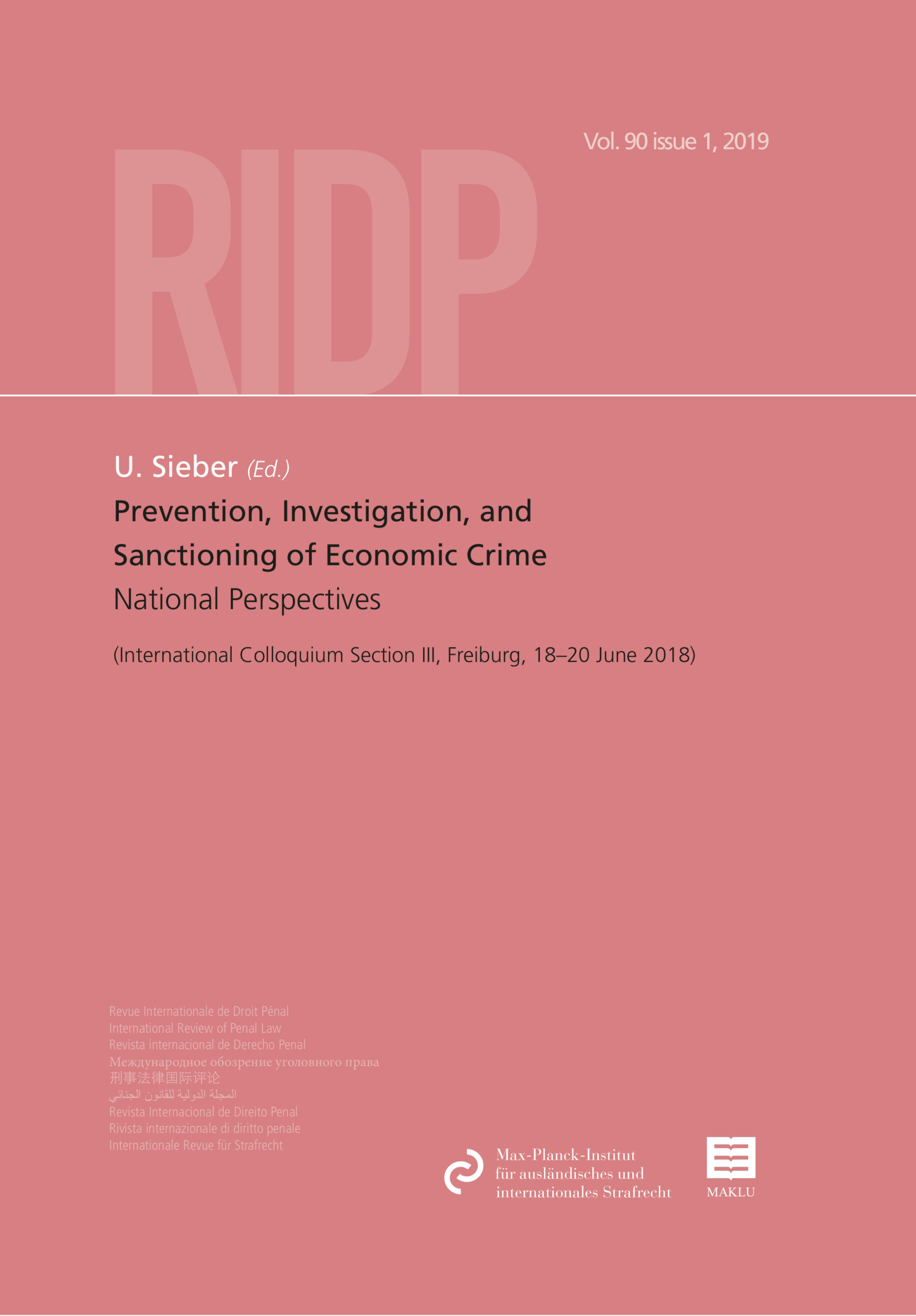
RIDP2019Vol90/iss1-Prevention, investigation, and sanctioning of economic crime. National perspectives
€ 70,00
This issue is part of the fourth milestone on the way to the 20th AIDP World Congress dedicated to ‘Criminal Justice and Corporate Business’. It contains an introduction and a selection of national reports for the International Colloquium for Section III on ‘Prevention, Investigation, and Sanctioning of Economic Crime’, organized by the Max Planck Institute for Foreign and International Criminal Law in Freiburg from 18 to 20 June 2018. The present issue is published simultaneously with issue 2 of Volume 90, featuring the additional colloquium reports on alternative regimes for controlling economic crime and the limits of human rights protection. The publication of the general report and the recommendations of the colloquium will follow. The background of the Freiburg colloquium was the evolution towards a new architecture for economic crime control, in which criminal law is increasingly amended and affected by alternative prevention, investigation, and sanctioning regimes (such as administrative criminal law, civil asset forfeiture, and private compliance regimes). The colloquium has analysed, compared, and evaluated such alternative control regimes, focusing on their practicability and their human rights safeguards, in view of developing recommendations for an improved comprehensive economic crime policy. The multi-level comparative methodological approach underlying the colloquium consisted of a comparison of a wide range of national and international legal orders and a functional comparison of the different criminal and alternative legal regimes within and across these legal orders.
Ulrich Sieber, Professor of Criminal Law, is director at the Max Planck Institute for Foreign and International Criminal Law. His main areas of research encompass the changing face of complex crime, criminal law, and legal policy in today’s global risk and information society. Major project areas include organized crime, terrorism, economic crime, and cybercrime, as well as comparative law, security law, European criminal law, and international criminal law.
Ulrich Sieber, Professor of Criminal Law, is director at the Max Planck Institute for Foreign and International Criminal Law. His main areas of research encompass the changing face of complex crime, criminal law, and legal policy in today’s global risk and information society. Major project areas include organized crime, terrorism, economic crime, and cybercrime, as well as comparative law, security law, European criminal law, and international criminal law.
RIDP2019Vol90/iss1-Prevention, investigation, and sanctioning of economic crime. National perspectives
€ 70,00
This issue is part of the fourth milestone on the way to the 20th AIDP World Congress dedicated to ‘Criminal Justice and Corporate Business’. It contains an introduction and a selection of national reports for the International Colloquium for Section III on ‘Prevention, Investigation, and Sanctioning of Economic Crime’, organized by the Max Planck Institute for Foreign and International Criminal Law in Freiburg from 18 to 20 June 2018. The present issue is published simultaneously with issue 2 of Volume 90, featuring the additional colloquium reports on alternative regimes for controlling economic crime and the limits of human rights protection. The publication of the general report and the recommendations of the colloquium will follow. The background of the Freiburg colloquium was the evolution towards a new architecture for economic crime control, in which criminal law is increasingly amended and affected by alternative prevention, investigation, and sanctioning regimes (such as administrative criminal law, civil asset forfeiture, and private compliance regimes). The colloquium has analysed, compared, and evaluated such alternative control regimes, focusing on their practicability and their human rights safeguards, in view of developing recommendations for an improved comprehensive economic crime policy. The multi-level comparative methodological approach underlying the colloquium consisted of a comparison of a wide range of national and international legal orders and a functional comparison of the different criminal and alternative legal regimes within and across these legal orders.
Ulrich Sieber, Professor of Criminal Law, is director at the Max Planck Institute for Foreign and International Criminal Law. His main areas of research encompass the changing face of complex crime, criminal law, and legal policy in today’s global risk and information society. Major project areas include organized crime, terrorism, economic crime, and cybercrime, as well as comparative law, security law, European criminal law, and international criminal law.
Ulrich Sieber, Professor of Criminal Law, is director at the Max Planck Institute for Foreign and International Criminal Law. His main areas of research encompass the changing face of complex crime, criminal law, and legal policy in today’s global risk and information society. Major project areas include organized crime, terrorism, economic crime, and cybercrime, as well as comparative law, security law, European criminal law, and international criminal law.
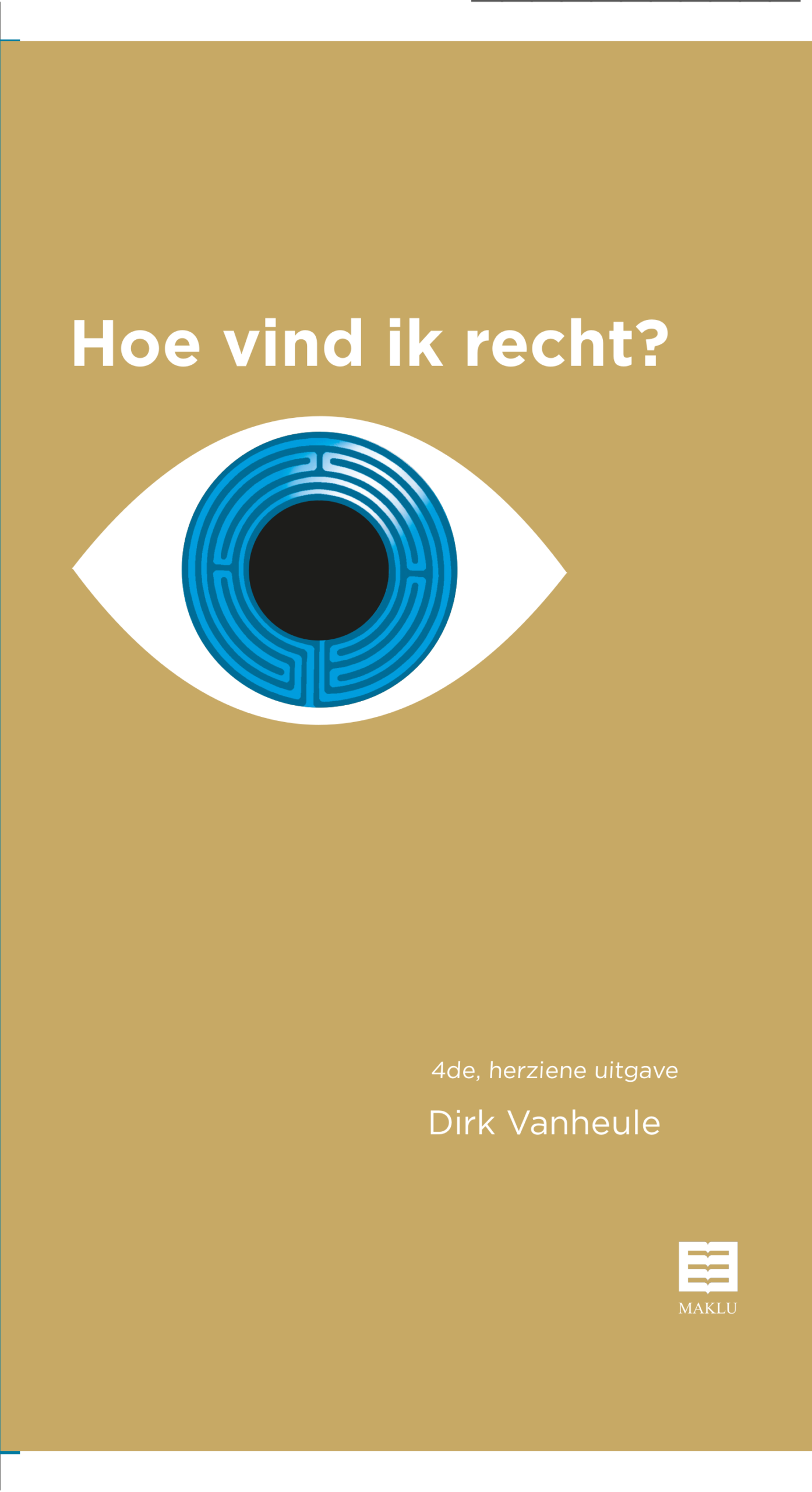
Hoe vind ik recht? 4de herziene uitgave.
€ 27,50
Wie een antwoord wil geven op een juridische vraag, moet op een efficiënte wijze het juridische bronnenmateriaal kunnen verzamelen waarmee hij of zij vervolgens het antwoord kan vinden. Via deze bronnen achterhaalt men de toepasselijke rechtsregels en kan men de draagwijdte ervan bepalen. Dit opzoekingswerk is noodzakelijk. Het recht evolueert immers voortdurend, zodat een allesomvattende kennis van “hét recht” niet meer haalbaar is.
Dit boek moet in de eerste plaats studenten in de rechten helpen om de basisvaardigheden in de rechtsmethodiek, die onmisbaar zijn in het geheel van de opleiding en de latere juridische beroepsuitoefening, aan te leren. Het biedt een inzicht in de voornaamste formele rechtsbronnen, het Belgische rechtsstelsel en de verschillende gedrukte en digitale publicatievormen van wetgeving, rechtspraak en rechtsleer. Daarbij gaat de aandacht uit naar zowel eenvoudige als meer complexe vormen van opzoeking, waarbij voorafgaandelijk aan de opzoeking en raadpleging van de rechtsbronnen, een casusanalyse nodig is. Praktische voorbeelden begeleiden de lezer doorheen het boek.
Het boek is eveneens een handige gids voor rechtspractici die hun kennis in het constant wijzigende aanbod van juridisch bronnenmateriaal willen bijhouden, en voor eenieder die zelf het recht wil vinden.
Dirk Vanheule is gewoon hoogleraar aan de Faculteit Rechten van de Universiteit Antwerpen en advocaat te Gent.
Dit boek moet in de eerste plaats studenten in de rechten helpen om de basisvaardigheden in de rechtsmethodiek, die onmisbaar zijn in het geheel van de opleiding en de latere juridische beroepsuitoefening, aan te leren. Het biedt een inzicht in de voornaamste formele rechtsbronnen, het Belgische rechtsstelsel en de verschillende gedrukte en digitale publicatievormen van wetgeving, rechtspraak en rechtsleer. Daarbij gaat de aandacht uit naar zowel eenvoudige als meer complexe vormen van opzoeking, waarbij voorafgaandelijk aan de opzoeking en raadpleging van de rechtsbronnen, een casusanalyse nodig is. Praktische voorbeelden begeleiden de lezer doorheen het boek.
Het boek is eveneens een handige gids voor rechtspractici die hun kennis in het constant wijzigende aanbod van juridisch bronnenmateriaal willen bijhouden, en voor eenieder die zelf het recht wil vinden.
Dirk Vanheule is gewoon hoogleraar aan de Faculteit Rechten van de Universiteit Antwerpen en advocaat te Gent.
Hoe vind ik recht? 4de herziene uitgave.
€ 27,50
Wie een antwoord wil geven op een juridische vraag, moet op een efficiënte wijze het juridische bronnenmateriaal kunnen verzamelen waarmee hij of zij vervolgens het antwoord kan vinden. Via deze bronnen achterhaalt men de toepasselijke rechtsregels en kan men de draagwijdte ervan bepalen. Dit opzoekingswerk is noodzakelijk. Het recht evolueert immers voortdurend, zodat een allesomvattende kennis van “hét recht” niet meer haalbaar is.
Dit boek moet in de eerste plaats studenten in de rechten helpen om de basisvaardigheden in de rechtsmethodiek, die onmisbaar zijn in het geheel van de opleiding en de latere juridische beroepsuitoefening, aan te leren. Het biedt een inzicht in de voornaamste formele rechtsbronnen, het Belgische rechtsstelsel en de verschillende gedrukte en digitale publicatievormen van wetgeving, rechtspraak en rechtsleer. Daarbij gaat de aandacht uit naar zowel eenvoudige als meer complexe vormen van opzoeking, waarbij voorafgaandelijk aan de opzoeking en raadpleging van de rechtsbronnen, een casusanalyse nodig is. Praktische voorbeelden begeleiden de lezer doorheen het boek.
Het boek is eveneens een handige gids voor rechtspractici die hun kennis in het constant wijzigende aanbod van juridisch bronnenmateriaal willen bijhouden, en voor eenieder die zelf het recht wil vinden.
Dirk Vanheule is gewoon hoogleraar aan de Faculteit Rechten van de Universiteit Antwerpen en advocaat te Gent.
Dit boek moet in de eerste plaats studenten in de rechten helpen om de basisvaardigheden in de rechtsmethodiek, die onmisbaar zijn in het geheel van de opleiding en de latere juridische beroepsuitoefening, aan te leren. Het biedt een inzicht in de voornaamste formele rechtsbronnen, het Belgische rechtsstelsel en de verschillende gedrukte en digitale publicatievormen van wetgeving, rechtspraak en rechtsleer. Daarbij gaat de aandacht uit naar zowel eenvoudige als meer complexe vormen van opzoeking, waarbij voorafgaandelijk aan de opzoeking en raadpleging van de rechtsbronnen, een casusanalyse nodig is. Praktische voorbeelden begeleiden de lezer doorheen het boek.
Het boek is eveneens een handige gids voor rechtspractici die hun kennis in het constant wijzigende aanbod van juridisch bronnenmateriaal willen bijhouden, en voor eenieder die zelf het recht wil vinden.
Dirk Vanheule is gewoon hoogleraar aan de Faculteit Rechten van de Universiteit Antwerpen en advocaat te Gent.
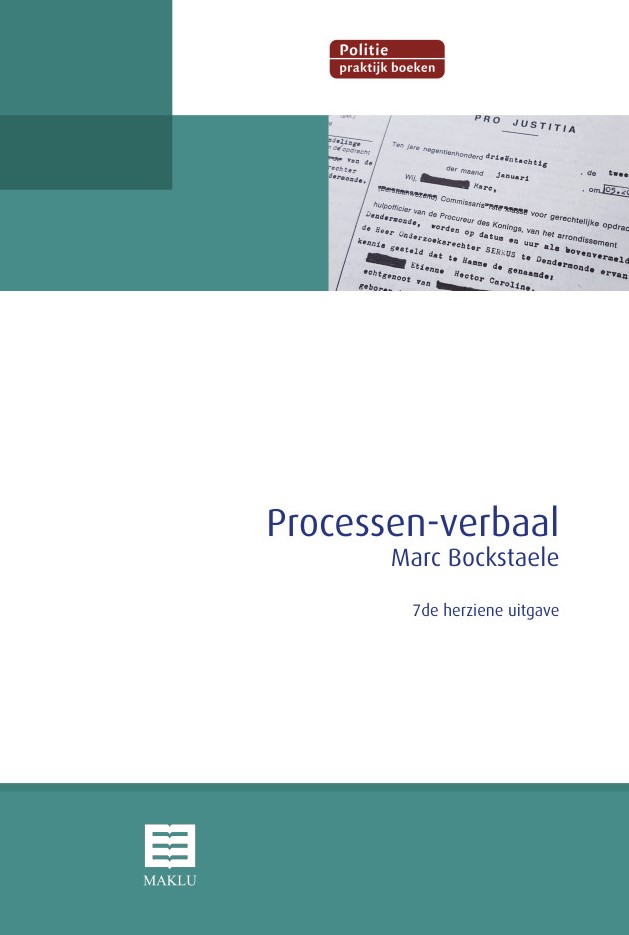
Processen-verbaal. 7de herziene uitgave.
€ 59,00
Het primaire doel van processen-verbaal is de bewijslevering in strafzaken, het relateren van misdrijven, vaststellingen, relevante omstandigheden en ambtsverrichtingen aan de bevoegde magistratuur. Het zijn juridische bewijsstukken en ze vormen de basis van nagenoeg elk strafdossier. De behandeling en beoordeling in elke strafzaak hangt in ruime mate af van de nauwkeurigheid, de volledigheid en de betrouwbaarheid van de processen-verbaal. Het lijkt niet overdreven te zeggen dat de strafrechtspleging staat of valt met het verschijnsel proces-verbaal.
Nagenoeg alle aspecten van processen-verbaal worden in dit praktijkboek besproken, inclusief de vormvereisten, de bewijswaarde, de taalwetgeving, de verwerking van inhoud, vaststellingen en verhoren.
Deze zevende uitgave (de eerste uitgave was van 1994) is volledig herzien, aangevuld en geactualiseerd. De talrijke verwijzingen naar wetgeving, rechtspraak en rechtsleer maken van dit boek een onmisbaar naslagwerk voor politiefunctionarissen, magistraten, advocaten en academici.
Nagenoeg alle aspecten van processen-verbaal worden in dit praktijkboek besproken, inclusief de vormvereisten, de bewijswaarde, de taalwetgeving, de verwerking van inhoud, vaststellingen en verhoren.
Deze zevende uitgave (de eerste uitgave was van 1994) is volledig herzien, aangevuld en geactualiseerd. De talrijke verwijzingen naar wetgeving, rechtspraak en rechtsleer maken van dit boek een onmisbaar naslagwerk voor politiefunctionarissen, magistraten, advocaten en academici.
Processen-verbaal. 7de herziene uitgave.
€ 59,00
Het primaire doel van processen-verbaal is de bewijslevering in strafzaken, het relateren van misdrijven, vaststellingen, relevante omstandigheden en ambtsverrichtingen aan de bevoegde magistratuur. Het zijn juridische bewijsstukken en ze vormen de basis van nagenoeg elk strafdossier. De behandeling en beoordeling in elke strafzaak hangt in ruime mate af van de nauwkeurigheid, de volledigheid en de betrouwbaarheid van de processen-verbaal. Het lijkt niet overdreven te zeggen dat de strafrechtspleging staat of valt met het verschijnsel proces-verbaal.
Nagenoeg alle aspecten van processen-verbaal worden in dit praktijkboek besproken, inclusief de vormvereisten, de bewijswaarde, de taalwetgeving, de verwerking van inhoud, vaststellingen en verhoren.
Deze zevende uitgave (de eerste uitgave was van 1994) is volledig herzien, aangevuld en geactualiseerd. De talrijke verwijzingen naar wetgeving, rechtspraak en rechtsleer maken van dit boek een onmisbaar naslagwerk voor politiefunctionarissen, magistraten, advocaten en academici.
Nagenoeg alle aspecten van processen-verbaal worden in dit praktijkboek besproken, inclusief de vormvereisten, de bewijswaarde, de taalwetgeving, de verwerking van inhoud, vaststellingen en verhoren.
Deze zevende uitgave (de eerste uitgave was van 1994) is volledig herzien, aangevuld en geactualiseerd. De talrijke verwijzingen naar wetgeving, rechtspraak en rechtsleer maken van dit boek een onmisbaar naslagwerk voor politiefunctionarissen, magistraten, advocaten en academici.
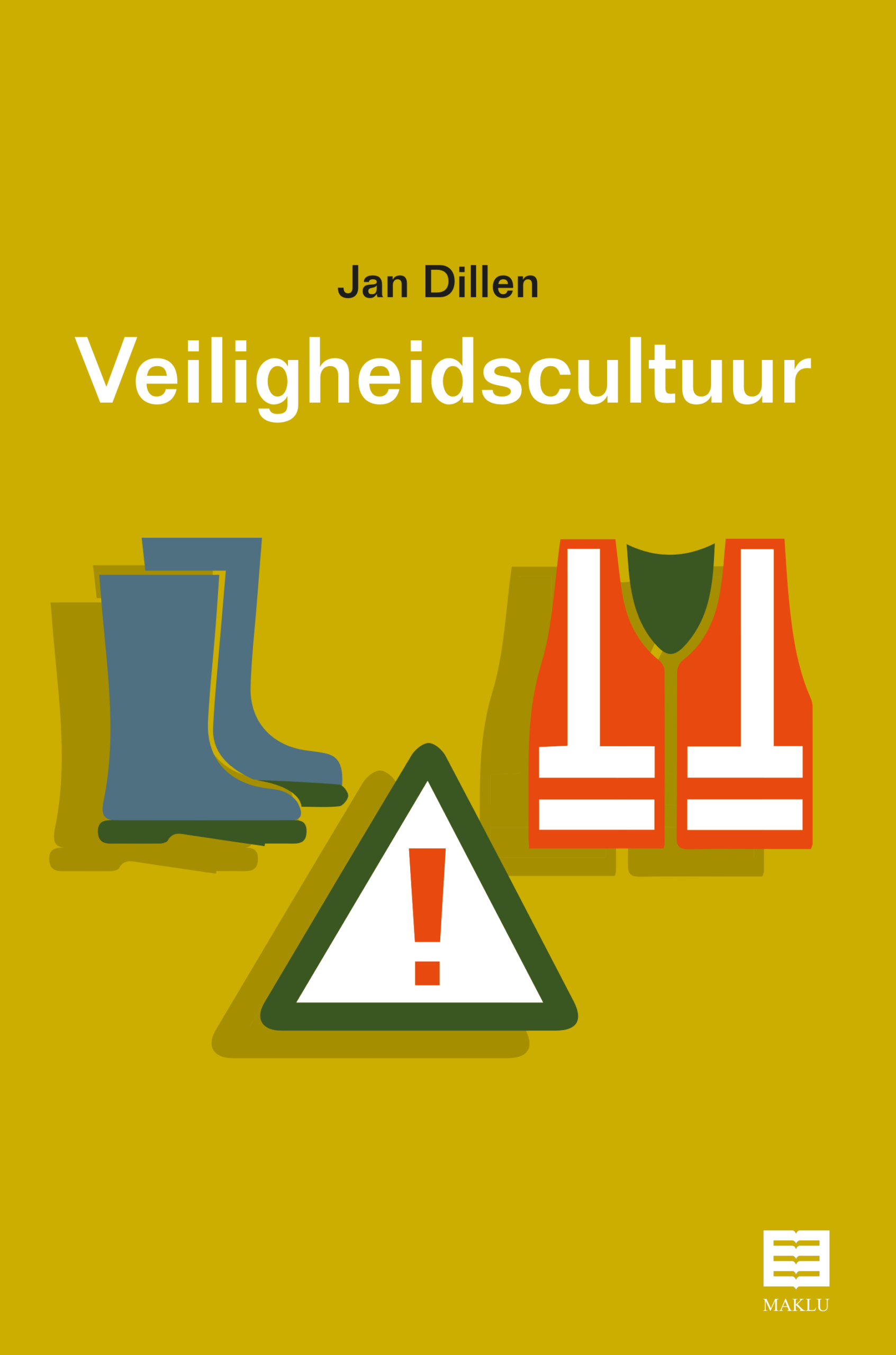
Veiligheidscultuur
€ 39,00
Veiligheidscultuur is niet meer weg te denken en wordt steeds belangrijker. Zowel voor de organisaties zelf - een interne motivatie - als door externe druk van opdrachtgevers of wetgever - een externe motivatie - krijgt veiligheidscultuur meer en meer aandacht. Deze evolutie is normaal en evolutief van technische veiligheid, naar managementsystemen om te komen tot veiligheidscultuur. En deze aandacht voor veiligheidscultuur zal niet meer verminderen in de toekomst, integendeel.
Vandaar de nood tot dit boek. Eerst wordt veiligheidscultuur gekaderd en daarna wordt de relatie gelegd tussen veiligheidscultuur en veilig gedrag. De beoordeling van de veiligheidscultuur in organisaties wordt beschreven aan de hand van de veiligheidscultuurchecklist VCC. De veiligheidscultuurchecklist VCC is een nieuw instrument om de veiligheidscultuur en veilig gedrag te beoordelen. De veiligheidscultuurchecklist is analoog aan de structuur van de ISO-managementsysteemnormen en de Veiligheidschecklist Aannemers (VCC*, VCC** en VCC P-HRO). Gezien het kaderen van de veiligheidscultuur in organisaties altijd al moeilijk was, is het auditeren of diagnosticeren ervan nog moeilijker. Maar het is niet omdat het moeilijk is, dat we hier niet hebben geprobeerd om de lezer meer duidelijkheid en meer duiding te geven over zowel veiligheidscultuur als het auditeren ervan.
Veiligheidscultuur
€ 39,00
Veiligheidscultuur is niet meer weg te denken en wordt steeds belangrijker. Zowel voor de organisaties zelf - een interne motivatie - als door externe druk van opdrachtgevers of wetgever - een externe motivatie - krijgt veiligheidscultuur meer en meer aandacht. Deze evolutie is normaal en evolutief van technische veiligheid, naar managementsystemen om te komen tot veiligheidscultuur. En deze aandacht voor veiligheidscultuur zal niet meer verminderen in de toekomst, integendeel.
Vandaar de nood tot dit boek. Eerst wordt veiligheidscultuur gekaderd en daarna wordt de relatie gelegd tussen veiligheidscultuur en veilig gedrag. De beoordeling van de veiligheidscultuur in organisaties wordt beschreven aan de hand van de veiligheidscultuurchecklist VCC. De veiligheidscultuurchecklist VCC is een nieuw instrument om de veiligheidscultuur en veilig gedrag te beoordelen. De veiligheidscultuurchecklist is analoog aan de structuur van de ISO-managementsysteemnormen en de Veiligheidschecklist Aannemers (VCC*, VCC** en VCC P-HRO). Gezien het kaderen van de veiligheidscultuur in organisaties altijd al moeilijk was, is het auditeren of diagnosticeren ervan nog moeilijker. Maar het is niet omdat het moeilijk is, dat we hier niet hebben geprobeerd om de lezer meer duidelijkheid en meer duiding te geven over zowel veiligheidscultuur als het auditeren ervan.
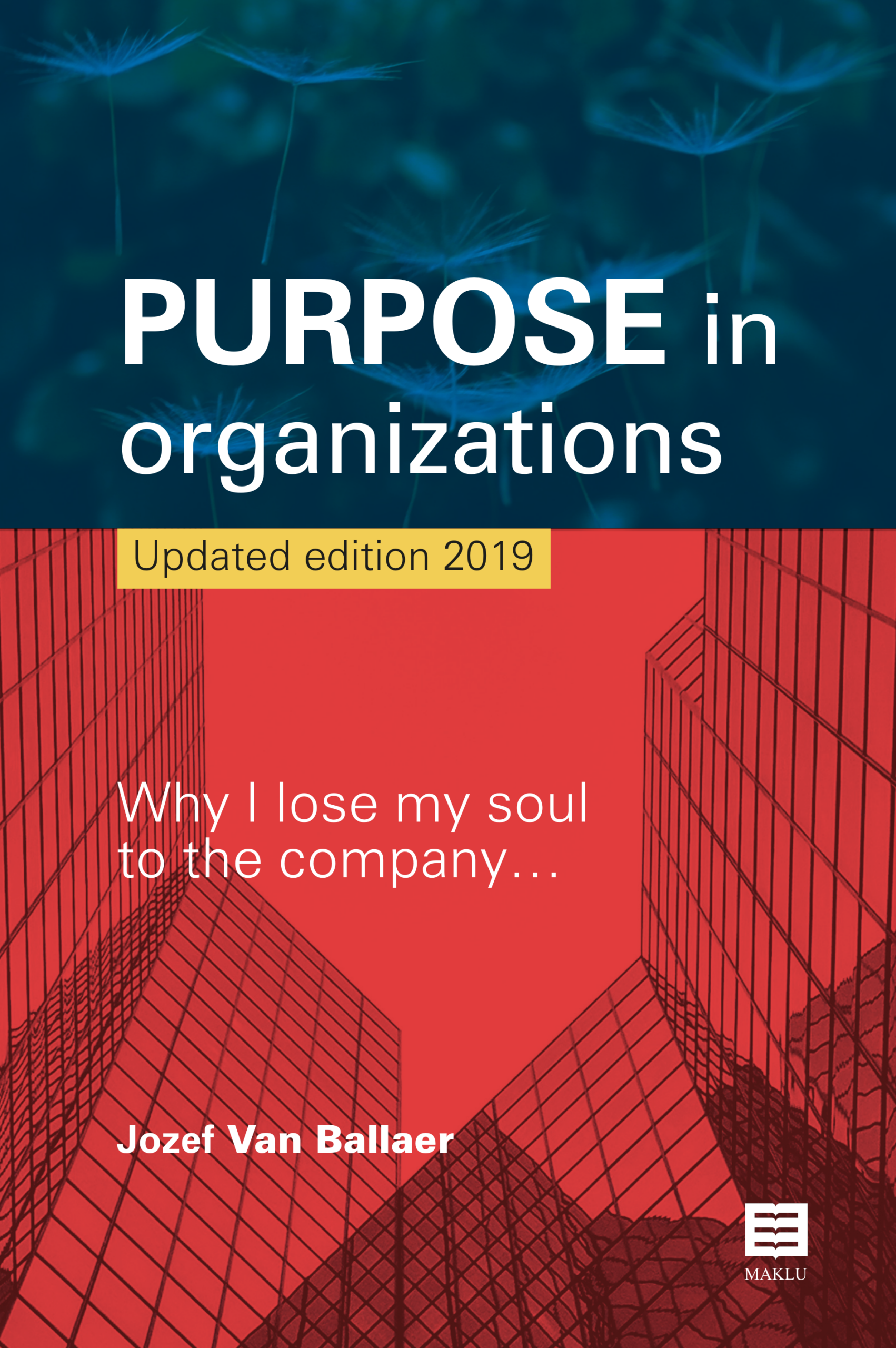
Purpose in organizations
€ 29,95
The author has studied the meaning of ‘Purpose’ in organizations and what constitutes
it. Starting from the most eye-catching actors - the employee, the leader or the
organization itself - it covers in depth the different angles. The question is whether this
can only be an individual matter valid for the employees, or perhaps that this ‘purpose’
is dominated by the influence of the leader of the organization. And also, how the
organization itself is influenced or influences.
That these aspects play a crucial role in organizations is not a gratuitous objection. It has to be taken seriously because there is a lot at stake. Namely the motivation and drive of employees, and at times, of the entire organization. This book recognizes this by sharply confirming the possibility of burn-out if Purpose is missing, or if the Story of the organization is not (anymore) present.
The author has not taken it lightly and has extensively surveyed the terrain. This both from current management literature and from his own experience as a consultant and organizational expert. As an extra, this book offers references to practical examples and a useful model of how to diagnose and culture Purpose in organizations.
Jozef Van Ballaer is truly multi-facetted, with Master’s diplomas in Philosophy, Human Ecology and Physical Education as foundation, but also postgraduate certificates in Quality Management, Prevention and Business Administration. His professional career started in the nuclear but made him earlyon very successful in implementing cultures within various multinational companies, albeit with the emphasis on Health & Safety. His current focus is on the impact of management improvement on the motivation of teams.
That these aspects play a crucial role in organizations is not a gratuitous objection. It has to be taken seriously because there is a lot at stake. Namely the motivation and drive of employees, and at times, of the entire organization. This book recognizes this by sharply confirming the possibility of burn-out if Purpose is missing, or if the Story of the organization is not (anymore) present.
The author has not taken it lightly and has extensively surveyed the terrain. This both from current management literature and from his own experience as a consultant and organizational expert. As an extra, this book offers references to practical examples and a useful model of how to diagnose and culture Purpose in organizations.
Jozef Van Ballaer is truly multi-facetted, with Master’s diplomas in Philosophy, Human Ecology and Physical Education as foundation, but also postgraduate certificates in Quality Management, Prevention and Business Administration. His professional career started in the nuclear but made him earlyon very successful in implementing cultures within various multinational companies, albeit with the emphasis on Health & Safety. His current focus is on the impact of management improvement on the motivation of teams.
Purpose in organizations
€ 29,95
The author has studied the meaning of ‘Purpose’ in organizations and what constitutes
it. Starting from the most eye-catching actors - the employee, the leader or the
organization itself - it covers in depth the different angles. The question is whether this
can only be an individual matter valid for the employees, or perhaps that this ‘purpose’
is dominated by the influence of the leader of the organization. And also, how the
organization itself is influenced or influences.
That these aspects play a crucial role in organizations is not a gratuitous objection. It has to be taken seriously because there is a lot at stake. Namely the motivation and drive of employees, and at times, of the entire organization. This book recognizes this by sharply confirming the possibility of burn-out if Purpose is missing, or if the Story of the organization is not (anymore) present.
The author has not taken it lightly and has extensively surveyed the terrain. This both from current management literature and from his own experience as a consultant and organizational expert. As an extra, this book offers references to practical examples and a useful model of how to diagnose and culture Purpose in organizations.
Jozef Van Ballaer is truly multi-facetted, with Master’s diplomas in Philosophy, Human Ecology and Physical Education as foundation, but also postgraduate certificates in Quality Management, Prevention and Business Administration. His professional career started in the nuclear but made him earlyon very successful in implementing cultures within various multinational companies, albeit with the emphasis on Health & Safety. His current focus is on the impact of management improvement on the motivation of teams.
That these aspects play a crucial role in organizations is not a gratuitous objection. It has to be taken seriously because there is a lot at stake. Namely the motivation and drive of employees, and at times, of the entire organization. This book recognizes this by sharply confirming the possibility of burn-out if Purpose is missing, or if the Story of the organization is not (anymore) present.
The author has not taken it lightly and has extensively surveyed the terrain. This both from current management literature and from his own experience as a consultant and organizational expert. As an extra, this book offers references to practical examples and a useful model of how to diagnose and culture Purpose in organizations.
Jozef Van Ballaer is truly multi-facetted, with Master’s diplomas in Philosophy, Human Ecology and Physical Education as foundation, but also postgraduate certificates in Quality Management, Prevention and Business Administration. His professional career started in the nuclear but made him earlyon very successful in implementing cultures within various multinational companies, albeit with the emphasis on Health & Safety. His current focus is on the impact of management improvement on the motivation of teams.
Geen voorraad
Zorg(e)loze jeugd
€ 35,00
Een zorg(e)loze jeugd verwijst naar jongeren die zich ontworstelen aan de zorg die eigenlijk nog niet gemist kan worden. Centraal in dit onderzoek staan transitiejongeren. Dit zijn jongmeerderjarige residentiële zorgverlaters met complexe en meervoudige problemen, bij wie in verband met het onttrekken aan zorg de dringende noodzaak wordt gevoeld door hulpverleners om (ook) na het bereiken van de meerderjarigheid en na het vertrek uit de residentiële jeugdhulpverlening, zorg te verlenen. Een juridische grondslag voor voortgezette gedwongen bescherming wordt verondersteld noodzakelijk te zijn, maar deze is er momenteel niet of nauwelijks vanwege - onder meer - de beperkte mogelijkheden in het jeugdbeschermingsrecht. Bijzonder aan dit proefschrift is dat de problematiek is onderzocht vanuit verschillende perspectieven. Naast een rechtswetenschappelijke analyse, bestaat het onderzoek uit een sociaalwetenschappelijke en medisch-wetenschappelijke analyse van transitieproblematiek. Vanuit de verbinding tussen deze wetenschappen is de onderzoeker tot conclusies gekomen. Dit boek is bedoeld voor professionals die vanuit de academie of de praktijk betrokken zijn bij de (al dan niet gedwongen) residentiële of andere jeugdhulpverlening voor jongeren met complexe meervoudige problemen.
Geen voorraad
Zorg(e)loze jeugd
€ 35,00
Een zorg(e)loze jeugd verwijst naar jongeren die zich ontworstelen aan de zorg die eigenlijk nog niet gemist kan worden. Centraal in dit onderzoek staan transitiejongeren. Dit zijn jongmeerderjarige residentiële zorgverlaters met complexe en meervoudige problemen, bij wie in verband met het onttrekken aan zorg de dringende noodzaak wordt gevoeld door hulpverleners om (ook) na het bereiken van de meerderjarigheid en na het vertrek uit de residentiële jeugdhulpverlening, zorg te verlenen. Een juridische grondslag voor voortgezette gedwongen bescherming wordt verondersteld noodzakelijk te zijn, maar deze is er momenteel niet of nauwelijks vanwege - onder meer - de beperkte mogelijkheden in het jeugdbeschermingsrecht. Bijzonder aan dit proefschrift is dat de problematiek is onderzocht vanuit verschillende perspectieven. Naast een rechtswetenschappelijke analyse, bestaat het onderzoek uit een sociaalwetenschappelijke en medisch-wetenschappelijke analyse van transitieproblematiek. Vanuit de verbinding tussen deze wetenschappen is de onderzoeker tot conclusies gekomen. Dit boek is bedoeld voor professionals die vanuit de academie of de praktijk betrokken zijn bij de (al dan niet gedwongen) residentiële of andere jeugdhulpverlening voor jongeren met complexe meervoudige problemen.
RIDP2018Vol89/issue2- International and Transitional Criminal Justice & Human Rights Essays
€ 40,00
A quarter-century ago, the ‘short twentieth century’ came to an end, marked by the fall of the Berlin Wall and the breakup of Yugoslavia and the Soviet Union. International criminal justice awakened from its post-Nuremberg hibernation. In the ensuing decades, a multitude of international criminal tribunals was established as well as unprecedented initiatives at the national and regional levels. This movement for justice and accountability transformed the protection of human rights.
Cherif Bassiouni was at the centre of this process from its beginning until his passing, in September 2017, and has been absolutely instrumental in its origins. From the beginning of his career, he brought oxygen to the embers of the post-Second World War initiatives. He linked them to more contemporary issues, such as the struggle against apartheid in South Africa and the campaign for new standards and instruments to address issues such as torture. Through the International Institute for Higher Studies in Criminal Sciences, now renamed the Siracusa International Institute for Criminal Justice and Human Rights, Cherif Bassiouni regularly assembled experts, practitioners, international officials and public intellectuals in the promotion of law and policy. He was also President of the International Association of Penal Law (IAPL-AIDP) for fifteen years.
In September 2018, colleagues and friends of Cherif Bassiouni assembled for a high-level academic conference in Siracusa, organised around themes central in his massive oeuvre: international and transitional criminal justice and human rights. The chapters in this humble volume provide a written record of the conference, in recognition, honour and memory of his legacy.
Christine Van den Wyngaert is Emeritus Professor of Law at the University of Antwerp, Belgium, Judge at the Kosovo Specialist Chambers and former Judge at the International Criminal Court, the International Criminal Tribunal for the Former Yugoslavia and the International Court of Justice (Judge ad hoc).
William Schabas is Professor of International Law at Middlesex University London, UK, and Professor of International Criminal Law and Human Rights at Leiden University, The Netherlands.
Gert Vermeulen is Professor of European and international Criminal Law and Data Protection Law, Director of the Institute for International Research on Criminal Policy (IRCP) and Director of the Knowledge and Research Platform on Privacy, Information Exchange, Law Enforcement and Surveillance (PIXLES) at Ghent University, Belgium. He is also General Director Publications of the AIDP and Editor-in-Chief of the RIDP.
Cherif Bassiouni was at the centre of this process from its beginning until his passing, in September 2017, and has been absolutely instrumental in its origins. From the beginning of his career, he brought oxygen to the embers of the post-Second World War initiatives. He linked them to more contemporary issues, such as the struggle against apartheid in South Africa and the campaign for new standards and instruments to address issues such as torture. Through the International Institute for Higher Studies in Criminal Sciences, now renamed the Siracusa International Institute for Criminal Justice and Human Rights, Cherif Bassiouni regularly assembled experts, practitioners, international officials and public intellectuals in the promotion of law and policy. He was also President of the International Association of Penal Law (IAPL-AIDP) for fifteen years.
In September 2018, colleagues and friends of Cherif Bassiouni assembled for a high-level academic conference in Siracusa, organised around themes central in his massive oeuvre: international and transitional criminal justice and human rights. The chapters in this humble volume provide a written record of the conference, in recognition, honour and memory of his legacy.
Christine Van den Wyngaert is Emeritus Professor of Law at the University of Antwerp, Belgium, Judge at the Kosovo Specialist Chambers and former Judge at the International Criminal Court, the International Criminal Tribunal for the Former Yugoslavia and the International Court of Justice (Judge ad hoc).
William Schabas is Professor of International Law at Middlesex University London, UK, and Professor of International Criminal Law and Human Rights at Leiden University, The Netherlands.
Gert Vermeulen is Professor of European and international Criminal Law and Data Protection Law, Director of the Institute for International Research on Criminal Policy (IRCP) and Director of the Knowledge and Research Platform on Privacy, Information Exchange, Law Enforcement and Surveillance (PIXLES) at Ghent University, Belgium. He is also General Director Publications of the AIDP and Editor-in-Chief of the RIDP.
RIDP2018Vol89/issue2- International and Transitional Criminal Justice & Human Rights Essays
€ 40,00
A quarter-century ago, the ‘short twentieth century’ came to an end, marked by the fall of the Berlin Wall and the breakup of Yugoslavia and the Soviet Union. International criminal justice awakened from its post-Nuremberg hibernation. In the ensuing decades, a multitude of international criminal tribunals was established as well as unprecedented initiatives at the national and regional levels. This movement for justice and accountability transformed the protection of human rights.
Cherif Bassiouni was at the centre of this process from its beginning until his passing, in September 2017, and has been absolutely instrumental in its origins. From the beginning of his career, he brought oxygen to the embers of the post-Second World War initiatives. He linked them to more contemporary issues, such as the struggle against apartheid in South Africa and the campaign for new standards and instruments to address issues such as torture. Through the International Institute for Higher Studies in Criminal Sciences, now renamed the Siracusa International Institute for Criminal Justice and Human Rights, Cherif Bassiouni regularly assembled experts, practitioners, international officials and public intellectuals in the promotion of law and policy. He was also President of the International Association of Penal Law (IAPL-AIDP) for fifteen years.
In September 2018, colleagues and friends of Cherif Bassiouni assembled for a high-level academic conference in Siracusa, organised around themes central in his massive oeuvre: international and transitional criminal justice and human rights. The chapters in this humble volume provide a written record of the conference, in recognition, honour and memory of his legacy.
Christine Van den Wyngaert is Emeritus Professor of Law at the University of Antwerp, Belgium, Judge at the Kosovo Specialist Chambers and former Judge at the International Criminal Court, the International Criminal Tribunal for the Former Yugoslavia and the International Court of Justice (Judge ad hoc).
William Schabas is Professor of International Law at Middlesex University London, UK, and Professor of International Criminal Law and Human Rights at Leiden University, The Netherlands.
Gert Vermeulen is Professor of European and international Criminal Law and Data Protection Law, Director of the Institute for International Research on Criminal Policy (IRCP) and Director of the Knowledge and Research Platform on Privacy, Information Exchange, Law Enforcement and Surveillance (PIXLES) at Ghent University, Belgium. He is also General Director Publications of the AIDP and Editor-in-Chief of the RIDP.
Cherif Bassiouni was at the centre of this process from its beginning until his passing, in September 2017, and has been absolutely instrumental in its origins. From the beginning of his career, he brought oxygen to the embers of the post-Second World War initiatives. He linked them to more contemporary issues, such as the struggle against apartheid in South Africa and the campaign for new standards and instruments to address issues such as torture. Through the International Institute for Higher Studies in Criminal Sciences, now renamed the Siracusa International Institute for Criminal Justice and Human Rights, Cherif Bassiouni regularly assembled experts, practitioners, international officials and public intellectuals in the promotion of law and policy. He was also President of the International Association of Penal Law (IAPL-AIDP) for fifteen years.
In September 2018, colleagues and friends of Cherif Bassiouni assembled for a high-level academic conference in Siracusa, organised around themes central in his massive oeuvre: international and transitional criminal justice and human rights. The chapters in this humble volume provide a written record of the conference, in recognition, honour and memory of his legacy.
Christine Van den Wyngaert is Emeritus Professor of Law at the University of Antwerp, Belgium, Judge at the Kosovo Specialist Chambers and former Judge at the International Criminal Court, the International Criminal Tribunal for the Former Yugoslavia and the International Court of Justice (Judge ad hoc).
William Schabas is Professor of International Law at Middlesex University London, UK, and Professor of International Criminal Law and Human Rights at Leiden University, The Netherlands.
Gert Vermeulen is Professor of European and international Criminal Law and Data Protection Law, Director of the Institute for International Research on Criminal Policy (IRCP) and Director of the Knowledge and Research Platform on Privacy, Information Exchange, Law Enforcement and Surveillance (PIXLES) at Ghent University, Belgium. He is also General Director Publications of the AIDP and Editor-in-Chief of the RIDP.
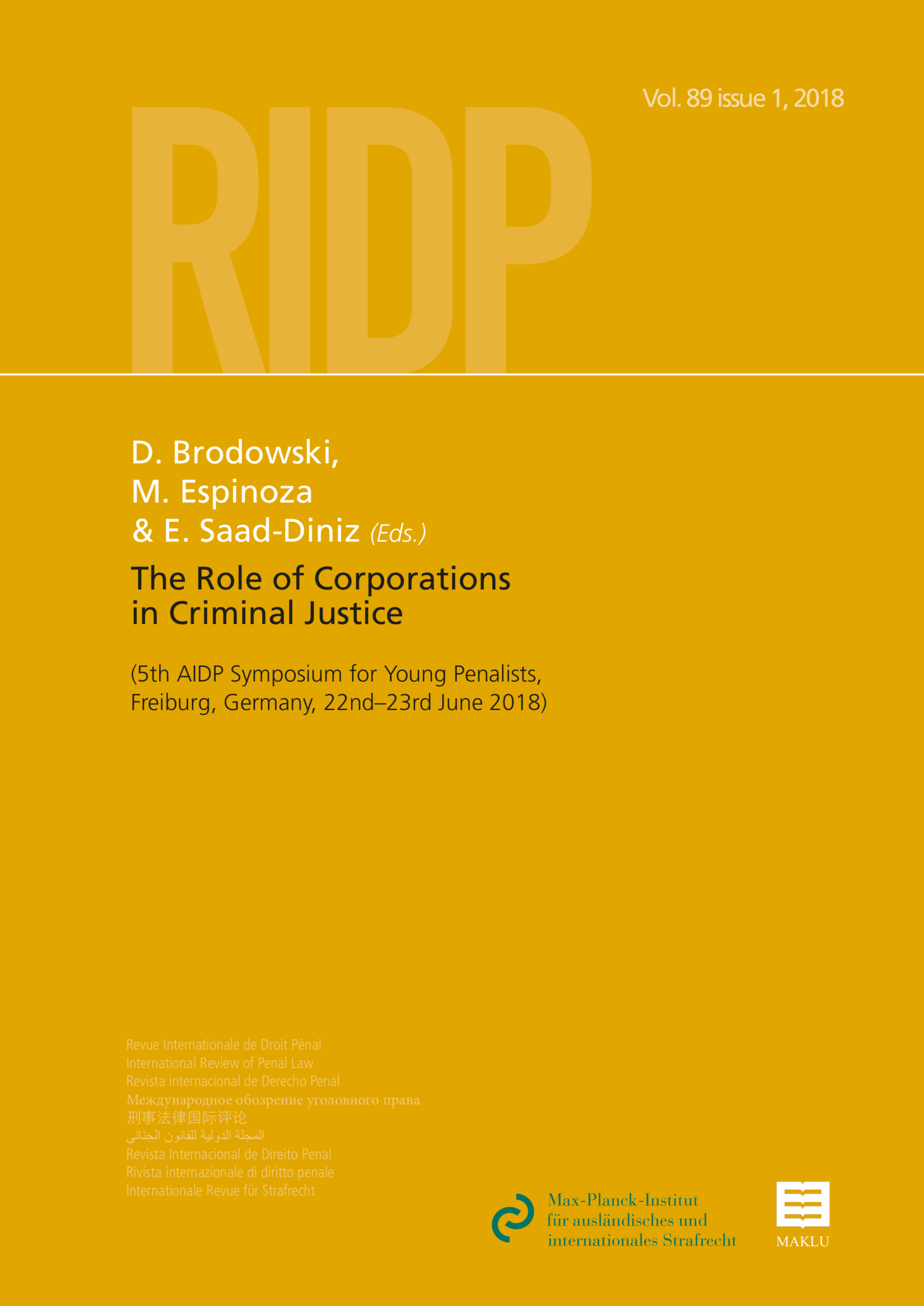
RIDP2018Vol89/issue1- The Role of Corporations in Criminal Justice
€ 70,00
The role of corporations in criminal justice is expanding, both in a purely business context and beyond. Corporations may be suspected or accused of criminal or quasi-criminal wrongdoing; they may be required to produce information and evidence in furtherance of a criminal case, or be compelled to send a witness to trial; they may be the victim of crimes; and they may perform or assist with criminal investigations. This issue addresses these distinct roles of corporations in modern criminal justice, with a particular focus on the framework for prosecuting corporations, on double jeopardy protections, on internal investigations and compliance programs.
This volume brings together major contributions to the 5th AIDP Symposium for Young Penalists (Freiburg, 22nd-23rd June 2018), organised by the AIDP Young Penalists Committee in collaboration with the German AIDP national group and the Max Planck Institute for Foreign and International Criminal Law. It sets a milestone on the way to the 20th AIDP World Congress dedicated to ‘Criminal Justice and Corporate Business’.
Dominik Brodowski is junior professor of criminal law and criminal procedure at Saarland University and a member of the AIDP Young Penalists Committee.
Manuel Espinoza de los Monteros de la Parra is president of the AIDP Young Penalists Committee and partner at Worth Street Group.
Eduardo Saad-Diniz is professor of criminology and criminal law at the Ribeirão Preto Law School and in the Program for Latin American Integration, University of São Paulo, Brazil, and a member of the AIDP Young Penalists Committee.
This volume brings together major contributions to the 5th AIDP Symposium for Young Penalists (Freiburg, 22nd-23rd June 2018), organised by the AIDP Young Penalists Committee in collaboration with the German AIDP national group and the Max Planck Institute for Foreign and International Criminal Law. It sets a milestone on the way to the 20th AIDP World Congress dedicated to ‘Criminal Justice and Corporate Business’.
Dominik Brodowski is junior professor of criminal law and criminal procedure at Saarland University and a member of the AIDP Young Penalists Committee.
Manuel Espinoza de los Monteros de la Parra is president of the AIDP Young Penalists Committee and partner at Worth Street Group.
Eduardo Saad-Diniz is professor of criminology and criminal law at the Ribeirão Preto Law School and in the Program for Latin American Integration, University of São Paulo, Brazil, and a member of the AIDP Young Penalists Committee.
RIDP2018Vol89/issue1- The Role of Corporations in Criminal Justice
€ 70,00
The role of corporations in criminal justice is expanding, both in a purely business context and beyond. Corporations may be suspected or accused of criminal or quasi-criminal wrongdoing; they may be required to produce information and evidence in furtherance of a criminal case, or be compelled to send a witness to trial; they may be the victim of crimes; and they may perform or assist with criminal investigations. This issue addresses these distinct roles of corporations in modern criminal justice, with a particular focus on the framework for prosecuting corporations, on double jeopardy protections, on internal investigations and compliance programs.
This volume brings together major contributions to the 5th AIDP Symposium for Young Penalists (Freiburg, 22nd-23rd June 2018), organised by the AIDP Young Penalists Committee in collaboration with the German AIDP national group and the Max Planck Institute for Foreign and International Criminal Law. It sets a milestone on the way to the 20th AIDP World Congress dedicated to ‘Criminal Justice and Corporate Business’.
Dominik Brodowski is junior professor of criminal law and criminal procedure at Saarland University and a member of the AIDP Young Penalists Committee.
Manuel Espinoza de los Monteros de la Parra is president of the AIDP Young Penalists Committee and partner at Worth Street Group.
Eduardo Saad-Diniz is professor of criminology and criminal law at the Ribeirão Preto Law School and in the Program for Latin American Integration, University of São Paulo, Brazil, and a member of the AIDP Young Penalists Committee.
This volume brings together major contributions to the 5th AIDP Symposium for Young Penalists (Freiburg, 22nd-23rd June 2018), organised by the AIDP Young Penalists Committee in collaboration with the German AIDP national group and the Max Planck Institute for Foreign and International Criminal Law. It sets a milestone on the way to the 20th AIDP World Congress dedicated to ‘Criminal Justice and Corporate Business’.
Dominik Brodowski is junior professor of criminal law and criminal procedure at Saarland University and a member of the AIDP Young Penalists Committee.
Manuel Espinoza de los Monteros de la Parra is president of the AIDP Young Penalists Committee and partner at Worth Street Group.
Eduardo Saad-Diniz is professor of criminology and criminal law at the Ribeirão Preto Law School and in the Program for Latin American Integration, University of São Paulo, Brazil, and a member of the AIDP Young Penalists Committee.
Sociale economie en btw. 2de, herziene en uitgebreide uitgave.
€ 35,00
De sociale economie wordt soms de economie met emotie genoemd. Sociale initiatieven houden echter niet noodzakelijk in dat er geen btw verschuldigd is. Wél bestaan er talrijke vrijstellingen inzake btw en kan in een aantal gevallen genoten worden van verlaagde btw-tarieven.
Een sociale economie verantwoordt door haar sociaal doel en maatschappelijk werk een uitzonderingspositie inzake btw. Wie sociaal zegt verwijst vaak naar erkenning door de bevoegde overheid en dan zitten we vaak in de sfeer van de vzw. De problematiek van de subsidies en zijn btw-aspecten is dan niet veraf. Is er btw verschuldigd over de subsidies of niet?
Dit boek bevat een aantal topics die specifiek van belang zijn in de sociale economie in de brede zin van het woord: het gaat over de btw-analyse van initiatieven die de sociaal zwakkeren in onze maatschappij ondersteunen. Naast de sociale woningbouw, de hulp aan senioren en zwakkeren en tewerkstellingsinitiatieven gaat het ook over maatschappelijk verantwoorde vormen van ondernemen via een deeleconomie en circulaire economie.
Stefan Ruysschaert is werkzaam bij de FOD Financiën als Adviseur. Hij is docent btw en auteur van talrijke bijdragen op fiscaal vlak in toonaangevende tijdschriften en boeken. Hij is o.a. redactielid van Fiscalnet en het Tijdschrift Huur. Hij doceert het vak btw aan de faculteit Economische Wetenschappen van de UGent en is gastdocent aan de Fiscale Hogeschool.
Een sociale economie verantwoordt door haar sociaal doel en maatschappelijk werk een uitzonderingspositie inzake btw. Wie sociaal zegt verwijst vaak naar erkenning door de bevoegde overheid en dan zitten we vaak in de sfeer van de vzw. De problematiek van de subsidies en zijn btw-aspecten is dan niet veraf. Is er btw verschuldigd over de subsidies of niet?
Dit boek bevat een aantal topics die specifiek van belang zijn in de sociale economie in de brede zin van het woord: het gaat over de btw-analyse van initiatieven die de sociaal zwakkeren in onze maatschappij ondersteunen. Naast de sociale woningbouw, de hulp aan senioren en zwakkeren en tewerkstellingsinitiatieven gaat het ook over maatschappelijk verantwoorde vormen van ondernemen via een deeleconomie en circulaire economie.
Stefan Ruysschaert is werkzaam bij de FOD Financiën als Adviseur. Hij is docent btw en auteur van talrijke bijdragen op fiscaal vlak in toonaangevende tijdschriften en boeken. Hij is o.a. redactielid van Fiscalnet en het Tijdschrift Huur. Hij doceert het vak btw aan de faculteit Economische Wetenschappen van de UGent en is gastdocent aan de Fiscale Hogeschool.
Sociale economie en btw. 2de, herziene en uitgebreide uitgave.
€ 35,00
De sociale economie wordt soms de economie met emotie genoemd. Sociale initiatieven houden echter niet noodzakelijk in dat er geen btw verschuldigd is. Wél bestaan er talrijke vrijstellingen inzake btw en kan in een aantal gevallen genoten worden van verlaagde btw-tarieven.
Een sociale economie verantwoordt door haar sociaal doel en maatschappelijk werk een uitzonderingspositie inzake btw. Wie sociaal zegt verwijst vaak naar erkenning door de bevoegde overheid en dan zitten we vaak in de sfeer van de vzw. De problematiek van de subsidies en zijn btw-aspecten is dan niet veraf. Is er btw verschuldigd over de subsidies of niet?
Dit boek bevat een aantal topics die specifiek van belang zijn in de sociale economie in de brede zin van het woord: het gaat over de btw-analyse van initiatieven die de sociaal zwakkeren in onze maatschappij ondersteunen. Naast de sociale woningbouw, de hulp aan senioren en zwakkeren en tewerkstellingsinitiatieven gaat het ook over maatschappelijk verantwoorde vormen van ondernemen via een deeleconomie en circulaire economie.
Stefan Ruysschaert is werkzaam bij de FOD Financiën als Adviseur. Hij is docent btw en auteur van talrijke bijdragen op fiscaal vlak in toonaangevende tijdschriften en boeken. Hij is o.a. redactielid van Fiscalnet en het Tijdschrift Huur. Hij doceert het vak btw aan de faculteit Economische Wetenschappen van de UGent en is gastdocent aan de Fiscale Hogeschool.
Een sociale economie verantwoordt door haar sociaal doel en maatschappelijk werk een uitzonderingspositie inzake btw. Wie sociaal zegt verwijst vaak naar erkenning door de bevoegde overheid en dan zitten we vaak in de sfeer van de vzw. De problematiek van de subsidies en zijn btw-aspecten is dan niet veraf. Is er btw verschuldigd over de subsidies of niet?
Dit boek bevat een aantal topics die specifiek van belang zijn in de sociale economie in de brede zin van het woord: het gaat over de btw-analyse van initiatieven die de sociaal zwakkeren in onze maatschappij ondersteunen. Naast de sociale woningbouw, de hulp aan senioren en zwakkeren en tewerkstellingsinitiatieven gaat het ook over maatschappelijk verantwoorde vormen van ondernemen via een deeleconomie en circulaire economie.
Stefan Ruysschaert is werkzaam bij de FOD Financiën als Adviseur. Hij is docent btw en auteur van talrijke bijdragen op fiscaal vlak in toonaangevende tijdschriften en boeken. Hij is o.a. redactielid van Fiscalnet en het Tijdschrift Huur. Hij doceert het vak btw aan de faculteit Economische Wetenschappen van de UGent en is gastdocent aan de Fiscale Hogeschool.
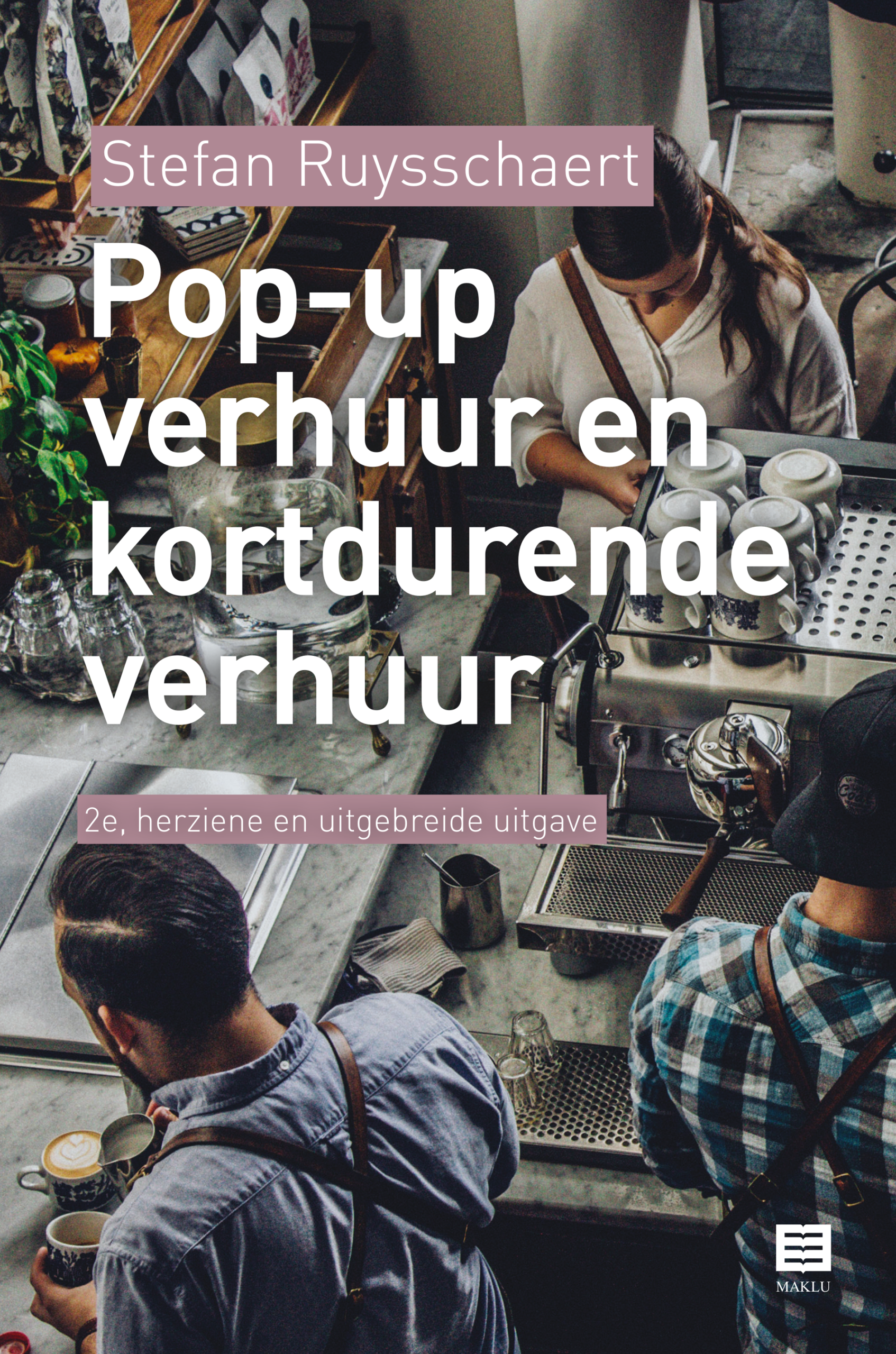
Pop-up verhuur en kortdurende verhuur. 2de, herziene en uitgebreide uitgave
€ 29,95
Tot voor kort was er geen duidelijk juridisch kader voor de huur van een pand in het kader van een pop-up. In de praktijk werd vaak de (in de rechtspraak ontwikkelde) rechtsfiguur van de “bezetting ter bede” gebruikt maar hierbij bestond het risico van herkwalificering naar een handelshuurovereenkomst. Pop-ups zijn uit hun aard evenwel tijdelijke handelszaken.
Intussen werd in Vlaanderen maar ook in de rest van België voorzien in een specifiek huurregime voor pop-upshops. De nieuwe regeling inzake optionele verhuur van gebouwen die in werking trad op 1 januari 2019 voerde tegelijk een nieuwe regeling in voor kortdurende verhuringen, d.w.z. verhuringen die niet langer zijn dan 6 maanden.
In dit boek analyseren we de kortdurende verhuringen vanuit juridisch en vanuit btw-standpunt. De kortdurende verhuur dient in de regel met btw belast te worden maar er zijn uitzonderingen.
Stefan Ruysschaert is adviseur bij de FOD Financiën. Hij doceert het vak btw aan de UGent en is gastdocent aan de Fiscale Hogeschool (Odisee).
Intussen werd in Vlaanderen maar ook in de rest van België voorzien in een specifiek huurregime voor pop-upshops. De nieuwe regeling inzake optionele verhuur van gebouwen die in werking trad op 1 januari 2019 voerde tegelijk een nieuwe regeling in voor kortdurende verhuringen, d.w.z. verhuringen die niet langer zijn dan 6 maanden.
In dit boek analyseren we de kortdurende verhuringen vanuit juridisch en vanuit btw-standpunt. De kortdurende verhuur dient in de regel met btw belast te worden maar er zijn uitzonderingen.
Stefan Ruysschaert is adviseur bij de FOD Financiën. Hij doceert het vak btw aan de UGent en is gastdocent aan de Fiscale Hogeschool (Odisee).
Pop-up verhuur en kortdurende verhuur. 2de, herziene en uitgebreide uitgave
€ 29,95
Tot voor kort was er geen duidelijk juridisch kader voor de huur van een pand in het kader van een pop-up. In de praktijk werd vaak de (in de rechtspraak ontwikkelde) rechtsfiguur van de “bezetting ter bede” gebruikt maar hierbij bestond het risico van herkwalificering naar een handelshuurovereenkomst. Pop-ups zijn uit hun aard evenwel tijdelijke handelszaken.
Intussen werd in Vlaanderen maar ook in de rest van België voorzien in een specifiek huurregime voor pop-upshops. De nieuwe regeling inzake optionele verhuur van gebouwen die in werking trad op 1 januari 2019 voerde tegelijk een nieuwe regeling in voor kortdurende verhuringen, d.w.z. verhuringen die niet langer zijn dan 6 maanden.
In dit boek analyseren we de kortdurende verhuringen vanuit juridisch en vanuit btw-standpunt. De kortdurende verhuur dient in de regel met btw belast te worden maar er zijn uitzonderingen.
Stefan Ruysschaert is adviseur bij de FOD Financiën. Hij doceert het vak btw aan de UGent en is gastdocent aan de Fiscale Hogeschool (Odisee).
Intussen werd in Vlaanderen maar ook in de rest van België voorzien in een specifiek huurregime voor pop-upshops. De nieuwe regeling inzake optionele verhuur van gebouwen die in werking trad op 1 januari 2019 voerde tegelijk een nieuwe regeling in voor kortdurende verhuringen, d.w.z. verhuringen die niet langer zijn dan 6 maanden.
In dit boek analyseren we de kortdurende verhuringen vanuit juridisch en vanuit btw-standpunt. De kortdurende verhuur dient in de regel met btw belast te worden maar er zijn uitzonderingen.
Stefan Ruysschaert is adviseur bij de FOD Financiën. Hij doceert het vak btw aan de UGent en is gastdocent aan de Fiscale Hogeschool (Odisee).
De commissaris en de andere organen of comites van de gecontroleerde entiteit (Reeks ICCI 2019-1)
€ 49,00
De bedrijfsrevisor vervult een opdracht van algemeen belang en is onontbeerlijk voor de goede werking van de economie. Hij stelt zijn deskundigheid, zijn professionalisme en zijn waarden ten dienste van zijn klanten en van alle belanghebbende partijen (klanten, leveranciers, investeerders, bankiers, publieke overheden, personeel) om een onafhankelijke dienstverlening te bieden met hoogstaande toegevoegde waarde en van algemeen belang met het oog op een versterking van het noodzakelijk vertrouwen in een goed functionerend economisch stelsel.
De voornaamste doelstelling van zijn tussenkomst als commissaris bestaat erin de transparantie en de betrouwbaarheid van de financiële overzichten te waarborgen, waarvan de gebruikers verwachten dat die een getrouw beeld geven van het vermogen, van de financiële toestand en de resultaten van de onderneming.
In zijn hoedanigheid van controleorgaan van de onderneming dialogeert de commissaris met verschillende organen en comités die meestal intern, maar ook extern kunnen zijn aan de gecontroleerde entiteit. Zijn verhouding ermee wordt in dit boek omstandig toegelicht.
Le réviseur d’entreprises a une mission d’intérêt public et est indispensable au bon fonctionnement de l’économie. Il met ses compétences, son professionnalisme et ses valeurs au service de ses clients mais également de toutes les parties prenantes (clients, fournisseurs, investisseurs, banquiers, pouvoirs publics, personnel) dans le but de fournir, en toute indépendance, des services de qualité et dans l’intérêt général dans le but de renforcer la confiance, indispensable au bon fonctionnement du système économique.
L’objectif principal de son intervention en tant que commissaire est d’assurer la transparence et la fiabilité des états financiers, dont les utilisateurs s’attendent à ce qu’ils donnent une image fidèle du patrimoine, de la situation financière et des résultats de l’entreprise.
En sa qualité d’organe de contrôle de l’entreprise, le commissaire dialogue avec différents organes et comités qui sont généralement internes à l’entité contrôlée, mais peuvent aussi être externes à celle-ci. Son rapport avec ceux-ci est expliqué en détail dans cet ouvrage.
De voornaamste doelstelling van zijn tussenkomst als commissaris bestaat erin de transparantie en de betrouwbaarheid van de financiële overzichten te waarborgen, waarvan de gebruikers verwachten dat die een getrouw beeld geven van het vermogen, van de financiële toestand en de resultaten van de onderneming.
In zijn hoedanigheid van controleorgaan van de onderneming dialogeert de commissaris met verschillende organen en comités die meestal intern, maar ook extern kunnen zijn aan de gecontroleerde entiteit. Zijn verhouding ermee wordt in dit boek omstandig toegelicht.
Le réviseur d’entreprises a une mission d’intérêt public et est indispensable au bon fonctionnement de l’économie. Il met ses compétences, son professionnalisme et ses valeurs au service de ses clients mais également de toutes les parties prenantes (clients, fournisseurs, investisseurs, banquiers, pouvoirs publics, personnel) dans le but de fournir, en toute indépendance, des services de qualité et dans l’intérêt général dans le but de renforcer la confiance, indispensable au bon fonctionnement du système économique.
L’objectif principal de son intervention en tant que commissaire est d’assurer la transparence et la fiabilité des états financiers, dont les utilisateurs s’attendent à ce qu’ils donnent une image fidèle du patrimoine, de la situation financière et des résultats de l’entreprise.
En sa qualité d’organe de contrôle de l’entreprise, le commissaire dialogue avec différents organes et comités qui sont généralement internes à l’entité contrôlée, mais peuvent aussi être externes à celle-ci. Son rapport avec ceux-ci est expliqué en détail dans cet ouvrage.
De commissaris en de andere organen of comites van de gecontroleerde entiteit (Reeks ICCI 2019-1)
€ 49,00
De bedrijfsrevisor vervult een opdracht van algemeen belang en is onontbeerlijk voor de goede werking van de economie. Hij stelt zijn deskundigheid, zijn professionalisme en zijn waarden ten dienste van zijn klanten en van alle belanghebbende partijen (klanten, leveranciers, investeerders, bankiers, publieke overheden, personeel) om een onafhankelijke dienstverlening te bieden met hoogstaande toegevoegde waarde en van algemeen belang met het oog op een versterking van het noodzakelijk vertrouwen in een goed functionerend economisch stelsel.
De voornaamste doelstelling van zijn tussenkomst als commissaris bestaat erin de transparantie en de betrouwbaarheid van de financiële overzichten te waarborgen, waarvan de gebruikers verwachten dat die een getrouw beeld geven van het vermogen, van de financiële toestand en de resultaten van de onderneming.
In zijn hoedanigheid van controleorgaan van de onderneming dialogeert de commissaris met verschillende organen en comités die meestal intern, maar ook extern kunnen zijn aan de gecontroleerde entiteit. Zijn verhouding ermee wordt in dit boek omstandig toegelicht.
Le réviseur d’entreprises a une mission d’intérêt public et est indispensable au bon fonctionnement de l’économie. Il met ses compétences, son professionnalisme et ses valeurs au service de ses clients mais également de toutes les parties prenantes (clients, fournisseurs, investisseurs, banquiers, pouvoirs publics, personnel) dans le but de fournir, en toute indépendance, des services de qualité et dans l’intérêt général dans le but de renforcer la confiance, indispensable au bon fonctionnement du système économique.
L’objectif principal de son intervention en tant que commissaire est d’assurer la transparence et la fiabilité des états financiers, dont les utilisateurs s’attendent à ce qu’ils donnent une image fidèle du patrimoine, de la situation financière et des résultats de l’entreprise.
En sa qualité d’organe de contrôle de l’entreprise, le commissaire dialogue avec différents organes et comités qui sont généralement internes à l’entité contrôlée, mais peuvent aussi être externes à celle-ci. Son rapport avec ceux-ci est expliqué en détail dans cet ouvrage.
De voornaamste doelstelling van zijn tussenkomst als commissaris bestaat erin de transparantie en de betrouwbaarheid van de financiële overzichten te waarborgen, waarvan de gebruikers verwachten dat die een getrouw beeld geven van het vermogen, van de financiële toestand en de resultaten van de onderneming.
In zijn hoedanigheid van controleorgaan van de onderneming dialogeert de commissaris met verschillende organen en comités die meestal intern, maar ook extern kunnen zijn aan de gecontroleerde entiteit. Zijn verhouding ermee wordt in dit boek omstandig toegelicht.
Le réviseur d’entreprises a une mission d’intérêt public et est indispensable au bon fonctionnement de l’économie. Il met ses compétences, son professionnalisme et ses valeurs au service de ses clients mais également de toutes les parties prenantes (clients, fournisseurs, investisseurs, banquiers, pouvoirs publics, personnel) dans le but de fournir, en toute indépendance, des services de qualité et dans l’intérêt général dans le but de renforcer la confiance, indispensable au bon fonctionnement du système économique.
L’objectif principal de son intervention en tant que commissaire est d’assurer la transparence et la fiabilité des états financiers, dont les utilisateurs s’attendent à ce qu’ils donnent une image fidèle du patrimoine, de la situation financière et des résultats de l’entreprise.
En sa qualité d’organe de contrôle de l’entreprise, le commissaire dialogue avec différents organes et comités qui sont généralement internes à l’entité contrôlée, mais peuvent aussi être externes à celle-ci. Son rapport avec ceux-ci est expliqué en détail dans cet ouvrage.

Reclamekosten. Analyse van de aftrekbaarheidsvoorwaarden.
€ 35,00
De aftrekbaarheid van kosten geeft vaak aanleiding tot discussie. Wanneer komt een kost als reclamekost in aanmerking voor aftrek? Is de btw dan ook aftrekbaar? Wanneer is er een aftrekbeperking of aftrekuitsluiting? Hoe zit met de aftrek inzake inkomstenbelasting en kan dit doorgetrokken worden inzake btw?
Dit boek geeft op praktische wijze een inzicht in de fiscale aftrekbaarheid van kosten die als publiciteitskosten kunnen worden gekwalificeerd.
Publiciteitskosten, reclamekosten en sponsoring worden geplaatst tegenover receptiekosten (kosten van onthaal) en kosten van spijzen en dranken in functie van de aard en het doel waarvoor de kosten worden gemaakt.
Hoe werken kortingbonnen en geldterugbonnen? Hoe zit de regeling voor vouchers in elkaar die gebruikt worden voor promotiedoeleinden? Het boek bevat de nieuwe regels inzake vouchers zoals die op basis van de “Voucherrichtlijn” in België zijn omgezet.
Luc Heylens is zaakvoerder van LH VAT Consult BVBA en belastingconsulent IAB. Hij is auteur van talrijke artikelen en boeken inzake btw. Zijn specialiteit situeert zich rond de begeleiding van ondernemingen op btw-vlak en de bewijsproblematiek bij internationaal handelsverkeer. Hij is eveneens een veelgevraagd docent bij talrijke organisaties van seminaries en opleidingen.
Stefan Ruysschaert is adviseur bij de Federale Overheidsdienst Financiën. Hij is auteur van talrijke artikelen en boeken inzake fiscaliteit. Hij is ook docent btw aan de UGent en de Fiscale Hogeschool en een gewaardeerd spreker op seminaries.
Dit boek geeft op praktische wijze een inzicht in de fiscale aftrekbaarheid van kosten die als publiciteitskosten kunnen worden gekwalificeerd.
Publiciteitskosten, reclamekosten en sponsoring worden geplaatst tegenover receptiekosten (kosten van onthaal) en kosten van spijzen en dranken in functie van de aard en het doel waarvoor de kosten worden gemaakt.
Hoe werken kortingbonnen en geldterugbonnen? Hoe zit de regeling voor vouchers in elkaar die gebruikt worden voor promotiedoeleinden? Het boek bevat de nieuwe regels inzake vouchers zoals die op basis van de “Voucherrichtlijn” in België zijn omgezet.
Luc Heylens is zaakvoerder van LH VAT Consult BVBA en belastingconsulent IAB. Hij is auteur van talrijke artikelen en boeken inzake btw. Zijn specialiteit situeert zich rond de begeleiding van ondernemingen op btw-vlak en de bewijsproblematiek bij internationaal handelsverkeer. Hij is eveneens een veelgevraagd docent bij talrijke organisaties van seminaries en opleidingen.
Stefan Ruysschaert is adviseur bij de Federale Overheidsdienst Financiën. Hij is auteur van talrijke artikelen en boeken inzake fiscaliteit. Hij is ook docent btw aan de UGent en de Fiscale Hogeschool en een gewaardeerd spreker op seminaries.
Reclamekosten. Analyse van de aftrekbaarheidsvoorwaarden.
€ 35,00
De aftrekbaarheid van kosten geeft vaak aanleiding tot discussie. Wanneer komt een kost als reclamekost in aanmerking voor aftrek? Is de btw dan ook aftrekbaar? Wanneer is er een aftrekbeperking of aftrekuitsluiting? Hoe zit met de aftrek inzake inkomstenbelasting en kan dit doorgetrokken worden inzake btw?
Dit boek geeft op praktische wijze een inzicht in de fiscale aftrekbaarheid van kosten die als publiciteitskosten kunnen worden gekwalificeerd.
Publiciteitskosten, reclamekosten en sponsoring worden geplaatst tegenover receptiekosten (kosten van onthaal) en kosten van spijzen en dranken in functie van de aard en het doel waarvoor de kosten worden gemaakt.
Hoe werken kortingbonnen en geldterugbonnen? Hoe zit de regeling voor vouchers in elkaar die gebruikt worden voor promotiedoeleinden? Het boek bevat de nieuwe regels inzake vouchers zoals die op basis van de “Voucherrichtlijn” in België zijn omgezet.
Luc Heylens is zaakvoerder van LH VAT Consult BVBA en belastingconsulent IAB. Hij is auteur van talrijke artikelen en boeken inzake btw. Zijn specialiteit situeert zich rond de begeleiding van ondernemingen op btw-vlak en de bewijsproblematiek bij internationaal handelsverkeer. Hij is eveneens een veelgevraagd docent bij talrijke organisaties van seminaries en opleidingen.
Stefan Ruysschaert is adviseur bij de Federale Overheidsdienst Financiën. Hij is auteur van talrijke artikelen en boeken inzake fiscaliteit. Hij is ook docent btw aan de UGent en de Fiscale Hogeschool en een gewaardeerd spreker op seminaries.
Dit boek geeft op praktische wijze een inzicht in de fiscale aftrekbaarheid van kosten die als publiciteitskosten kunnen worden gekwalificeerd.
Publiciteitskosten, reclamekosten en sponsoring worden geplaatst tegenover receptiekosten (kosten van onthaal) en kosten van spijzen en dranken in functie van de aard en het doel waarvoor de kosten worden gemaakt.
Hoe werken kortingbonnen en geldterugbonnen? Hoe zit de regeling voor vouchers in elkaar die gebruikt worden voor promotiedoeleinden? Het boek bevat de nieuwe regels inzake vouchers zoals die op basis van de “Voucherrichtlijn” in België zijn omgezet.
Luc Heylens is zaakvoerder van LH VAT Consult BVBA en belastingconsulent IAB. Hij is auteur van talrijke artikelen en boeken inzake btw. Zijn specialiteit situeert zich rond de begeleiding van ondernemingen op btw-vlak en de bewijsproblematiek bij internationaal handelsverkeer. Hij is eveneens een veelgevraagd docent bij talrijke organisaties van seminaries en opleidingen.
Stefan Ruysschaert is adviseur bij de Federale Overheidsdienst Financiën. Hij is auteur van talrijke artikelen en boeken inzake fiscaliteit. Hij is ook docent btw aan de UGent en de Fiscale Hogeschool en een gewaardeerd spreker op seminaries.
De blauwe kamer
€ 22,95
De blauwe kamer gaat over het plegen van de perfecte moord.
Louis werkt als belastingcontroleur. Hij verveelt zich op het werk en begint een roman te schrijven. Moeilijk is dat niet. De collega’s en de wereld rondom zich zijn een afdoende inspiratiebron. Kijken en meeluisteren is voldoende. Weldra geraakt hij echter verstrikt in een wereld waarin fictie en realiteit nog moeilijk van elkaar te onderscheiden zijn.
Als zijn vrouw een minnaar neemt, beraamt hij de perfecte moord. Maar alles loopt even anders dan verwacht.
Stefan Ruysschaert is een veelzijdig creatief schrijver. Na zijn debuutroman “De Sterrenchef”, die op veel bijval kon rekenen, is dit zijn tweede roman. Opnieuw gaat een spannend verhaal gepaard met de nodige humor, die enkele knipogen trekt naar de grote Vlaamse schrijver met het lange haar.
Louis werkt als belastingcontroleur. Hij verveelt zich op het werk en begint een roman te schrijven. Moeilijk is dat niet. De collega’s en de wereld rondom zich zijn een afdoende inspiratiebron. Kijken en meeluisteren is voldoende. Weldra geraakt hij echter verstrikt in een wereld waarin fictie en realiteit nog moeilijk van elkaar te onderscheiden zijn.
Als zijn vrouw een minnaar neemt, beraamt hij de perfecte moord. Maar alles loopt even anders dan verwacht.
Stefan Ruysschaert is een veelzijdig creatief schrijver. Na zijn debuutroman “De Sterrenchef”, die op veel bijval kon rekenen, is dit zijn tweede roman. Opnieuw gaat een spannend verhaal gepaard met de nodige humor, die enkele knipogen trekt naar de grote Vlaamse schrijver met het lange haar.
De blauwe kamer
€ 22,95
De blauwe kamer gaat over het plegen van de perfecte moord.
Louis werkt als belastingcontroleur. Hij verveelt zich op het werk en begint een roman te schrijven. Moeilijk is dat niet. De collega’s en de wereld rondom zich zijn een afdoende inspiratiebron. Kijken en meeluisteren is voldoende. Weldra geraakt hij echter verstrikt in een wereld waarin fictie en realiteit nog moeilijk van elkaar te onderscheiden zijn.
Als zijn vrouw een minnaar neemt, beraamt hij de perfecte moord. Maar alles loopt even anders dan verwacht.
Stefan Ruysschaert is een veelzijdig creatief schrijver. Na zijn debuutroman “De Sterrenchef”, die op veel bijval kon rekenen, is dit zijn tweede roman. Opnieuw gaat een spannend verhaal gepaard met de nodige humor, die enkele knipogen trekt naar de grote Vlaamse schrijver met het lange haar.
Louis werkt als belastingcontroleur. Hij verveelt zich op het werk en begint een roman te schrijven. Moeilijk is dat niet. De collega’s en de wereld rondom zich zijn een afdoende inspiratiebron. Kijken en meeluisteren is voldoende. Weldra geraakt hij echter verstrikt in een wereld waarin fictie en realiteit nog moeilijk van elkaar te onderscheiden zijn.
Als zijn vrouw een minnaar neemt, beraamt hij de perfecte moord. Maar alles loopt even anders dan verwacht.
Stefan Ruysschaert is een veelzijdig creatief schrijver. Na zijn debuutroman “De Sterrenchef”, die op veel bijval kon rekenen, is dit zijn tweede roman. Opnieuw gaat een spannend verhaal gepaard met de nodige humor, die enkele knipogen trekt naar de grote Vlaamse schrijver met het lange haar.
European integration through member states’ constitutional identity in EU law
€ 45,00
The present research aims to verify the nature and extent of the identity clause and to establish the role that art. 4, par. 2 TEU is called to perform in the management of the aforementioned conflicts. More specifically, it is of interest to verify whether the law has its own autonomy, what consequences may result its being violated in the light of CEU jurisprudence and what added value could have a consistent use of the identity clause in the context of the management of inter-order conflicts affecting the national identity of member states. To this end, it is essential to start from an examination of the reasons that led to the affirmation of respect for the national identity by the singular member states. To understand the legal value of art. 4, par. 2 TEUs must first reflect on the important developments in the matter of safeguarding the national identity of the Maastricht Treaty up to the Treaty of Nice and analyze them in correlation with other relevant provisions of primary law to protect state prerogatives but also to affirm a European identity founded on respect for values such as democracy and the rule of law as well as on the protection of fundamental rights. The analysis carried out in the first understanding focuses precisely on these aspects, trying to outline the path taken at the normative and jurisprudential level, not only in relation to the identity clause but also with respect to particular conceptions of fundamental rights as well as to cultural, linguistic and religious considered to be worthy of protection (as an expression of national specificity and capable of affecting the assessments of CJEU both on the admissibility of the exceptions to EU law, as well as in relation to their proportionality.
The possibility of recognizing an autonomous character - and not merely complementary and ancillary - in art. 4, par. 2 TEU necessarily passes through a more precise definition of its legal boundaries, which implies, on the one hand, a careful reflection on the differences with respect to the formulation of the clause as contained in art. 6, par. 3 TEU (dating back to the Amsterdam Treaty) as well as the changes proposed by Group V of the Convention on the Future of Europe. On the other hand, a careful reading and adequate knowledge of CJEU jurisprudence and of the relevant factual and legal context.
Dimitris Liakopoulos is Professor of international law, European Union law and criminal and procedural law in various Universities in US and Europe. Attorney at Law at New York and Brussels. ORCID ID: 0000-0002-1048-6468.
The possibility of recognizing an autonomous character - and not merely complementary and ancillary - in art. 4, par. 2 TEU necessarily passes through a more precise definition of its legal boundaries, which implies, on the one hand, a careful reflection on the differences with respect to the formulation of the clause as contained in art. 6, par. 3 TEU (dating back to the Amsterdam Treaty) as well as the changes proposed by Group V of the Convention on the Future of Europe. On the other hand, a careful reading and adequate knowledge of CJEU jurisprudence and of the relevant factual and legal context.
Dimitris Liakopoulos is Professor of international law, European Union law and criminal and procedural law in various Universities in US and Europe. Attorney at Law at New York and Brussels. ORCID ID: 0000-0002-1048-6468.
European integration through member states’ constitutional identity in EU law
€ 45,00
The present research aims to verify the nature and extent of the identity clause and to establish the role that art. 4, par. 2 TEU is called to perform in the management of the aforementioned conflicts. More specifically, it is of interest to verify whether the law has its own autonomy, what consequences may result its being violated in the light of CEU jurisprudence and what added value could have a consistent use of the identity clause in the context of the management of inter-order conflicts affecting the national identity of member states. To this end, it is essential to start from an examination of the reasons that led to the affirmation of respect for the national identity by the singular member states. To understand the legal value of art. 4, par. 2 TEUs must first reflect on the important developments in the matter of safeguarding the national identity of the Maastricht Treaty up to the Treaty of Nice and analyze them in correlation with other relevant provisions of primary law to protect state prerogatives but also to affirm a European identity founded on respect for values such as democracy and the rule of law as well as on the protection of fundamental rights. The analysis carried out in the first understanding focuses precisely on these aspects, trying to outline the path taken at the normative and jurisprudential level, not only in relation to the identity clause but also with respect to particular conceptions of fundamental rights as well as to cultural, linguistic and religious considered to be worthy of protection (as an expression of national specificity and capable of affecting the assessments of CJEU both on the admissibility of the exceptions to EU law, as well as in relation to their proportionality.
The possibility of recognizing an autonomous character - and not merely complementary and ancillary - in art. 4, par. 2 TEU necessarily passes through a more precise definition of its legal boundaries, which implies, on the one hand, a careful reflection on the differences with respect to the formulation of the clause as contained in art. 6, par. 3 TEU (dating back to the Amsterdam Treaty) as well as the changes proposed by Group V of the Convention on the Future of Europe. On the other hand, a careful reading and adequate knowledge of CJEU jurisprudence and of the relevant factual and legal context.
Dimitris Liakopoulos is Professor of international law, European Union law and criminal and procedural law in various Universities in US and Europe. Attorney at Law at New York and Brussels. ORCID ID: 0000-0002-1048-6468.
The possibility of recognizing an autonomous character - and not merely complementary and ancillary - in art. 4, par. 2 TEU necessarily passes through a more precise definition of its legal boundaries, which implies, on the one hand, a careful reflection on the differences with respect to the formulation of the clause as contained in art. 6, par. 3 TEU (dating back to the Amsterdam Treaty) as well as the changes proposed by Group V of the Convention on the Future of Europe. On the other hand, a careful reading and adequate knowledge of CJEU jurisprudence and of the relevant factual and legal context.
Dimitris Liakopoulos is Professor of international law, European Union law and criminal and procedural law in various Universities in US and Europe. Attorney at Law at New York and Brussels. ORCID ID: 0000-0002-1048-6468.
Btw-eetjes deel 12
€ 44,00
Dit boek vormt reeds het twaalfde in de reeks succesrijke handboeken Btw-eetjes. Het is geen klassiek btw-handboek. Dit twaalfde deel bevat opnieuw een aantal in de praktijk voorkomende btw-problemen waarop het antwoord niet onmiddellijk te vinden is in een klassiek btw-handboek.
Het gaat om praktische vragen waarmee elke boekhouder, accountant of advocaat in zijn fiscale praktijk vroeg of laat geconfronteerd wordt. Het gaat daarbij soms om schijnbaar eenvoudige vragen maar waarop men toch vaak het antwoord schuldig blijkt te zijn of twijfelt.
Deze Btw-eetjes werden zoals in de vorige delen op een bondige en aantrekkelijke wijze weergegeven waardoor u snel vindt wat u zoekt.
Het antwoord op de vraag wordt telkens bondig en klaar geformuleerd zonder aan inhoudelijke kwaliteit en volledigheid in te boeten.
Stefan Ruysschaert heeft een economische vooropleiding genoten (UGent). Hij is adviseur bij de Federale Overheidsdienst Financiën. Hij is auteur van talrijke bijdragen op fiscaal vlak in toonaangevende tijdschriften en boeken. Hij is o.a. redactielid van Fiscalnet en het Tijdschrift Huur. Hij is professor aan de faculteit Economie van de UGent, vakgroep Accountancy, bedrijfsfinanciering en fiscaliteit waar hij het vak btw doceert en is (plaatsvervangend) lid van de stagecommissie van het BIBF. Hij is ook gastdocent aan de Fiscale Hogeschool (Odisee).
Het gaat om praktische vragen waarmee elke boekhouder, accountant of advocaat in zijn fiscale praktijk vroeg of laat geconfronteerd wordt. Het gaat daarbij soms om schijnbaar eenvoudige vragen maar waarop men toch vaak het antwoord schuldig blijkt te zijn of twijfelt.
Deze Btw-eetjes werden zoals in de vorige delen op een bondige en aantrekkelijke wijze weergegeven waardoor u snel vindt wat u zoekt.
Het antwoord op de vraag wordt telkens bondig en klaar geformuleerd zonder aan inhoudelijke kwaliteit en volledigheid in te boeten.
Stefan Ruysschaert heeft een economische vooropleiding genoten (UGent). Hij is adviseur bij de Federale Overheidsdienst Financiën. Hij is auteur van talrijke bijdragen op fiscaal vlak in toonaangevende tijdschriften en boeken. Hij is o.a. redactielid van Fiscalnet en het Tijdschrift Huur. Hij is professor aan de faculteit Economie van de UGent, vakgroep Accountancy, bedrijfsfinanciering en fiscaliteit waar hij het vak btw doceert en is (plaatsvervangend) lid van de stagecommissie van het BIBF. Hij is ook gastdocent aan de Fiscale Hogeschool (Odisee).
Btw-eetjes deel 12
€ 44,00
Dit boek vormt reeds het twaalfde in de reeks succesrijke handboeken Btw-eetjes. Het is geen klassiek btw-handboek. Dit twaalfde deel bevat opnieuw een aantal in de praktijk voorkomende btw-problemen waarop het antwoord niet onmiddellijk te vinden is in een klassiek btw-handboek.
Het gaat om praktische vragen waarmee elke boekhouder, accountant of advocaat in zijn fiscale praktijk vroeg of laat geconfronteerd wordt. Het gaat daarbij soms om schijnbaar eenvoudige vragen maar waarop men toch vaak het antwoord schuldig blijkt te zijn of twijfelt.
Deze Btw-eetjes werden zoals in de vorige delen op een bondige en aantrekkelijke wijze weergegeven waardoor u snel vindt wat u zoekt.
Het antwoord op de vraag wordt telkens bondig en klaar geformuleerd zonder aan inhoudelijke kwaliteit en volledigheid in te boeten.
Stefan Ruysschaert heeft een economische vooropleiding genoten (UGent). Hij is adviseur bij de Federale Overheidsdienst Financiën. Hij is auteur van talrijke bijdragen op fiscaal vlak in toonaangevende tijdschriften en boeken. Hij is o.a. redactielid van Fiscalnet en het Tijdschrift Huur. Hij is professor aan de faculteit Economie van de UGent, vakgroep Accountancy, bedrijfsfinanciering en fiscaliteit waar hij het vak btw doceert en is (plaatsvervangend) lid van de stagecommissie van het BIBF. Hij is ook gastdocent aan de Fiscale Hogeschool (Odisee).
Het gaat om praktische vragen waarmee elke boekhouder, accountant of advocaat in zijn fiscale praktijk vroeg of laat geconfronteerd wordt. Het gaat daarbij soms om schijnbaar eenvoudige vragen maar waarop men toch vaak het antwoord schuldig blijkt te zijn of twijfelt.
Deze Btw-eetjes werden zoals in de vorige delen op een bondige en aantrekkelijke wijze weergegeven waardoor u snel vindt wat u zoekt.
Het antwoord op de vraag wordt telkens bondig en klaar geformuleerd zonder aan inhoudelijke kwaliteit en volledigheid in te boeten.
Stefan Ruysschaert heeft een economische vooropleiding genoten (UGent). Hij is adviseur bij de Federale Overheidsdienst Financiën. Hij is auteur van talrijke bijdragen op fiscaal vlak in toonaangevende tijdschriften en boeken. Hij is o.a. redactielid van Fiscalnet en het Tijdschrift Huur. Hij is professor aan de faculteit Economie van de UGent, vakgroep Accountancy, bedrijfsfinanciering en fiscaliteit waar hij het vak btw doceert en is (plaatsvervangend) lid van de stagecommissie van het BIBF. Hij is ook gastdocent aan de Fiscale Hogeschool (Odisee).
De kunstenaar, kunsthandelaars en -galerijen.
€ 29,00
Dit boek behandelt het btw-statuut van de kunstenaar en zijn relatie tot tussenpersonen en kopers van kunstwerken.
Hoe is de btw-regeling bij de exploitant van een kunstgalerij? Wanneer kan kunst verkocht worden met 6 % btw? Is er btw op de verhuur van kunst? Wanneer is er een vrijstelling voor de prestaties van uitvoerende artiesten? Wanneer kan kunst verkocht worden onder de margeregeling? Behoort het volgrecht tot de maatstaf van heffing bij de verkoop van kunst? Is de btw aftrekbaar indien men kunst aankoopt? Op deze vragen en nog veel meer krijgt u een antwoord in dit boek.
Stefan Ruysschaert is werkzaam bij de FOD Financiën als Adviseur. Hij is docent btw en auteur van talrijke bijdragen op fiscaal vlak in toonaangevende tijdschriften en boeken. Hij is o.a. redactielid van Fiscalnet en het Tijdschrift Huur. Hij doceert het vak btw aan de faculteit Economische Wetenschappen van de UGent en is gastdocent aan de Fiscale Hogeschool.
Véronique De Vulder is master in de handels- en financiële wetenschappen, optie accountancy en zaakvoerder van Interaccounts BVBA. Haar activiteiten situeren zich in de totale begeleiding van kmo-vennootschappen, zowel op boekhoudkundig en fiscaal vlak als op het vlak van de interne organisatie, overdracht en waardering.
Hoe is de btw-regeling bij de exploitant van een kunstgalerij? Wanneer kan kunst verkocht worden met 6 % btw? Is er btw op de verhuur van kunst? Wanneer is er een vrijstelling voor de prestaties van uitvoerende artiesten? Wanneer kan kunst verkocht worden onder de margeregeling? Behoort het volgrecht tot de maatstaf van heffing bij de verkoop van kunst? Is de btw aftrekbaar indien men kunst aankoopt? Op deze vragen en nog veel meer krijgt u een antwoord in dit boek.
Stefan Ruysschaert is werkzaam bij de FOD Financiën als Adviseur. Hij is docent btw en auteur van talrijke bijdragen op fiscaal vlak in toonaangevende tijdschriften en boeken. Hij is o.a. redactielid van Fiscalnet en het Tijdschrift Huur. Hij doceert het vak btw aan de faculteit Economische Wetenschappen van de UGent en is gastdocent aan de Fiscale Hogeschool.
Véronique De Vulder is master in de handels- en financiële wetenschappen, optie accountancy en zaakvoerder van Interaccounts BVBA. Haar activiteiten situeren zich in de totale begeleiding van kmo-vennootschappen, zowel op boekhoudkundig en fiscaal vlak als op het vlak van de interne organisatie, overdracht en waardering.
De kunstenaar, kunsthandelaars en -galerijen.
€ 29,00
Dit boek behandelt het btw-statuut van de kunstenaar en zijn relatie tot tussenpersonen en kopers van kunstwerken.
Hoe is de btw-regeling bij de exploitant van een kunstgalerij? Wanneer kan kunst verkocht worden met 6 % btw? Is er btw op de verhuur van kunst? Wanneer is er een vrijstelling voor de prestaties van uitvoerende artiesten? Wanneer kan kunst verkocht worden onder de margeregeling? Behoort het volgrecht tot de maatstaf van heffing bij de verkoop van kunst? Is de btw aftrekbaar indien men kunst aankoopt? Op deze vragen en nog veel meer krijgt u een antwoord in dit boek.
Stefan Ruysschaert is werkzaam bij de FOD Financiën als Adviseur. Hij is docent btw en auteur van talrijke bijdragen op fiscaal vlak in toonaangevende tijdschriften en boeken. Hij is o.a. redactielid van Fiscalnet en het Tijdschrift Huur. Hij doceert het vak btw aan de faculteit Economische Wetenschappen van de UGent en is gastdocent aan de Fiscale Hogeschool.
Véronique De Vulder is master in de handels- en financiële wetenschappen, optie accountancy en zaakvoerder van Interaccounts BVBA. Haar activiteiten situeren zich in de totale begeleiding van kmo-vennootschappen, zowel op boekhoudkundig en fiscaal vlak als op het vlak van de interne organisatie, overdracht en waardering.
Hoe is de btw-regeling bij de exploitant van een kunstgalerij? Wanneer kan kunst verkocht worden met 6 % btw? Is er btw op de verhuur van kunst? Wanneer is er een vrijstelling voor de prestaties van uitvoerende artiesten? Wanneer kan kunst verkocht worden onder de margeregeling? Behoort het volgrecht tot de maatstaf van heffing bij de verkoop van kunst? Is de btw aftrekbaar indien men kunst aankoopt? Op deze vragen en nog veel meer krijgt u een antwoord in dit boek.
Stefan Ruysschaert is werkzaam bij de FOD Financiën als Adviseur. Hij is docent btw en auteur van talrijke bijdragen op fiscaal vlak in toonaangevende tijdschriften en boeken. Hij is o.a. redactielid van Fiscalnet en het Tijdschrift Huur. Hij doceert het vak btw aan de faculteit Economische Wetenschappen van de UGent en is gastdocent aan de Fiscale Hogeschool.
Véronique De Vulder is master in de handels- en financiële wetenschappen, optie accountancy en zaakvoerder van Interaccounts BVBA. Haar activiteiten situeren zich in de totale begeleiding van kmo-vennootschappen, zowel op boekhoudkundig en fiscaal vlak als op het vlak van de interne organisatie, overdracht en waardering.
Werk in onroerende staat.
€ 43,00
Dit boek gaat over de btw-aspecten van het verrichten van “werk in onroerende staat”. Het onderscheid tussen werk in onroerende staat en leveringen (met installatie of montage) is niet alleen van belang voor het toepasselijke btw-tarief maar ook voor de regeling inzake verlegging van de heffing.
Zowel werk in onroerende staat verricht in België als grensoverschrijdend werk in onroerende staat komen aan bod in het boek. Hierbij wordt ook stilgestaan bij de eventuele verplichting tot btw-identificatie.
Wanneer is er sprake van een verbouwing en wanneer spreekt men van nieuwbouw? Onder welke voorwaarden zijn de verlaagde btw-tarieven van toepassing?
Wat moet er gebeuren als men zelf als belastingplichtige werk in onroerende staat verricht?
Een correcte facturering van het werk in onroerende staat is van belang in de praktijk omdat enkel wettelijk opeisbare btw bij de klant het recht op aftrek van de voorbelasting opent.
Vaak wordt er echter ten onrechte met of zonder verlegging van de heffing gefactureerd. Hoe dient dit dan te worden geregulariseerd en bij wie gaat de fiscus aankloppen?
Het boek geeft ten slotte een overzicht van alle mogelijke situaties inzake werk in onroerende staat en hun verwerking in de btw-aangifte.
Het boek staat vol met (praktijk)voorbeelden.
Stefan Ruysschaert is adviseur bij de FOD Financiën. Hij is docent btw en auteur van talrijke bijdragen op fiscaal vlak in toonaangevende tijdschriften en boeken. Hij is o.a. redactielid van Fiscalnet en het Tijdschrift Huur. Hij is tevens deeltijds professor aan de faculteit Economie en bedrijfskunde van de U.Gent waar hij het vak btw doceert. Hij is ook gastdocent aan de Fiscale Hogeschool (Odisee).
Zowel werk in onroerende staat verricht in België als grensoverschrijdend werk in onroerende staat komen aan bod in het boek. Hierbij wordt ook stilgestaan bij de eventuele verplichting tot btw-identificatie.
Wanneer is er sprake van een verbouwing en wanneer spreekt men van nieuwbouw? Onder welke voorwaarden zijn de verlaagde btw-tarieven van toepassing?
Wat moet er gebeuren als men zelf als belastingplichtige werk in onroerende staat verricht?
Een correcte facturering van het werk in onroerende staat is van belang in de praktijk omdat enkel wettelijk opeisbare btw bij de klant het recht op aftrek van de voorbelasting opent.
Vaak wordt er echter ten onrechte met of zonder verlegging van de heffing gefactureerd. Hoe dient dit dan te worden geregulariseerd en bij wie gaat de fiscus aankloppen?
Het boek geeft ten slotte een overzicht van alle mogelijke situaties inzake werk in onroerende staat en hun verwerking in de btw-aangifte.
Het boek staat vol met (praktijk)voorbeelden.
Stefan Ruysschaert is adviseur bij de FOD Financiën. Hij is docent btw en auteur van talrijke bijdragen op fiscaal vlak in toonaangevende tijdschriften en boeken. Hij is o.a. redactielid van Fiscalnet en het Tijdschrift Huur. Hij is tevens deeltijds professor aan de faculteit Economie en bedrijfskunde van de U.Gent waar hij het vak btw doceert. Hij is ook gastdocent aan de Fiscale Hogeschool (Odisee).
Werk in onroerende staat.
€ 43,00
Dit boek gaat over de btw-aspecten van het verrichten van “werk in onroerende staat”. Het onderscheid tussen werk in onroerende staat en leveringen (met installatie of montage) is niet alleen van belang voor het toepasselijke btw-tarief maar ook voor de regeling inzake verlegging van de heffing.
Zowel werk in onroerende staat verricht in België als grensoverschrijdend werk in onroerende staat komen aan bod in het boek. Hierbij wordt ook stilgestaan bij de eventuele verplichting tot btw-identificatie.
Wanneer is er sprake van een verbouwing en wanneer spreekt men van nieuwbouw? Onder welke voorwaarden zijn de verlaagde btw-tarieven van toepassing?
Wat moet er gebeuren als men zelf als belastingplichtige werk in onroerende staat verricht?
Een correcte facturering van het werk in onroerende staat is van belang in de praktijk omdat enkel wettelijk opeisbare btw bij de klant het recht op aftrek van de voorbelasting opent.
Vaak wordt er echter ten onrechte met of zonder verlegging van de heffing gefactureerd. Hoe dient dit dan te worden geregulariseerd en bij wie gaat de fiscus aankloppen?
Het boek geeft ten slotte een overzicht van alle mogelijke situaties inzake werk in onroerende staat en hun verwerking in de btw-aangifte.
Het boek staat vol met (praktijk)voorbeelden.
Stefan Ruysschaert is adviseur bij de FOD Financiën. Hij is docent btw en auteur van talrijke bijdragen op fiscaal vlak in toonaangevende tijdschriften en boeken. Hij is o.a. redactielid van Fiscalnet en het Tijdschrift Huur. Hij is tevens deeltijds professor aan de faculteit Economie en bedrijfskunde van de U.Gent waar hij het vak btw doceert. Hij is ook gastdocent aan de Fiscale Hogeschool (Odisee).
Zowel werk in onroerende staat verricht in België als grensoverschrijdend werk in onroerende staat komen aan bod in het boek. Hierbij wordt ook stilgestaan bij de eventuele verplichting tot btw-identificatie.
Wanneer is er sprake van een verbouwing en wanneer spreekt men van nieuwbouw? Onder welke voorwaarden zijn de verlaagde btw-tarieven van toepassing?
Wat moet er gebeuren als men zelf als belastingplichtige werk in onroerende staat verricht?
Een correcte facturering van het werk in onroerende staat is van belang in de praktijk omdat enkel wettelijk opeisbare btw bij de klant het recht op aftrek van de voorbelasting opent.
Vaak wordt er echter ten onrechte met of zonder verlegging van de heffing gefactureerd. Hoe dient dit dan te worden geregulariseerd en bij wie gaat de fiscus aankloppen?
Het boek geeft ten slotte een overzicht van alle mogelijke situaties inzake werk in onroerende staat en hun verwerking in de btw-aangifte.
Het boek staat vol met (praktijk)voorbeelden.
Stefan Ruysschaert is adviseur bij de FOD Financiën. Hij is docent btw en auteur van talrijke bijdragen op fiscaal vlak in toonaangevende tijdschriften en boeken. Hij is o.a. redactielid van Fiscalnet en het Tijdschrift Huur. Hij is tevens deeltijds professor aan de faculteit Economie en bedrijfskunde van de U.Gent waar hij het vak btw doceert. Hij is ook gastdocent aan de Fiscale Hogeschool (Odisee).
Specifieke topics inzake het doorrekenen en de doorfacturering van kosten.
€ 35,00
Dit boek bespreekt de regels inzake doorrekening of doorfacturering van kosten.
De doorrekening van kosten houdt verband met de regels inzake:
1) de facturering van belastbare handelingen en de maatstaf van heffing
2) voorschotten (in naam en voor rekening van een derde)
3) "bijzaak volgt hoofdzaak"
De doorfacturering van kosten houdt verband met de commissionairsfictie inzake btw.
Aan de hand van veel voorkomende gevallen uit de praktijk worden de regels inzake de doorrekening en doorfacturering toegepast.
Stefan Ruysschaert is adviseur bij de FOD Financiën. Hij is auteur van talrijke artikelen en boeken inzake fiscaliteit. Hij is ook docent btw aan de UGent en de Fiscale Hogeschool en een gewaardeerd spreker op seminaries.
Luc Heylens is zaakvoerder van LH VAT Consult BVBA en belastingconsulent IAB. Hij is auteur van talrijke artikelen en boeken inzake btw. Zijn specialiteit situeert zich rond de begeleiding van ondernemingen op btw-vlak en de bewijsproblematiek bij internationaal handelsverkeer. Hij is eveneens een veelgevraagd docent bij talrijke organisaties.
De doorrekening van kosten houdt verband met de regels inzake:
1) de facturering van belastbare handelingen en de maatstaf van heffing
2) voorschotten (in naam en voor rekening van een derde)
3) "bijzaak volgt hoofdzaak"
De doorfacturering van kosten houdt verband met de commissionairsfictie inzake btw.
Aan de hand van veel voorkomende gevallen uit de praktijk worden de regels inzake de doorrekening en doorfacturering toegepast.
Stefan Ruysschaert is adviseur bij de FOD Financiën. Hij is auteur van talrijke artikelen en boeken inzake fiscaliteit. Hij is ook docent btw aan de UGent en de Fiscale Hogeschool en een gewaardeerd spreker op seminaries.
Luc Heylens is zaakvoerder van LH VAT Consult BVBA en belastingconsulent IAB. Hij is auteur van talrijke artikelen en boeken inzake btw. Zijn specialiteit situeert zich rond de begeleiding van ondernemingen op btw-vlak en de bewijsproblematiek bij internationaal handelsverkeer. Hij is eveneens een veelgevraagd docent bij talrijke organisaties.
Specifieke topics inzake het doorrekenen en de doorfacturering van kosten.
€ 35,00
Dit boek bespreekt de regels inzake doorrekening of doorfacturering van kosten.
De doorrekening van kosten houdt verband met de regels inzake:
1) de facturering van belastbare handelingen en de maatstaf van heffing
2) voorschotten (in naam en voor rekening van een derde)
3) "bijzaak volgt hoofdzaak"
De doorfacturering van kosten houdt verband met de commissionairsfictie inzake btw.
Aan de hand van veel voorkomende gevallen uit de praktijk worden de regels inzake de doorrekening en doorfacturering toegepast.
Stefan Ruysschaert is adviseur bij de FOD Financiën. Hij is auteur van talrijke artikelen en boeken inzake fiscaliteit. Hij is ook docent btw aan de UGent en de Fiscale Hogeschool en een gewaardeerd spreker op seminaries.
Luc Heylens is zaakvoerder van LH VAT Consult BVBA en belastingconsulent IAB. Hij is auteur van talrijke artikelen en boeken inzake btw. Zijn specialiteit situeert zich rond de begeleiding van ondernemingen op btw-vlak en de bewijsproblematiek bij internationaal handelsverkeer. Hij is eveneens een veelgevraagd docent bij talrijke organisaties.
De doorrekening van kosten houdt verband met de regels inzake:
1) de facturering van belastbare handelingen en de maatstaf van heffing
2) voorschotten (in naam en voor rekening van een derde)
3) "bijzaak volgt hoofdzaak"
De doorfacturering van kosten houdt verband met de commissionairsfictie inzake btw.
Aan de hand van veel voorkomende gevallen uit de praktijk worden de regels inzake de doorrekening en doorfacturering toegepast.
Stefan Ruysschaert is adviseur bij de FOD Financiën. Hij is auteur van talrijke artikelen en boeken inzake fiscaliteit. Hij is ook docent btw aan de UGent en de Fiscale Hogeschool en een gewaardeerd spreker op seminaries.
Luc Heylens is zaakvoerder van LH VAT Consult BVBA en belastingconsulent IAB. Hij is auteur van talrijke artikelen en boeken inzake btw. Zijn specialiteit situeert zich rond de begeleiding van ondernemingen op btw-vlak en de bewijsproblematiek bij internationaal handelsverkeer. Hij is eveneens een veelgevraagd docent bij talrijke organisaties.

Milieumanagementsystemen. De ISO 14001-norm
€ 39,00
Het landschap op het gebied van milieu is permanent in verandering. Nieuwe wetgeving, nieuwe milieugevaarlijke stoffen, nieuwe milieurisico’s of nieuwe productiemethoden maken het voor de milieucoördinator uitdagend om deze veranderingen op te volgen en te implementeren in de organisatie. Een belangrijke verandering is ook de publicatie door de International Standardization Organisation (ISO) in 2015 van de norm ISO 14001:2015. Deze norm is een managementsysteemnorm voor milieu. Maar wat is dat nu juist, een managementsysteem en een milieumanagementsysteem? Wat zijn de voordelen voor mijn organisatie om over een – al dan niet gecertificeerd – milieumanagementsysteem te beschikken? Waarop legt een managementsysteem nu juist de nadruk? Al deze vragen zullen in deze uitgave worden beantwoord. Na het lezen zal het voor jou als milieucoördinator duidelijk zijn dat een milieumanagementsysteem jou helpt om op de vele veranderingen die op je afkomen gepast te reageren. Nieuwe milieuwetgeving wordt opgevolgd en geïmplementeerd, nieuwe risico’s worden (her)beoordeeld, nieuwe opleidingen voor het personeel worden ingericht, enz. De norm ISO 14001:2015 geeft je daarbij hulp. Deze milieumanagementsysteemnorm geeft je een manier van aanpakken, die je makkelijk kan gebruiken in andere vestigingen van je organisatie. Speciaal voor vestigingen in het buitenland geeft ISO 14001:2015 een duidelijk ‘raamwerk’, waarrond je het milieumanagement kan opbouwen en kan communiceren met je buitenlandse milieuprofessionals. Met als uiteindelijk doel: het verhogen van het milieuniveau in de organisatie. Veel succes hiermee!
Jan Dillen is ingenieur bouwkunde, preventieadviseur niveau 1 (HVK) en milieucoördinator niveau A. Hij was lange tijd werkzaam bij een verzekeringsmaatschappij op het gebied van preventie van arbeidsongevallen, brandverzekeringen en bouwrisico’s. Hij werkt momenteel als auditor op het gebied van kwaliteit, milieu en maatschappelijk verantwoord ondernemen. Voor milieu auditeert hij ISO 14001, liefst gecombineerd met ISO 9001 en/of ISO 45001.
Daarnaast verzorgt Jan Dillen opleidingen voor preventieadviseurs niveau 1&2/middelbaar en hoger milieukundigen en milieuprofessionals aan de Universiteit Antwerpen en de Universiteit Hasselt. Jan Dillen publiceert regelmatig over milieu en spreekt op congressen.
Jan Dillen is ingenieur bouwkunde, preventieadviseur niveau 1 (HVK) en milieucoördinator niveau A. Hij was lange tijd werkzaam bij een verzekeringsmaatschappij op het gebied van preventie van arbeidsongevallen, brandverzekeringen en bouwrisico’s. Hij werkt momenteel als auditor op het gebied van kwaliteit, milieu en maatschappelijk verantwoord ondernemen. Voor milieu auditeert hij ISO 14001, liefst gecombineerd met ISO 9001 en/of ISO 45001.
Daarnaast verzorgt Jan Dillen opleidingen voor preventieadviseurs niveau 1&2/middelbaar en hoger milieukundigen en milieuprofessionals aan de Universiteit Antwerpen en de Universiteit Hasselt. Jan Dillen publiceert regelmatig over milieu en spreekt op congressen.
Milieumanagementsystemen. De ISO 14001-norm
€ 39,00
Het landschap op het gebied van milieu is permanent in verandering. Nieuwe wetgeving, nieuwe milieugevaarlijke stoffen, nieuwe milieurisico’s of nieuwe productiemethoden maken het voor de milieucoördinator uitdagend om deze veranderingen op te volgen en te implementeren in de organisatie. Een belangrijke verandering is ook de publicatie door de International Standardization Organisation (ISO) in 2015 van de norm ISO 14001:2015. Deze norm is een managementsysteemnorm voor milieu. Maar wat is dat nu juist, een managementsysteem en een milieumanagementsysteem? Wat zijn de voordelen voor mijn organisatie om over een – al dan niet gecertificeerd – milieumanagementsysteem te beschikken? Waarop legt een managementsysteem nu juist de nadruk? Al deze vragen zullen in deze uitgave worden beantwoord. Na het lezen zal het voor jou als milieucoördinator duidelijk zijn dat een milieumanagementsysteem jou helpt om op de vele veranderingen die op je afkomen gepast te reageren. Nieuwe milieuwetgeving wordt opgevolgd en geïmplementeerd, nieuwe risico’s worden (her)beoordeeld, nieuwe opleidingen voor het personeel worden ingericht, enz. De norm ISO 14001:2015 geeft je daarbij hulp. Deze milieumanagementsysteemnorm geeft je een manier van aanpakken, die je makkelijk kan gebruiken in andere vestigingen van je organisatie. Speciaal voor vestigingen in het buitenland geeft ISO 14001:2015 een duidelijk ‘raamwerk’, waarrond je het milieumanagement kan opbouwen en kan communiceren met je buitenlandse milieuprofessionals. Met als uiteindelijk doel: het verhogen van het milieuniveau in de organisatie. Veel succes hiermee!
Jan Dillen is ingenieur bouwkunde, preventieadviseur niveau 1 (HVK) en milieucoördinator niveau A. Hij was lange tijd werkzaam bij een verzekeringsmaatschappij op het gebied van preventie van arbeidsongevallen, brandverzekeringen en bouwrisico’s. Hij werkt momenteel als auditor op het gebied van kwaliteit, milieu en maatschappelijk verantwoord ondernemen. Voor milieu auditeert hij ISO 14001, liefst gecombineerd met ISO 9001 en/of ISO 45001.
Daarnaast verzorgt Jan Dillen opleidingen voor preventieadviseurs niveau 1&2/middelbaar en hoger milieukundigen en milieuprofessionals aan de Universiteit Antwerpen en de Universiteit Hasselt. Jan Dillen publiceert regelmatig over milieu en spreekt op congressen.
Jan Dillen is ingenieur bouwkunde, preventieadviseur niveau 1 (HVK) en milieucoördinator niveau A. Hij was lange tijd werkzaam bij een verzekeringsmaatschappij op het gebied van preventie van arbeidsongevallen, brandverzekeringen en bouwrisico’s. Hij werkt momenteel als auditor op het gebied van kwaliteit, milieu en maatschappelijk verantwoord ondernemen. Voor milieu auditeert hij ISO 14001, liefst gecombineerd met ISO 9001 en/of ISO 45001.
Daarnaast verzorgt Jan Dillen opleidingen voor preventieadviseurs niveau 1&2/middelbaar en hoger milieukundigen en milieuprofessionals aan de Universiteit Antwerpen en de Universiteit Hasselt. Jan Dillen publiceert regelmatig over milieu en spreekt op congressen.