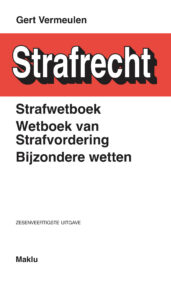

Reeks Maklu Wetteksten Nederland
Met een abonnement op de reeks krijgt u elke nieuwe bij Maklu verschenen uitgave automatisch toegestuurd met een korting van 15% op de normale verkoopprijs. -->
Verschenen:
- European Union Health Law, treaties and legislation
A.P. den Exter, T. Hervey (eds.) - International Health Law & Ethics
A.P. den Exter (ed.) - Basisteksten Internationaal en Europees Strafrecht - 8ste herziene uitgave
G. Vermeulen (red.) - Essential Texts on International & European Criminal Law - 8th edition
G. Vermeulen (ed.) - Handleiding volkenrecht
K. De Feyter (ed.) - Wetgeving gezondheidszorg - 3de, herziene uitgave
Prof. mr. dr. M.A.J.M. Buijsen (ed.) - Wetgeving Familie- en jeugdrecht
mr. V.M. Smits (ed.)
<!--
- Wetboek Wegverkeer
A. Mys - Wetboek Echtscheiding en Echtelijke Moeilijkheden
A. Mys - Wetboek Huurrecht. Woninghuur - Handelshuur - Pacht - Federale Wetgeving - Vlaams Gewest - Sociale Woninghuur - Fiscale aspecten
A. Mys - Wetboek Bedrijven in moeilijkheden
A. Mys
-->
Reeks Maklu Wetteksten Nederland
Met een abonnement op de reeks krijgt u elke nieuwe bij Maklu verschenen uitgave automatisch toegestuurd met een korting van 15% op de normale verkoopprijs. -->
Verschenen:
- European Union Health Law, treaties and legislation
A.P. den Exter, T. Hervey (eds.) - International Health Law & Ethics
A.P. den Exter (ed.) - Basisteksten Internationaal en Europees Strafrecht - 8ste herziene uitgave
G. Vermeulen (red.) - Essential Texts on International & European Criminal Law - 8th edition
G. Vermeulen (ed.) - Handleiding volkenrecht
K. De Feyter (ed.) - Wetgeving gezondheidszorg - 3de, herziene uitgave
Prof. mr. dr. M.A.J.M. Buijsen (ed.) - Wetgeving Familie- en jeugdrecht
mr. V.M. Smits (ed.)
<!--
- Wetboek Wegverkeer
A. Mys - Wetboek Echtscheiding en Echtelijke Moeilijkheden
A. Mys - Wetboek Huurrecht. Woninghuur - Handelshuur - Pacht - Federale Wetgeving - Vlaams Gewest - Sociale Woninghuur - Fiscale aspecten
A. Mys - Wetboek Bedrijven in moeilijkheden
A. Mys
-->
Reeks Maklu Wetteksten België
Met een abonnement op de reeks krijgt u elke nieuwe bij Maklu verschenen uitgave automatisch toegestuurd met een korting van 15% op de normale verkoopprijs. -->
Verschenen:
- Belgisch internationaal privaatrecht - 2de herziene uitgave
B. Volders, L. Samyn (red.) - Wetboek Economisch Recht en aanvullende regelgeving
G. Straetmans (red.) - Wetboek Staatsrecht
J. Velaers (red.) - Wetboek vennootschappen en aanvullende regelgeving
E. Lefever (red.) - European Union Health Law, treaties and legislation
A.P. den Exter, T. Hervey (eds.) - International Health Law & Ethics
A.P. den Exter (ed.) - Basisteksten Internationaal en Europees Strafrecht - 9de herziene uitgave
G. Vermeulen (red.) - Essential Texts on International & European Criminal Law - 9th edition
G. Vermeulen (ed.) - European and International Asylum and Migration Law and Policy
G. Vermeulen & Ellen Desmet (ed.)
<!--
- Wetboek Wegverkeer
A. Mys - Wetboek Echtscheiding en Echtelijke Moeilijkheden
A. Mys - Wetboek Huurrecht. Woninghuur - Handelshuur - Pacht - Federale Wetgeving - Vlaams Gewest - Sociale Woninghuur - Fiscale aspecten
A. Mys - Wetboek Bedrijven in moeilijkheden
A. Mys
-->
Reeks Maklu Wetteksten België
Met een abonnement op de reeks krijgt u elke nieuwe bij Maklu verschenen uitgave automatisch toegestuurd met een korting van 15% op de normale verkoopprijs. -->
Verschenen:
- Belgisch internationaal privaatrecht - 2de herziene uitgave
B. Volders, L. Samyn (red.) - Wetboek Economisch Recht en aanvullende regelgeving
G. Straetmans (red.) - Wetboek Staatsrecht
J. Velaers (red.) - Wetboek vennootschappen en aanvullende regelgeving
E. Lefever (red.) - European Union Health Law, treaties and legislation
A.P. den Exter, T. Hervey (eds.) - International Health Law & Ethics
A.P. den Exter (ed.) - Basisteksten Internationaal en Europees Strafrecht - 9de herziene uitgave
G. Vermeulen (red.) - Essential Texts on International & European Criminal Law - 9th edition
G. Vermeulen (ed.) - European and International Asylum and Migration Law and Policy
G. Vermeulen & Ellen Desmet (ed.)
<!--
- Wetboek Wegverkeer
A. Mys - Wetboek Echtscheiding en Echtelijke Moeilijkheden
A. Mys - Wetboek Huurrecht. Woninghuur - Handelshuur - Pacht - Federale Wetgeving - Vlaams Gewest - Sociale Woninghuur - Fiscale aspecten
A. Mys - Wetboek Bedrijven in moeilijkheden
A. Mys
-->
European Journal of Policing Studies – Jaargang 2/4 (2014) (ISSN 2034-760x). Special Issue: Migrants as police officers
Contents:
Introduction
A. Verhage, L. Bisschop, W. Hardyns
Articles
Migrants as Police Officers. Introduction
F. Sack (1) & D. Klimke (2)
(1) Professor emeritus of criminology at the Universität Hamburg, Institut für Kriminologische Sozialforschung.
(2) Professor for criminology at the Police Academy in Nienburg.
Interculturalism in the Police. Diversity or Assimilation?
D. Klimke (1)
Abstract
The German police force has so far largely been unaffected by the growing minority of migrants.
In contrast to many large companies that have understood that diversity is rewarding, the police
have operated as a closed shop towards migrants. Diversity management is a very recent concept
in the German police forces compared to other countries. While the active police force largely
expresses some resistance to the integration of migrants, police administration has understood
that the integration of migrants into the police force is now of vital importance. However, this
process is still hampered by the existing police and cop culture and, correspondingly, the rejection
of anything foreign.
Keywords: ethnic minority police officer, diversity, police culture
(1) Professor for criminology at the Police Academy in Nienburg.
Professional Anomalies. Diversity Policies Policing Ethnic
Minority Police Officers
S. Çankaya (1)
Abstract
This paper discusses how diversity policies within organizations contribute to paradoxical outcomes
in face-to-face interactions. The findings are the result of a long-term ethnographic study on the
processes of in- and exclusion of ethnic minority police officers in the Netherlands between 2007-
2011. Since the 1980s the Dutch police struggle both in terms of recruitment and retention of
ethnic minorities. Various policy measures have been taken since then. The main argument is that
diversity policies construct and perpetuate ethnic differences. This discourse impacts processes of
in- and exclusion in everyday interactions, increases ‘groupness’ and leads to dilemmas in ways of
feeling and acting among ethnic minority police officers. In specific situations, the norm images of
a ‘good’ police officer, such as integrity, solidarity and neutrality, diametrically clash with the ideal
images within diversity policies. Paradoxically, diversity policies within the Dutch police context
sustain everyday inequalities for ethnic minorities, while striving for equality.
Keywords: ethnic categorization, police organization, police culture, ethnicity, in- and exclusion, discrimination, racialization, diversity policy
(1) Currently conducts a research on security guards in semi-public environments,
commissioned by The Hague School of Applied Sciences.
Minority Police Officers in the
French Police. The ‘Republican tradition’ and the
Workplace Experience of
Minority Officers
J. Gauthier (1) & R. Lévy (2)
Abstract
This article discusses the situation of police officers from visible ethnic minorities within the French
National Police Force. Part one deals with the main ideological and institutional factors responsible
for the longstanding refusal to consider the issue of ethnicity in the police institution and goes on
to describe the more pragmatic attitude prevailing within that institution in recent years, in spite of
some resistance. Part two describes the tangible problems encountered by officers from minority
groups as uncovered in a field study conducted in the Paris area.
Keywords: police, security, minorities, discrimination, France
(1) Researcher at the Centre Marc Bloch in Berlin.
(2) Senior research d
European Journal of Policing Studies – Jaargang 2/4 (2014) (ISSN 2034-760x). Special Issue: Migrants as police officers
Contents:
Introduction
A. Verhage, L. Bisschop, W. Hardyns
Articles
Migrants as Police Officers. Introduction
F. Sack (1) & D. Klimke (2)
(1) Professor emeritus of criminology at the Universität Hamburg, Institut für Kriminologische Sozialforschung.
(2) Professor for criminology at the Police Academy in Nienburg.
Interculturalism in the Police. Diversity or Assimilation?
D. Klimke (1)
Abstract
The German police force has so far largely been unaffected by the growing minority of migrants.
In contrast to many large companies that have understood that diversity is rewarding, the police
have operated as a closed shop towards migrants. Diversity management is a very recent concept
in the German police forces compared to other countries. While the active police force largely
expresses some resistance to the integration of migrants, police administration has understood
that the integration of migrants into the police force is now of vital importance. However, this
process is still hampered by the existing police and cop culture and, correspondingly, the rejection
of anything foreign.
Keywords: ethnic minority police officer, diversity, police culture
(1) Professor for criminology at the Police Academy in Nienburg.
Professional Anomalies. Diversity Policies Policing Ethnic
Minority Police Officers
S. Çankaya (1)
Abstract
This paper discusses how diversity policies within organizations contribute to paradoxical outcomes
in face-to-face interactions. The findings are the result of a long-term ethnographic study on the
processes of in- and exclusion of ethnic minority police officers in the Netherlands between 2007-
2011. Since the 1980s the Dutch police struggle both in terms of recruitment and retention of
ethnic minorities. Various policy measures have been taken since then. The main argument is that
diversity policies construct and perpetuate ethnic differences. This discourse impacts processes of
in- and exclusion in everyday interactions, increases ‘groupness’ and leads to dilemmas in ways of
feeling and acting among ethnic minority police officers. In specific situations, the norm images of
a ‘good’ police officer, such as integrity, solidarity and neutrality, diametrically clash with the ideal
images within diversity policies. Paradoxically, diversity policies within the Dutch police context
sustain everyday inequalities for ethnic minorities, while striving for equality.
Keywords: ethnic categorization, police organization, police culture, ethnicity, in- and exclusion, discrimination, racialization, diversity policy
(1) Currently conducts a research on security guards in semi-public environments,
commissioned by The Hague School of Applied Sciences.
Minority Police Officers in the
French Police. The ‘Republican tradition’ and the
Workplace Experience of
Minority Officers
J. Gauthier (1) & R. Lévy (2)
Abstract
This article discusses the situation of police officers from visible ethnic minorities within the French
National Police Force. Part one deals with the main ideological and institutional factors responsible
for the longstanding refusal to consider the issue of ethnicity in the police institution and goes on
to describe the more pragmatic attitude prevailing within that institution in recent years, in spite of
some resistance. Part two describes the tangible problems encountered by officers from minority
groups as uncovered in a field study conducted in the Paris area.
Keywords: police, security, minorities, discrimination, France
(1) Researcher at the Centre Marc Bloch in Berlin.
(2) Senior research d
European Journal of Policing Studies – Jaargang 2/3 (2014) (ISSN 2034-760x) – Special issue Plural Policing
Contents:
Introduction
Antoinette Verhage, Lieselot Bisschop & Wim Hardyns
Articles
Plural Policing in Western Europe. A Comparison
Elke Devroe (1) & Jan Terpstra (2)
Abstract
One of the almost undisputed findings of contemporary policing studies is that
the past few decades have witnessed a far-reaching pluralization of policing. Many
countries, in different regions of the world, were confronted with the rise of new
non-police providers of policing services. Increasingly, the myth of one organization
(the public police) with a monopoly on policing lost its power of persuasion as a
valid description of reality. Generally, the new agencies of policing concentrate on
the management of petty crime and social disorder in public places. With this new
situation, multiple providers, both public and private, have become involved in the
prevention and management of crime and social disorder. It is often assumed that
this development of the past three decades created a more or less quiet revolution
(or what Bayley and Shearing (1996) called a ‘watershed’) in the systems of crime
control and law enforcement. Although this claim has been disputed, also in the
Anglo-Saxon world (Jones & Newburn, 2002), the proposition of the pluralization
of policing often seems to have reached the status of a universal, world-wide trend.
Until recently, however, outside the Anglo-Saxon world there has been a lack of
empirical studies on plural policing. With the exception of the collection edited
by Jones and Newburn (2006), the recent study by Terpstra, Van Stokkom and
Spreeuwers (2013), and the volume edited by Edwards et al. (2014), there were no
other international comparative studies of this issue. As a result, until now the claim of a universally similar trend of plural policing has remained largely uncontested.
In fact, the absence of international comparisons implied that theories and explanations
of plural policing were based only on a limited (Anglo-Saxon) sample of
countries. As a consequence, there was an unanswered question concerning the
extent to which descriptions and explanations of plural policing were also relevant
to understanding recent changes elsewhere. For example, one question that must be
asked is if there is something like a Western-European style of plural policing? Or
are the differences between these European countries so great that the developments
in policing cannot be gathered under a single conceptual label?
Keywords: Criminal investigation teams, decision-making, tunnel vision, naturalistic decision making
--> (1) Elke Devroe is master in criminology, associate professor in Public Administration, university Leiden, campus The Hague. She teaches in the international master ‘Crisis en Security Management’ (CSM) the courses ‘Governance of crime and social disorder’, ‘Evidence-based policing’ and ‘Research Design’. She conducts research on plural policing and governance of local security problems in particular on incivilities.(2) Jan Terpstra is professor of criminology at the University of Nijmegen, the Netherlands. He published books and articles about policing, local public safety policies, (private) security and criminal justice. Recently he published the book Who patrols the Streets? (coauthors B. van Stokkom and R. Spreeuwers) about plural policing in an international comparative perspective, and the book Centralizing Forces? (co-editors N.R. Fyfe and P. Tops) about police reforms in several Northern and Western European countries.
The Policing of Public Space. Recent Developments in Plural Policing
in England and Wales
Trevor Jones (1) & Stuart Lister (2)
Abstract
This p
European Journal of Policing Studies – Jaargang 2/3 (2014) (ISSN 2034-760x) – Special issue Plural Policing
Contents:
Introduction
Antoinette Verhage, Lieselot Bisschop & Wim Hardyns
Articles
Plural Policing in Western Europe. A Comparison
Elke Devroe (1) & Jan Terpstra (2)
Abstract
One of the almost undisputed findings of contemporary policing studies is that
the past few decades have witnessed a far-reaching pluralization of policing. Many
countries, in different regions of the world, were confronted with the rise of new
non-police providers of policing services. Increasingly, the myth of one organization
(the public police) with a monopoly on policing lost its power of persuasion as a
valid description of reality. Generally, the new agencies of policing concentrate on
the management of petty crime and social disorder in public places. With this new
situation, multiple providers, both public and private, have become involved in the
prevention and management of crime and social disorder. It is often assumed that
this development of the past three decades created a more or less quiet revolution
(or what Bayley and Shearing (1996) called a ‘watershed’) in the systems of crime
control and law enforcement. Although this claim has been disputed, also in the
Anglo-Saxon world (Jones & Newburn, 2002), the proposition of the pluralization
of policing often seems to have reached the status of a universal, world-wide trend.
Until recently, however, outside the Anglo-Saxon world there has been a lack of
empirical studies on plural policing. With the exception of the collection edited
by Jones and Newburn (2006), the recent study by Terpstra, Van Stokkom and
Spreeuwers (2013), and the volume edited by Edwards et al. (2014), there were no
other international comparative studies of this issue. As a result, until now the claim of a universally similar trend of plural policing has remained largely uncontested.
In fact, the absence of international comparisons implied that theories and explanations
of plural policing were based only on a limited (Anglo-Saxon) sample of
countries. As a consequence, there was an unanswered question concerning the
extent to which descriptions and explanations of plural policing were also relevant
to understanding recent changes elsewhere. For example, one question that must be
asked is if there is something like a Western-European style of plural policing? Or
are the differences between these European countries so great that the developments
in policing cannot be gathered under a single conceptual label?
Keywords: Criminal investigation teams, decision-making, tunnel vision, naturalistic decision making
--> (1) Elke Devroe is master in criminology, associate professor in Public Administration, university Leiden, campus The Hague. She teaches in the international master ‘Crisis en Security Management’ (CSM) the courses ‘Governance of crime and social disorder’, ‘Evidence-based policing’ and ‘Research Design’. She conducts research on plural policing and governance of local security problems in particular on incivilities.(2) Jan Terpstra is professor of criminology at the University of Nijmegen, the Netherlands. He published books and articles about policing, local public safety policies, (private) security and criminal justice. Recently he published the book Who patrols the Streets? (coauthors B. van Stokkom and R. Spreeuwers) about plural policing in an international comparative perspective, and the book Centralizing Forces? (co-editors N.R. Fyfe and P. Tops) about police reforms in several Northern and Western European countries.
The Policing of Public Space. Recent Developments in Plural Policing
in England and Wales
Trevor Jones (1) & Stuart Lister (2)
Abstract
This p
European Journal of Policing Studies – Jaargang 2/2 (2014) (ISSN 2034-760x)
Contents:
Introduction
A. Verhage, L. Bisschop, W. Hardyns
Articles
Investigating decision-making mechanisms and biases in Dutch criminal investigation teams by using a serious game
Jelle Groenendaal (1) en Ira Helsloot (2)
Abstract
In this article we examine by means of a serious game how ten teams of police leaders from major criminal investigation teams from five regional forces in the Netherlands, during criminal investiga-tion, deal with tunnel vision and other potential causes of flawed decision-making, described according to Naturalistic Decision-Making models. Findings show that in the serious game, the danger of tunnel vision was widely acknowledged and that a great deal of energy was wasted as a result. In addition, the teams proved susceptible to other types of decision-making pitfalls. For example, the teams searched predominantly for confirmatory evidence, unconsciously used ingrained process-related rules of thumb, and there was evidence of a form of ‘information impulsion fallacy’. The present research is an elaboration on existing literature in that it attempts to shed light on decision-making practices during criminal investigations. The study shows that a serious game can be a useful tool to uncover decision-making behaviour.
Keywords: Criminal investigation teams, decision-making, tunnel vision, naturalistic decision making
(1) Jelle Groenendaal is senior researcher at Crisislab and Ph.D candidate at the Radboud University Nijmegen. His research interests are crisis decision-making and control of front line responders.(2) Ira Helsloot is professor of the governance of safety at the Radboud University Nijmegen. He is editor of the Journal of Contingencies and Crisis Management and chair of research foundation Crisislab.
Women as Leaders in Policing: A Path Forward
Maria Koeppel (1)
Abstract
As a result of changing gender dynamics in leadership, a substantial body of literature has been dedicated to understanding differences between leadership styles and effectiveness for men and women, often finding differences between the two groups. Despite this growing body of research, there is still a substantial gap in the leadership and policing literature, specifically regarding women as leaders in policing. This paper provides an overview of the gender leadership literature both in and out of policing, as well as a succinct review of research pertaining to women as leaders in policing. Recommendations for future research are drawn from existing literature in a call for a greater understanding of the role of gender in leadership in policing.
Keywords: policing, leadership, gender
(1) Maria Koeppel received her Ph.D. in criminal justice from Sam Houston State University. Her research interests include victimology, gender, and sexual identity. Currently she is working as a research analyst for the Kansas Department of Corrections.
Guardian of Democracy?
Theoretical aspects of police roles and functions in democracy
Samuel Salzborn (1)
Abstract
In the research on democracy and democratization, there is a lack of systematic thought on the relationship between police and democracy. In this paper I argue that it is possible to go beyond empirical and historical research into police roles and functions in real-life political systems, in order to formulate a theoretical framework that outlines the specific relationships between police and democracy. Because the functions of police in democracies are clearly different from those existing under authoritarian and totalitarian regimes, it makes sense to examine these interrelationships more closely. Although the pol
European Journal of Policing Studies – Jaargang 2/2 (2014) (ISSN 2034-760x)
Contents:
Introduction
A. Verhage, L. Bisschop, W. Hardyns
Articles
Investigating decision-making mechanisms and biases in Dutch criminal investigation teams by using a serious game
Jelle Groenendaal (1) en Ira Helsloot (2)
Abstract
In this article we examine by means of a serious game how ten teams of police leaders from major criminal investigation teams from five regional forces in the Netherlands, during criminal investiga-tion, deal with tunnel vision and other potential causes of flawed decision-making, described according to Naturalistic Decision-Making models. Findings show that in the serious game, the danger of tunnel vision was widely acknowledged and that a great deal of energy was wasted as a result. In addition, the teams proved susceptible to other types of decision-making pitfalls. For example, the teams searched predominantly for confirmatory evidence, unconsciously used ingrained process-related rules of thumb, and there was evidence of a form of ‘information impulsion fallacy’. The present research is an elaboration on existing literature in that it attempts to shed light on decision-making practices during criminal investigations. The study shows that a serious game can be a useful tool to uncover decision-making behaviour.
Keywords: Criminal investigation teams, decision-making, tunnel vision, naturalistic decision making
(1) Jelle Groenendaal is senior researcher at Crisislab and Ph.D candidate at the Radboud University Nijmegen. His research interests are crisis decision-making and control of front line responders.(2) Ira Helsloot is professor of the governance of safety at the Radboud University Nijmegen. He is editor of the Journal of Contingencies and Crisis Management and chair of research foundation Crisislab.
Women as Leaders in Policing: A Path Forward
Maria Koeppel (1)
Abstract
As a result of changing gender dynamics in leadership, a substantial body of literature has been dedicated to understanding differences between leadership styles and effectiveness for men and women, often finding differences between the two groups. Despite this growing body of research, there is still a substantial gap in the leadership and policing literature, specifically regarding women as leaders in policing. This paper provides an overview of the gender leadership literature both in and out of policing, as well as a succinct review of research pertaining to women as leaders in policing. Recommendations for future research are drawn from existing literature in a call for a greater understanding of the role of gender in leadership in policing.
Keywords: policing, leadership, gender
(1) Maria Koeppel received her Ph.D. in criminal justice from Sam Houston State University. Her research interests include victimology, gender, and sexual identity. Currently she is working as a research analyst for the Kansas Department of Corrections.
Guardian of Democracy?
Theoretical aspects of police roles and functions in democracy
Samuel Salzborn (1)
Abstract
In the research on democracy and democratization, there is a lack of systematic thought on the relationship between police and democracy. In this paper I argue that it is possible to go beyond empirical and historical research into police roles and functions in real-life political systems, in order to formulate a theoretical framework that outlines the specific relationships between police and democracy. Because the functions of police in democracies are clearly different from those existing under authoritarian and totalitarian regimes, it makes sense to examine these interrelationships more closely. Although the pol
European Journal of Policing Studies – Jaargang 1/4 (2013) (ISSN 2034-760x)
Contents:
Introduction
A. Verhage, L. Bisschop, W. Hardyns
Articles
Capacity building and the Afghan National Police. Views from the frontline
G. Boyd (1) & G. Marnoch (2)
Abstract
The article reports on a study of an intelligence management capacity building programme involving
former Police Service of Northern Ireland officers mentoring members of the Afghan National
Police. The study contributes to the formative evaluation of a policy transfer based on principles and
practices developed in Northern Ireland. A short discussion of Afghanistan, policing, intelligence
management and policy transfer is provided, before attention is given to the capacity building
programme. The study is context rich drawing on qualitative data. Analysis draws on face to face
interviews conducted with mentors working with the ANP during 2010-2012. Interview questions
were broad in nature encouraging respondents to discuss implementation in their own terms.
Respondents generally concluded policy transfer was viable but were in a position to provide a great
deal of information on the Afghan context and how specific problems occurred during implementation
of the capacity building programme. Cultural issues, corruption and resource constraints
presented obstacles to the transfer as did the general absence of a bureaucratic basis for managing
the ANP. Violence and physical geography presented rather less of a problem than was anticipated.
The need to learn more about appropriate inter-personal skills in capacity building emerged as a
significant finding. Such knowledge is currently undervalued in policy transfer within the policing
sector.
Keywords: Afghanistan, intelligence, capacity, policy transfer
(1) Policing consultant and researcher.
(2) Public policy specialist and reader in policy studies at the University of Ulster.
Two systems, one challenge? Comparing legal regulation
on police co-operation
in Australia and Europe
S. Hufnagel (1)
Abstract
This article compares of legal harmonisation with a view to facilitating police cooperation in the
EU and Australia. It addresses the main processes of harmonisation and the parallel strategies
of mutual recognition and the creation broad legal frameworks in relation to both systems. The
legal analysis is complemented by interviews with practitioners in the field to assess the impact
of legal initiatives on actual police cooperation practice. It is argued that both systems have
developed distinctive strategies to promote police cooperation through legal harmonisation, but
that Australia, due to its federal political structure, has more potential to achieve harmonised and
even uniform legislation within its states. However, the strategies developed in the EU to promote
cooperation without legal harmonisation and in particular broad legal frameworks have created
a high level of regional practitioner initiative promoting bilateral and multilateral formalisation of
cooperation strategies that cannot be observed in Australia. Both entities have hence developed
distinct structures that might be relevant to the respective other system. This study is the first to
compare the Australian federal system of cooperation with the EU.
Keywords: police cooperation, legal harmonisation, Mutual Recognition, EU, Australia
(1) Lecturer in Criminal Law at Queen Mary, University of London.
International police reform
and project management. Empirical observations
on EULEX Kosovo
J. Janssens (1)
Abstract
In February 2008, the European Union (EU) launched its largest civilian crisis management operation
under its Common Security and Defence Policy:
European Journal of Policing Studies – Jaargang 1/4 (2013) (ISSN 2034-760x)
Contents:
Introduction
A. Verhage, L. Bisschop, W. Hardyns
Articles
Capacity building and the Afghan National Police. Views from the frontline
G. Boyd (1) & G. Marnoch (2)
Abstract
The article reports on a study of an intelligence management capacity building programme involving
former Police Service of Northern Ireland officers mentoring members of the Afghan National
Police. The study contributes to the formative evaluation of a policy transfer based on principles and
practices developed in Northern Ireland. A short discussion of Afghanistan, policing, intelligence
management and policy transfer is provided, before attention is given to the capacity building
programme. The study is context rich drawing on qualitative data. Analysis draws on face to face
interviews conducted with mentors working with the ANP during 2010-2012. Interview questions
were broad in nature encouraging respondents to discuss implementation in their own terms.
Respondents generally concluded policy transfer was viable but were in a position to provide a great
deal of information on the Afghan context and how specific problems occurred during implementation
of the capacity building programme. Cultural issues, corruption and resource constraints
presented obstacles to the transfer as did the general absence of a bureaucratic basis for managing
the ANP. Violence and physical geography presented rather less of a problem than was anticipated.
The need to learn more about appropriate inter-personal skills in capacity building emerged as a
significant finding. Such knowledge is currently undervalued in policy transfer within the policing
sector.
Keywords: Afghanistan, intelligence, capacity, policy transfer
(1) Policing consultant and researcher.
(2) Public policy specialist and reader in policy studies at the University of Ulster.
Two systems, one challenge? Comparing legal regulation
on police co-operation
in Australia and Europe
S. Hufnagel (1)
Abstract
This article compares of legal harmonisation with a view to facilitating police cooperation in the
EU and Australia. It addresses the main processes of harmonisation and the parallel strategies
of mutual recognition and the creation broad legal frameworks in relation to both systems. The
legal analysis is complemented by interviews with practitioners in the field to assess the impact
of legal initiatives on actual police cooperation practice. It is argued that both systems have
developed distinctive strategies to promote police cooperation through legal harmonisation, but
that Australia, due to its federal political structure, has more potential to achieve harmonised and
even uniform legislation within its states. However, the strategies developed in the EU to promote
cooperation without legal harmonisation and in particular broad legal frameworks have created
a high level of regional practitioner initiative promoting bilateral and multilateral formalisation of
cooperation strategies that cannot be observed in Australia. Both entities have hence developed
distinct structures that might be relevant to the respective other system. This study is the first to
compare the Australian federal system of cooperation with the EU.
Keywords: police cooperation, legal harmonisation, Mutual Recognition, EU, Australia
(1) Lecturer in Criminal Law at Queen Mary, University of London.
International police reform
and project management. Empirical observations
on EULEX Kosovo
J. Janssens (1)
Abstract
In February 2008, the European Union (EU) launched its largest civilian crisis management operation
under its Common Security and Defence Policy:
European Journal of Policing Studies – Jaargang 1/3 (2013) (ISSN 2034-760x)
Contents:
Introduction
A. Verhage, L. Bisschop, W. Hardyns
Articles
Modelling intelligence-led policing to identify its potential
M. den Hengst-Bruggeling (1), B. de Graaf (2) & P. van Scheepstal (3)
Abstract
Intelligence-led policing is a concept of policing that has been applied throughout the world.
Despite some encouraging reports, the effect of intelligence-led policing is largely unknown. This
paper presents a method with which it is possible to identify intelligence-led policing’s potential
to increase the effectiveness of policing. The method is based on modelling with system dynamics
and takes into account the complexities of intelligence-led policing. For evaluation purposes, this
method has been applied using a case study in the Netherlands. The case study shows that collaboratively
constructing the system dynamics model provides a more structured insight into the
effects of intelligence-led policing. With system dynamics it is possible to support the ‘good stories’
of intelligence-led policing with argumentation explaining the mechanisms in which intelligence-led
policing potentially improves effectiveness.
Keywords: System dynamics, collaboration, intelligence, police, intelligence-led policing
(1) Researcher at Delft University of Technology and the Police Academy of the Netherlands.
(2) Consultant in the area of Workplace Innovation in the expertise group Sustainable
Productivity and Employment of the Dutch research institute TNO.
(3) Operational analyst at the expertise group Military Operations of the Dutch
research institute TNO.
Physical fitness and anthropometric characteristics of graduating Norwegian Police University College students
T. Dillern (1), O. Ragnar Norheim Jenssen (2) & J. Ingebrigtsen (3)
Abstract
The aim of the study was to assess physical fitness and anthropometric characteristics of Norwegian
male and female graduating police university college students. Several fitness tests (i.e. upper
body strength, explosive leg power and endurance capacity) were conducted and anthropometric
data (i.e. body mass and stature) were collected. Compared with relevant reference groups, the
present students perform well on physical fitness tests. Moreover, this study provides a better
understanding of some of the properties forthcoming police officers obtain, and the present
findings could be valuable if one aims to further investigate the development of physical fitness
throughout police careers.
Keywords: Physical test performance, physical health, police officers, work ability
(1) Teacher at the Norwegian Police University College.
(2) Teacher at the Norwegian Police University College.
(3) Ph.D. student at the University of Nordland, Bodø, Norway.
The importance of relating theory and practice when teaching police students
P. Lagestad (1)
Abstract
The general trend of scientific and academic professionalization of practical professions, challenges
practical professions all over the world. On the basis of interviews and surveys among
police students, this study examines what police students experience to be good teaching at the
Police University College. In accordance with Dewey (1916), the results clearly demonstrate the
importance of relating theory to police practice in social science. For this reason, it is suggested
that obligatory participation in police patrols and other police work should be a requirement for
teachers in social science at the Police University College. Surprisingly, the students pointed to
engagement and to relate theory to practice as important skills of a teacher as knowledge of the
subject, to be prepared f
European Journal of Policing Studies – Jaargang 1/3 (2013) (ISSN 2034-760x)
Contents:
Introduction
A. Verhage, L. Bisschop, W. Hardyns
Articles
Modelling intelligence-led policing to identify its potential
M. den Hengst-Bruggeling (1), B. de Graaf (2) & P. van Scheepstal (3)
Abstract
Intelligence-led policing is a concept of policing that has been applied throughout the world.
Despite some encouraging reports, the effect of intelligence-led policing is largely unknown. This
paper presents a method with which it is possible to identify intelligence-led policing’s potential
to increase the effectiveness of policing. The method is based on modelling with system dynamics
and takes into account the complexities of intelligence-led policing. For evaluation purposes, this
method has been applied using a case study in the Netherlands. The case study shows that collaboratively
constructing the system dynamics model provides a more structured insight into the
effects of intelligence-led policing. With system dynamics it is possible to support the ‘good stories’
of intelligence-led policing with argumentation explaining the mechanisms in which intelligence-led
policing potentially improves effectiveness.
Keywords: System dynamics, collaboration, intelligence, police, intelligence-led policing
(1) Researcher at Delft University of Technology and the Police Academy of the Netherlands.
(2) Consultant in the area of Workplace Innovation in the expertise group Sustainable
Productivity and Employment of the Dutch research institute TNO.
(3) Operational analyst at the expertise group Military Operations of the Dutch
research institute TNO.
Physical fitness and anthropometric characteristics of graduating Norwegian Police University College students
T. Dillern (1), O. Ragnar Norheim Jenssen (2) & J. Ingebrigtsen (3)
Abstract
The aim of the study was to assess physical fitness and anthropometric characteristics of Norwegian
male and female graduating police university college students. Several fitness tests (i.e. upper
body strength, explosive leg power and endurance capacity) were conducted and anthropometric
data (i.e. body mass and stature) were collected. Compared with relevant reference groups, the
present students perform well on physical fitness tests. Moreover, this study provides a better
understanding of some of the properties forthcoming police officers obtain, and the present
findings could be valuable if one aims to further investigate the development of physical fitness
throughout police careers.
Keywords: Physical test performance, physical health, police officers, work ability
(1) Teacher at the Norwegian Police University College.
(2) Teacher at the Norwegian Police University College.
(3) Ph.D. student at the University of Nordland, Bodø, Norway.
The importance of relating theory and practice when teaching police students
P. Lagestad (1)
Abstract
The general trend of scientific and academic professionalization of practical professions, challenges
practical professions all over the world. On the basis of interviews and surveys among
police students, this study examines what police students experience to be good teaching at the
Police University College. In accordance with Dewey (1916), the results clearly demonstrate the
importance of relating theory to police practice in social science. For this reason, it is suggested
that obligatory participation in police patrols and other police work should be a requirement for
teachers in social science at the Police University College. Surprisingly, the students pointed to
engagement and to relate theory to practice as important skills of a teacher as knowledge of the
subject, to be prepared f