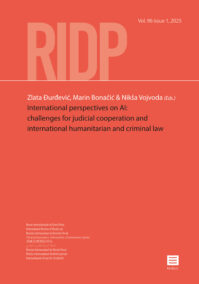
International perspectives on AI: challenges for judicial cooperation and international humanitarian and criminal law (RIDP 2025.1)
€ 70,00
This volume brings together state-of-the-art scholarship on one of the most urgent issues of contemporary international law: the governance of artificial intelligence (AI) in military contexts. Drawing on contributions from the international scientific AIDP Section IV colloquium held in Opatija, Croatia, in December 2023, it explores how national and international legal systems confront the emergence of autonomous weapon systems (AWS) and other AI-driven military technologies.
Featuring six national reports from Belgium, Croatia, Finland, Hungary, Italy, and Poland, the publication provides a comparative perspective on the legal, ethical, and policy challenges posed by AWS. Authors examine critical issues such as the distinction between autonomous and automated weapons, meaningful human control, individual and corporate accountability, command responsibility, compliance with international humanitarian law (IHL) principles and transnational judicial cooperation, including jurisdiction, extradition, evidence gathering, and prosecution in cases involving AI-related cases.
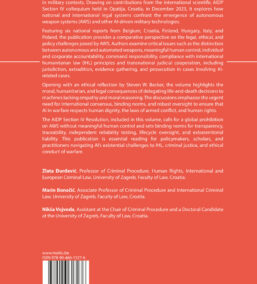
Opening with an ethical reflection by Steven W. Becker, the volume highlights the moral, humanitarian, and legal consequences of delegating life-and-death decisions to machines lacking empathy and moral reasoning. The discussions emphasise the urgent need for international consensus, binding norms, and robust oversight to ensure that AI in warfare respects human dignity, the laws of armed conflict, and human rights. The AIDP Section IV Resolution, included in this volume, calls for a global prohibition on AWS without meaningful human control and sets binding norms for transparency, traceability, independent reliability testing, lifecycle oversight, and extraterritorial liability. This publication is essential reading for policymakers, scholars, and practitioners navigating AI’s existential challenges to IHL, criminal justice, and ethical conduct of warfare.
Zlata Đurđević, Professor of Criminal Procedure, Human Rights, International and European Criminal Law, University of Zagreb, Faculty of Law, Croatia. Marin Bonačić, Associate Professor of Criminal Procedure and International Criminal Law, University of Zagreb, Faculty of Law, Croatia. Nikša Vojvoda, Assistant at the Chair of Criminal Procedure and a Doctoral Candidate at the University of Zagreb, Faculty of Law, Croatia.
Zlata Đurđević, Professor of Criminal Procedure, Human Rights, International and European Criminal Law, University of Zagreb, Faculty of Law, Croatia. Marin Bonačić, Associate Professor of Criminal Procedure and International Criminal Law, University of Zagreb, Faculty of Law, Croatia. Nikša Vojvoda, Assistant at the Chair of Criminal Procedure and a Doctoral Candidate at the University of Zagreb, Faculty of Law, Croatia.
International perspectives on AI: challenges for judicial cooperation and international humanitarian and criminal law (RIDP 2025.1)
€ 70,00
This volume brings together state-of-the-art scholarship on one of the most urgent issues of contemporary international law: the governance of artificial intelligence (AI) in military contexts. Drawing on contributions from the international scientific AIDP Section IV colloquium held in Opatija, Croatia, in December 2023, it explores how national and international legal systems confront the emergence of autonomous weapon systems (AWS) and other AI-driven military technologies.
Featuring six national reports from Belgium, Croatia, Finland, Hungary, Italy, and Poland, the publication provides a comparative perspective on the legal, ethical, and policy challenges posed by AWS. Authors examine critical issues such as the distinction between autonomous and automated weapons, meaningful human control, individual and corporate accountability, command responsibility, compliance with international humanitarian law (IHL) principles and transnational judicial cooperation, including jurisdiction, extradition, evidence gathering, and prosecution in cases involving AI-related cases.
Opening with an ethical reflection by Steven W. Becker, the volume highlights the moral, humanitarian, and legal consequences of delegating life-and-death decisions to machines lacking empathy and moral reasoning. The discussions emphasise the urgent need for international consensus, binding norms, and robust oversight to ensure that AI in warfare respects human dignity, the laws of armed conflict, and human rights. The AIDP Section IV Resolution, included in this volume, calls for a global prohibition on AWS without meaningful human control and sets binding norms for transparency, traceability, independent reliability testing, lifecycle oversight, and extraterritorial liability. This publication is essential reading for policymakers, scholars, and practitioners navigating AI’s existential challenges to IHL, criminal justice, and ethical conduct of warfare.
Zlata Đurđević, Professor of Criminal Procedure, Human Rights, International and European Criminal Law, University of Zagreb, Faculty of Law, Croatia. Marin Bonačić, Associate Professor of Criminal Procedure and International Criminal Law, University of Zagreb, Faculty of Law, Croatia. Nikša Vojvoda, Assistant at the Chair of Criminal Procedure and a Doctoral Candidate at the University of Zagreb, Faculty of Law, Croatia.
Zlata Đurđević, Professor of Criminal Procedure, Human Rights, International and European Criminal Law, University of Zagreb, Faculty of Law, Croatia. Marin Bonačić, Associate Professor of Criminal Procedure and International Criminal Law, University of Zagreb, Faculty of Law, Croatia. Nikša Vojvoda, Assistant at the Chair of Criminal Procedure and a Doctoral Candidate at the University of Zagreb, Faculty of Law, Croatia.