
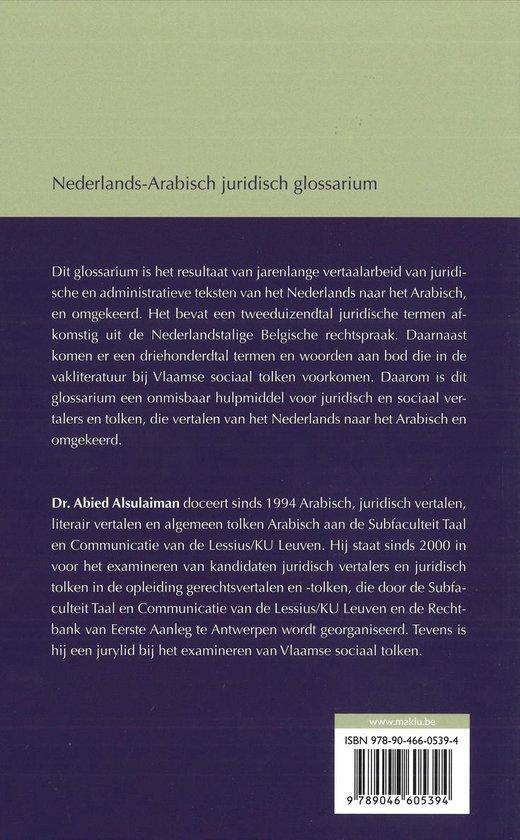
Nederlands – Arabisch juridisch glossarium
Dr. Abied Alsulaiman doceert sinds 1994 Arabisch, juridisch vertalen, literair vertalen en algemeen tolken Arabisch aan de Subfaculteit Taal en Communicatie van de Lessius/KU Leuven. Hij staat sinds 2000 in voor het examineren van kandidaten juridisch vertalers en juridisch tolken in de opleiding gerechtsvertalen en -tolken, die door de Subfaculteit Taal en Communicatie van de Lessius/KU Leuven en de Rechtbank van Eerste Aanleg te Antwerpen wordt georganiseerd. Tevens is hij een jurylid bij het examineren van Vlaamse sociaal tolken.
Nederlands – Arabisch juridisch glossarium
Dr. Abied Alsulaiman doceert sinds 1994 Arabisch, juridisch vertalen, literair vertalen en algemeen tolken Arabisch aan de Subfaculteit Taal en Communicatie van de Lessius/KU Leuven. Hij staat sinds 2000 in voor het examineren van kandidaten juridisch vertalers en juridisch tolken in de opleiding gerechtsvertalen en -tolken, die door de Subfaculteit Taal en Communicatie van de Lessius/KU Leuven en de Rechtbank van Eerste Aanleg te Antwerpen wordt georganiseerd. Tevens is hij een jurylid bij het examineren van Vlaamse sociaal tolken.
Need for and feasibility of an EU offence policy
Starting from the observation that criminal law is different in each of the member states as a result of which
(1) what constitutes an offence in one member state does not necessarily constitute an offence in another member state,
(2) even where offences are equally criminalised in all member states, the sanction levels may still vary and
(3) more generally, the position of the offences in the entirety of the justice system may vary,
the question arises to what extent those so-called offence diversities are an obstacle for EU policy making and to what extent it is feasible to overcome those obstacles.
The author underpins the need for the development of an EU offence policy, using the common criminalisation acquis as a centre piece. She argues that the common criminalisation acquis can help
(1) to ensure comparability of crime statistics,
(2) to avoid redundant double criminality testing,
(3) to overcome evidence gathering difficulties,
(4) to clarify the mandates of the EU level actors,
(5) to identify the equivalent national sentence and
(6) to scope the taking account of prior convictions.
The only condition: the development of a comprehensive, consistent and well-balanced EU offence policy.
This book contains the conclusions of her publication based doctoral thesis defended at Ghent University on 22 June 2012. It is essential reading for policy makers both at national and European level in any policy field that is linked to offences.
Wendy De Bondt holds a master’s degree in law (2006) and criminology (2007) and a PhD in law (2012). She has been a member of the Institute for International Research on Criminal Policy affiliated to the Department of Penal Law and Criminology of Ghent University since 2007.
Need for and feasibility of an EU offence policy
Starting from the observation that criminal law is different in each of the member states as a result of which
(1) what constitutes an offence in one member state does not necessarily constitute an offence in another member state,
(2) even where offences are equally criminalised in all member states, the sanction levels may still vary and
(3) more generally, the position of the offences in the entirety of the justice system may vary,
the question arises to what extent those so-called offence diversities are an obstacle for EU policy making and to what extent it is feasible to overcome those obstacles.
The author underpins the need for the development of an EU offence policy, using the common criminalisation acquis as a centre piece. She argues that the common criminalisation acquis can help
(1) to ensure comparability of crime statistics,
(2) to avoid redundant double criminality testing,
(3) to overcome evidence gathering difficulties,
(4) to clarify the mandates of the EU level actors,
(5) to identify the equivalent national sentence and
(6) to scope the taking account of prior convictions.
The only condition: the development of a comprehensive, consistent and well-balanced EU offence policy.
This book contains the conclusions of her publication based doctoral thesis defended at Ghent University on 22 June 2012. It is essential reading for policy makers both at national and European level in any policy field that is linked to offences.
Wendy De Bondt holds a master’s degree in law (2006) and criminology (2007) and a PhD in law (2012). She has been a member of the Institute for International Research on Criminal Policy affiliated to the Department of Penal Law and Criminology of Ghent University since 2007.
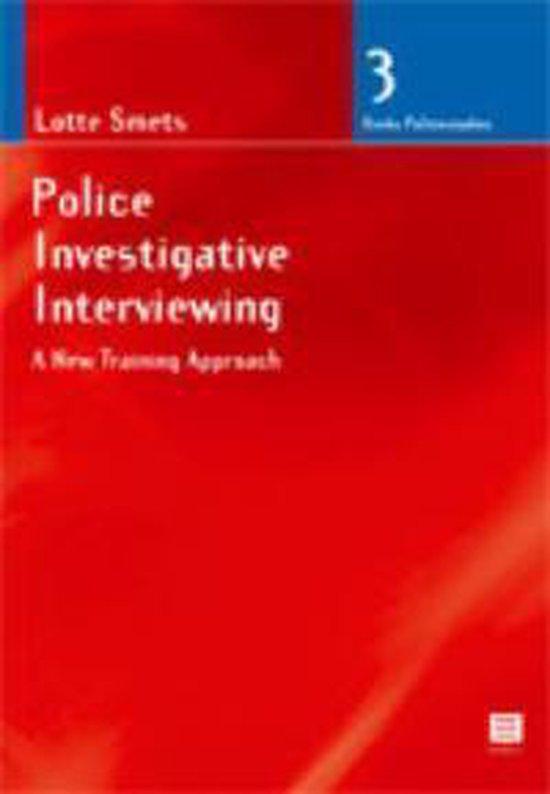
Police Investigative Interviewing. A new Training Approach (Reeks Politiestudies, nr. 3)
Today however we believe that special attention to training and education is obligatory as investigative interviewing is a specialism rather than a general police skill that anyone can easily apply. Police interviewing is a very important and specialised technique that requires efficient training including a great deal of supervised practice in both educational and real-life settings.
Based on an empirical study this book explains how two newly developed training methods, individual coaching and one-day group training, can be used to optimise daily police interview practices by coaching interviewers at work. Coaching police interviewers gives them the opportunity to acquire insight into their personal interview strengths and weaknesses. Consequently developing personal awareness will help to optimise the interview practices of individual police officers by instilling a process of self-reflection and giving the interviewers insight into how to use certain techniques.
Working with interview coaches also has the advantage that police interviewers can not only reflect on their personal practice, but they also can seek advice and guidance when preparing for and conducting complex interviews. On this level coaching is more focused on the content of the case than on interpersonal capacities – which will increase job satisfaction and can prevent tunnel vision when working on a criminal case.
Our main findings are that 52% of individually coached interviewers further developed their personal interview competences significantly, and 17% of the interviewers who received only a one-day group coaching session with their peers, showed progress after seven months on four of the five main interview competences measured by the Police Interview Competency Inventory.Based on the principles of coaching, a new way of policing will be explained when describing the two newly developed training methods, a way that will change the practical organisation of criminal investigations for good and will enhance the quality of investigative interviews.
This book is unique as no previous studies have ever empirically tested the learning effect of applying competency management and coaching as we know it from the world of trade and industry to a police interview training context.
Police Investigative Interviewing. A new Training Approach (Reeks Politiestudies, nr. 3)
Today however we believe that special attention to training and education is obligatory as investigative interviewing is a specialism rather than a general police skill that anyone can easily apply. Police interviewing is a very important and specialised technique that requires efficient training including a great deal of supervised practice in both educational and real-life settings.
Based on an empirical study this book explains how two newly developed training methods, individual coaching and one-day group training, can be used to optimise daily police interview practices by coaching interviewers at work. Coaching police interviewers gives them the opportunity to acquire insight into their personal interview strengths and weaknesses. Consequently developing personal awareness will help to optimise the interview practices of individual police officers by instilling a process of self-reflection and giving the interviewers insight into how to use certain techniques.
Working with interview coaches also has the advantage that police interviewers can not only reflect on their personal practice, but they also can seek advice and guidance when preparing for and conducting complex interviews. On this level coaching is more focused on the content of the case than on interpersonal capacities – which will increase job satisfaction and can prevent tunnel vision when working on a criminal case.
Our main findings are that 52% of individually coached interviewers further developed their personal interview competences significantly, and 17% of the interviewers who received only a one-day group coaching session with their peers, showed progress after seven months on four of the five main interview competences measured by the Police Interview Competency Inventory.Based on the principles of coaching, a new way of policing will be explained when describing the two newly developed training methods, a way that will change the practical organisation of criminal investigations for good and will enhance the quality of investigative interviews.
This book is unique as no previous studies have ever empirically tested the learning effect of applying competency management and coaching as we know it from the world of trade and industry to a police interview training context.
Toezicht op detentie: tekst en context (IRCP-series, vol. 46)
Hoe functioneren die organen in de praktijk en op welke wijze verhouden ze zich tot elkaar?
Is het huidige toezicht in Europa toereikend of moet de controle nog opgevoerd worden?
Welke rol speelt de EU in dit ganse verhaal?
Toezicht op detentie biedt de lezer een up-to-date overzicht van het hedendaagse toezichtlandschap en bediscussieert een aantal van de hete hangijzers waarmee actoren op dit terrein heden ten dage worden geconfronteerd.
Toezicht op detentie: tekst en context (IRCP-series, vol. 46)
Hoe functioneren die organen in de praktijk en op welke wijze verhouden ze zich tot elkaar?
Is het huidige toezicht in Europa toereikend of moet de controle nog opgevoerd worden?
Welke rol speelt de EU in dit ganse verhaal?
Toezicht op detentie biedt de lezer een up-to-date overzicht van het hedendaagse toezichtlandschap en bediscussieert een aantal van de hete hangijzers waarmee actoren op dit terrein heden ten dage worden geconfronteerd.

Europol, Quo Vadis? Critical Analysis and Evaluation of the Development of the European Police Office
The establishment of Europol was in essence a political decision and to a large extent the agency has remained a political construct. Every political decision represents choices embodying the development of Europol. Choices also have to be made in the legal translation of policy decisions. In her doctoral thesis Alexandra De Moor traces these choices, as they are materialised in legal and policy documents, and makes them subject of analysis and evaluation. The research model she develops for this purpose consists of eras (the pre-Convention, Convention and post-Convention era), clusters (legal basis, objective, competence, tasks, governance and control) and criteria (necessity, consistency, balance and transparency). The three-dimensional model is perfectly suited for a doctoral thesis based on a compilation of peer-reviewed publications (seven in total). This booklet presents the main conclusions, as well as the policy epilogue.
Europol, Quo Vadis? reads like a ‘Bildungsroman’, a coming of age story with lots of ups and downs, and a story with an open ending, as the identity of Europol is still under debate today. The preparations of the new Europol Regulation (after 2013) have started under Danish Presidency (first half of 2012). De Moor wants to fuel the debate on the future of Europol by signaling key concerns and providing useful recommendations. She doubts whether a European Police Office with operational-executive powers (modeled after the FBI) should by definition be the terminus of the development of Europol.
Alexandra De Moor has been affiliated (2006-2012) with the Department of Penal Law and Criminology, Institute for International Research on Criminal Policy (IRCP), Ghent University (Belgium). Although she is a legal scholar, this publication has a hybrid character, in view of the criminological, political and policy relevance of the subject.
Europol, Quo Vadis? Critical Analysis and Evaluation of the Development of the European Police Office
The establishment of Europol was in essence a political decision and to a large extent the agency has remained a political construct. Every political decision represents choices embodying the development of Europol. Choices also have to be made in the legal translation of policy decisions. In her doctoral thesis Alexandra De Moor traces these choices, as they are materialised in legal and policy documents, and makes them subject of analysis and evaluation. The research model she develops for this purpose consists of eras (the pre-Convention, Convention and post-Convention era), clusters (legal basis, objective, competence, tasks, governance and control) and criteria (necessity, consistency, balance and transparency). The three-dimensional model is perfectly suited for a doctoral thesis based on a compilation of peer-reviewed publications (seven in total). This booklet presents the main conclusions, as well as the policy epilogue.
Europol, Quo Vadis? reads like a ‘Bildungsroman’, a coming of age story with lots of ups and downs, and a story with an open ending, as the identity of Europol is still under debate today. The preparations of the new Europol Regulation (after 2013) have started under Danish Presidency (first half of 2012). De Moor wants to fuel the debate on the future of Europol by signaling key concerns and providing useful recommendations. She doubts whether a European Police Office with operational-executive powers (modeled after the FBI) should by definition be the terminus of the development of Europol.
Alexandra De Moor has been affiliated (2006-2012) with the Department of Penal Law and Criminology, Institute for International Research on Criminal Policy (IRCP), Ghent University (Belgium). Although she is a legal scholar, this publication has a hybrid character, in view of the criminological, political and policy relevance of the subject.
Private Antitrust Litigation in the European Union and Japan. A Comparative Perspective.
Companies in Europe and Japan are increasingly the target of private antitrust litigation. These lawsuits are being facilitated by favorable case law, legislative changes and a growing awareness of antitrust remedies in all layers of society.
This book analyzes and compares this burgeoning
area of litigation in the European Union and Japan. It
analyzes the legal framework for these lawsuits and
takes stock of the hundreds of cases that have been
brought in Japan and the EU in recent years. It also
examines the novel contexts in which private litigants
are invoking antitrust violations, such as in derivative
suits and in actions to challenge arbitral awards. Finally,
it assesses the impact of private litigation on the
enforcement of antitrust law and shows how Japan’s
experience can be useful for Europe and vice versa in
shaping future reforms.
Simon Vande Walle is a research fellow of the Japan
Society for the Promotion of Science at the University
of Tokyo. He holds law degrees from Kyushu University
(LL.D.), Georgetown University Law Center (LL.M.) and
the University of Leuven (Master of Laws). Previously,
he worked as a lawyer at Linklaters in Brussels, where
he specialized in litigation and was closely involved in
several major private antitrust cases.
Christopher Heath in Journal of Japanese Law:
„Bemerkenswert an der vorliegenden Arbeit sind die profunde Auseinandersetzung mit japanischen Quellen, der klare Aufbau, die gute Lesbarkeit und analytische Prägnanz. Wer ein Vorbild für die Abfassung einer Dissertation zum japanischen Recht sucht, sollte das Buch von Vande Walle zur Hand nehmen“.
Private Antitrust Litigation in the European Union and Japan. A Comparative Perspective.
Companies in Europe and Japan are increasingly the target of private antitrust litigation. These lawsuits are being facilitated by favorable case law, legislative changes and a growing awareness of antitrust remedies in all layers of society.
This book analyzes and compares this burgeoning
area of litigation in the European Union and Japan. It
analyzes the legal framework for these lawsuits and
takes stock of the hundreds of cases that have been
brought in Japan and the EU in recent years. It also
examines the novel contexts in which private litigants
are invoking antitrust violations, such as in derivative
suits and in actions to challenge arbitral awards. Finally,
it assesses the impact of private litigation on the
enforcement of antitrust law and shows how Japan’s
experience can be useful for Europe and vice versa in
shaping future reforms.
Simon Vande Walle is a research fellow of the Japan
Society for the Promotion of Science at the University
of Tokyo. He holds law degrees from Kyushu University
(LL.D.), Georgetown University Law Center (LL.M.) and
the University of Leuven (Master of Laws). Previously,
he worked as a lawyer at Linklaters in Brussels, where
he specialized in litigation and was closely involved in
several major private antitrust cases.
Christopher Heath in Journal of Japanese Law:
„Bemerkenswert an der vorliegenden Arbeit sind die profunde Auseinandersetzung mit japanischen Quellen, der klare Aufbau, die gute Lesbarkeit und analytische Prägnanz. Wer ein Vorbild für die Abfassung einer Dissertation zum japanischen Recht sucht, sollte das Buch von Vande Walle zur Hand nehmen“.
Rationing Health Care. Hard choices and unavoidable trade-offs.
One of the most controversial issues in many health care systems is health care rationing. In essence, rationing refers to the denial of - or delay in - access to scarce goods and services in health care, despite the existence of medical need. Scarcity of financial and medical resources confronts society with painful questions.
These are difficult questions that suggest the need for transparent and democratic decision-making. In reality, however, the rationing debate occurs in a sub rosa world, based on imperfect information, distorted interpretations of effectiveness, and hidden cost concerns.
‘Rationing Health Care. Hard Choices and Unavoidable Tradeoffs’ explores these and other questions from various perspectives (medicine, philosophy, ethics, economics and law). Each of the authors’ contributions analyses the debate from a different angle in search of fair and just rationing decisions.
André den Exter and Martin Buijsen are both academics affiliated with Erasmus University Rotterdam, the Netherlands and founders of the Erasmus Observatory on Health Law.
Rationing Health Care. Hard choices and unavoidable trade-offs.
One of the most controversial issues in many health care systems is health care rationing. In essence, rationing refers to the denial of - or delay in - access to scarce goods and services in health care, despite the existence of medical need. Scarcity of financial and medical resources confronts society with painful questions.
These are difficult questions that suggest the need for transparent and democratic decision-making. In reality, however, the rationing debate occurs in a sub rosa world, based on imperfect information, distorted interpretations of effectiveness, and hidden cost concerns.
‘Rationing Health Care. Hard Choices and Unavoidable Tradeoffs’ explores these and other questions from various perspectives (medicine, philosophy, ethics, economics and law). Each of the authors’ contributions analyses the debate from a different angle in search of fair and just rationing decisions.
André den Exter and Martin Buijsen are both academics affiliated with Erasmus University Rotterdam, the Netherlands and founders of the Erasmus Observatory on Health Law.
Diefstal in woningen. Bijdragen voor een geïntegreerde beheersing vanuit beleid, praktijk en wetenschap (Reeks Cahiers Integrale Veiligheid, nr. 2)
In dit cahier komen verschillende invalshoeken van diefstal in woningen aan bod, al dan niet gekoppeld aan het specifieke Belgische, regionale of lokale beleidskader. De lezer van dit ‘Cahier Integrale Veiligheid’ vindt er onder meer bijdragen terug die ingaan op de kenmerken die een woning kwetsbaar maken, hoe deze door inbrekers worden benut en hoe men zich hiertegen kan wapenen, hetzij als individu, hetzij als gemeenschap.
Daarnaast wordt aandacht besteed aan de concentraties van inbraken in tijd en ruimte en de gevolgen hiervan voor patronen in dadergedrag. Naast de daderkant komt het perspectief van het slachtoffer aan bod. Zo wordt gekeken naar de impact van voor de slachtoffers een diefstal in de woning en welke maatregelen men kan nemen om de negatieve gevolgen van slachtofferschap zoveel mogelijk te beperken. Tot slot komt ook de gerechtelijke keten aan bod, waarbij wordt stilgestaan bij enkele drempels en opportuniteiten voor een coherente strijd tegen dit criminele fenomeen.
Diefstal in woningen. Bijdragen voor een geïntegreerde beheersing vanuit beleid, praktijk en wetenschap (Reeks Cahiers Integrale Veiligheid, nr. 2)
In dit cahier komen verschillende invalshoeken van diefstal in woningen aan bod, al dan niet gekoppeld aan het specifieke Belgische, regionale of lokale beleidskader. De lezer van dit ‘Cahier Integrale Veiligheid’ vindt er onder meer bijdragen terug die ingaan op de kenmerken die een woning kwetsbaar maken, hoe deze door inbrekers worden benut en hoe men zich hiertegen kan wapenen, hetzij als individu, hetzij als gemeenschap.
Daarnaast wordt aandacht besteed aan de concentraties van inbraken in tijd en ruimte en de gevolgen hiervan voor patronen in dadergedrag. Naast de daderkant komt het perspectief van het slachtoffer aan bod. Zo wordt gekeken naar de impact van voor de slachtoffers een diefstal in de woning en welke maatregelen men kan nemen om de negatieve gevolgen van slachtofferschap zoveel mogelijk te beperken. Tot slot komt ook de gerechtelijke keten aan bod, waarbij wordt stilgestaan bij enkele drempels en opportuniteiten voor een coherente strijd tegen dit criminele fenomeen.

Hoofdstukken pensioenrecht (Bibliotheek Sociaal Recht, nr. 3)
Hoofdstukken Pensioenrecht behandelt de onderwerpen waardeoverdracht, pensioen(proces)recht en pensioenschade bij ontslag. Dit boek is zowel bedoeld voor de (rechten)student, als de praktijkjurist die te maken heeft met vraagstukken omtrent pensioen.
Mr. T.J. Zuiderman is partner bij het in pensioenrecht gespecialiseerde kantoor Onno F. Blom Advocaten. Daarnaast is hij voorzitter van de Klachten- en geschillencommissie van de Stichting Pensioenfonds Ford Nederland en is hij bestuurslid van de Vereniging voor Pensioenrecht. Zuiderman publiceert regelmatig in vakbladen met betrekking tot het pensioenrecht.
Mr. O.F. Blom is naast advocaat onder meer voorzitter van de Geschillencommissie van de Stichting Pensioenfonds TNT en de Geschillencommissie van de Stichting Chevron Pensioenfonds. Hij doceert pensioenrecht aan de Grotius Academie en is benoemd tot raadsheer-plaatsvervanger in het Gerechtshof ’s-Gravenhage.
Meer over Reeks Bibliotheek Sociaal Recht
Hoofdstukken pensioenrecht (Bibliotheek Sociaal Recht, nr. 3)
Hoofdstukken Pensioenrecht behandelt de onderwerpen waardeoverdracht, pensioen(proces)recht en pensioenschade bij ontslag. Dit boek is zowel bedoeld voor de (rechten)student, als de praktijkjurist die te maken heeft met vraagstukken omtrent pensioen.
Mr. T.J. Zuiderman is partner bij het in pensioenrecht gespecialiseerde kantoor Onno F. Blom Advocaten. Daarnaast is hij voorzitter van de Klachten- en geschillencommissie van de Stichting Pensioenfonds Ford Nederland en is hij bestuurslid van de Vereniging voor Pensioenrecht. Zuiderman publiceert regelmatig in vakbladen met betrekking tot het pensioenrecht.
Mr. O.F. Blom is naast advocaat onder meer voorzitter van de Geschillencommissie van de Stichting Pensioenfonds TNT en de Geschillencommissie van de Stichting Chevron Pensioenfonds. Hij doceert pensioenrecht aan de Grotius Academie en is benoemd tot raadsheer-plaatsvervanger in het Gerechtshof ’s-Gravenhage.
Meer over Reeks Bibliotheek Sociaal Recht
The disqualification triad (IRCP-series, vol. 45)
In answer to a call from the European Commission, the authors have conducted a comparative legal analysis in the EU 27 and looked into the practical experiences with disqualifications from a domestic and a cross-border perspective. To that end, academics, policy makers and practitioners in the member states have been consulted.
Analysis reveals a wide variety in the typology of disqualifications as a sanction measure, persons to whom the disqualifications can be imposed and authorities involved. Furthermore, there are considerable differences with respect to the inclusion of disqualifications in the national criminal records databases. Linked thereto, information on foreign disqualifications is scarce and rarely used in practice.
To ensure a comprehensive and consistent policy approach, the authors have come up with a so-called disqualification triad, comprising (1) unified EU-wide disqualifications, (2) mutual recognition of disqualifications and (3) EU-wide equivalent effect of disqualifications. The functioning of the disqualification triad was further elaborated in three case studies, being public procurement disqualifications, disqualifications from working with children and driving disqualifications.
This book is essential reading for both EU and national policy makers as well as for researchers and practitioners involved.
The disqualification triad (IRCP-series, vol. 45)
In answer to a call from the European Commission, the authors have conducted a comparative legal analysis in the EU 27 and looked into the practical experiences with disqualifications from a domestic and a cross-border perspective. To that end, academics, policy makers and practitioners in the member states have been consulted.
Analysis reveals a wide variety in the typology of disqualifications as a sanction measure, persons to whom the disqualifications can be imposed and authorities involved. Furthermore, there are considerable differences with respect to the inclusion of disqualifications in the national criminal records databases. Linked thereto, information on foreign disqualifications is scarce and rarely used in practice.
To ensure a comprehensive and consistent policy approach, the authors have come up with a so-called disqualification triad, comprising (1) unified EU-wide disqualifications, (2) mutual recognition of disqualifications and (3) EU-wide equivalent effect of disqualifications. The functioning of the disqualification triad was further elaborated in three case studies, being public procurement disqualifications, disqualifications from working with children and driving disqualifications.
This book is essential reading for both EU and national policy makers as well as for researchers and practitioners involved.
Liability of legal persons for offences in the EU (IRCP-series, vol. 44)
Based on comparative legal analysis in the EU27, recommendations are formulated relating to the EU approximation policy (amongst others to reconsider the concept of a ‘legal person’ and to look into the need for specific ‘legal person’-offences), the functioning of mutual recognition (amongst others to extend the current mutual recognition instrumentarium), the exchange of information (amongst others to develop a criminal records policy) and procedural safeguards (amongst others to secure equivalent protection outside a criminal liability context).
In other words, a helicopter view is taken to ensure consistent EU policy making.
This book is essential reading for both EU and national policy makers as well as for researchers and practitioners involved.
Liability of legal persons for offences in the EU (IRCP-series, vol. 44)
Based on comparative legal analysis in the EU27, recommendations are formulated relating to the EU approximation policy (amongst others to reconsider the concept of a ‘legal person’ and to look into the need for specific ‘legal person’-offences), the functioning of mutual recognition (amongst others to extend the current mutual recognition instrumentarium), the exchange of information (amongst others to develop a criminal records policy) and procedural safeguards (amongst others to secure equivalent protection outside a criminal liability context).
In other words, a helicopter view is taken to ensure consistent EU policy making.
This book is essential reading for both EU and national policy makers as well as for researchers and practitioners involved.
Recht in beweging – 19de VRG Alumnidag 2012
Dit boek omhelst de laatste stand van het recht in verschillende disciplines. De vele bijdragen vormen de uitgewerkte neerslag van de lezingen die vooraanstaande Leuvense juristen gaven op 9 maart 2012, ter gelegenheid van de 19de Alumnidag van het Vlaams Rechts Genootschap.
Uit het voorwoord door Roger Blanpain, de voorzitter, en Robbie tas, de secretaris:
"Recht in beweging", zo luidt de titel van dit boek. En zo is dat. Het recht is immers een geheel van normen, die de maatschappelijke ontwikkelingen "in goede banen" dienen te leiden. Nog nooit kende onze samenleving dergelijke explosieve ontwikkelingen, die gepaard gaan met de globalisatie van onze informatiemaatschappij enerzijds en de nieuwe technologieën anderzijds.
"Recht in beweging" is dan ook het uithangbord van onze jaarlijkse Alumnidagen. Nu de negentiende op rij.
Dit boek bevat de tekst van de lezingen, die op 9 maart 2012 door niet minder dan 600 juristen beluisterd en besproken werden.
Meteen een bundel van onschatbare waarde. De laatste stand van zaken en nog meer dan dat.
Voorwoord
Inhoudsopgave
Recht in beweging – 19de VRG Alumnidag 2012
Dit boek omhelst de laatste stand van het recht in verschillende disciplines. De vele bijdragen vormen de uitgewerkte neerslag van de lezingen die vooraanstaande Leuvense juristen gaven op 9 maart 2012, ter gelegenheid van de 19de Alumnidag van het Vlaams Rechts Genootschap.
Uit het voorwoord door Roger Blanpain, de voorzitter, en Robbie tas, de secretaris:
"Recht in beweging", zo luidt de titel van dit boek. En zo is dat. Het recht is immers een geheel van normen, die de maatschappelijke ontwikkelingen "in goede banen" dienen te leiden. Nog nooit kende onze samenleving dergelijke explosieve ontwikkelingen, die gepaard gaan met de globalisatie van onze informatiemaatschappij enerzijds en de nieuwe technologieën anderzijds.
"Recht in beweging" is dan ook het uithangbord van onze jaarlijkse Alumnidagen. Nu de negentiende op rij.
Dit boek bevat de tekst van de lezingen, die op 9 maart 2012 door niet minder dan 600 juristen beluisterd en besproken werden.
Meteen een bundel van onschatbare waarde. De laatste stand van zaken en nog meer dan dat.
Voorwoord
Inhoudsopgave