
Framing Europe. Television news and European integration
€ 24,00
Op voorraad
Boek informatie
ISBN 13
9789055892341
Aantal pagina's
232
Auteur(s)
C.H. de Vreese
NUR
756 - Sociologie algemeen
Gerelateerde producten

Mass media advertising: information or wallpaper?
€ 17,00
For most consumers, advertising is less important than advertisers might think. Advertising appears to function as ''wallpaper'', something in the background that is hardly noticed. The advertiser, however, wants the consumer to use his advertisement as a piece of information, for example, when standing in front of a shelf thinking what kind of detergent is ''best'' or ''cheapest''. Mass mediated advertising campaigns should therefore at least function as a reminder when making all kinds of choices concerning brands, products or services.
This book describes consumers'' use of advertising. The question to be answered is: "How and why do people use advertising?". Are they searching for information or simply watching commercials because they are funny? Are they avoiding ads because they find them irritating? And to what extent is (claimed) advertising use related to remembering having seen specific ads? The five studies in this book use different methods and research designs for addressing these questions, to understand and explain advertising use. These include: a meta-analysis of more than 50 studies on advertising, several in-depth interviews, a nation-wide telephone survey with follow-up by mail, an experiment, and a face-to-face survey.
Edith Smit is Associate Professor at the University of Amsterdam, Department of Communication, and The Amsterdam School of Communications Research ASCoR. She is also Deputy Director of SWOCC, the Dutch Foundation for Fundamental Research on Commercial Communication.
Mass media advertising: information or wallpaper?
€ 17,00
For most consumers, advertising is less important than advertisers might think. Advertising appears to function as ''wallpaper'', something in the background that is hardly noticed. The advertiser, however, wants the consumer to use his advertisement as a piece of information, for example, when standing in front of a shelf thinking what kind of detergent is ''best'' or ''cheapest''. Mass mediated advertising campaigns should therefore at least function as a reminder when making all kinds of choices concerning brands, products or services.
This book describes consumers'' use of advertising. The question to be answered is: "How and why do people use advertising?". Are they searching for information or simply watching commercials because they are funny? Are they avoiding ads because they find them irritating? And to what extent is (claimed) advertising use related to remembering having seen specific ads? The five studies in this book use different methods and research designs for addressing these questions, to understand and explain advertising use. These include: a meta-analysis of more than 50 studies on advertising, several in-depth interviews, a nation-wide telephone survey with follow-up by mail, an experiment, and a face-to-face survey.
Edith Smit is Associate Professor at the University of Amsterdam, Department of Communication, and The Amsterdam School of Communications Research ASCoR. She is also Deputy Director of SWOCC, the Dutch Foundation for Fundamental Research on Commercial Communication.
Geen voorraad
Nachtzwervers in Amsterdam 2003
€ 7,50
Dit rapport gaat over de nachtzwervers, daklozen die de nacht op straat doorbrengen. Hoeveel nachtzwervers zijn er in Amsterdam en over wat voor groep hebben we het? Om deze vragen te beantwoorden stroopten tachtig onderzoekers van de Universiteit van Amsterdam de straten af om de ‘echte’ daklozen te vinden en te enquêteren. Het resultaat van deze nachtelijke activiteit is een nuchter overzicht van feiten over een stedelijk verschijnsel dat nogal eens wordt omgeven met emoties. Dit onderzoek is de vijfde in een reeks vanaf 1995. Trends en trendbreuken tekenen zich af. Voor het eerst sinds 1999 is er weer een toename te zien van het aantal nachtzwervers, een groep die steeds verder veroudert en internationaliseert, een groep die steeds minder gebruik maakt van zorg en steun en een groep waarin verslaving aan harddrugs een grote rol speelt.
Léon Deben en Peter Rensen zijn socioloog en verbonden aan de Sectie Stadssociologie van de Universiteit van Amsterdam en aan het Amsterdam Study Centre for Metropolitan Environment (AME). Robert Duiveman studeert Stadssociologie aan de Universiteit van Amsterdam.
Geen voorraad
Nachtzwervers in Amsterdam 2003
€ 7,50
Dit rapport gaat over de nachtzwervers, daklozen die de nacht op straat doorbrengen. Hoeveel nachtzwervers zijn er in Amsterdam en over wat voor groep hebben we het? Om deze vragen te beantwoorden stroopten tachtig onderzoekers van de Universiteit van Amsterdam de straten af om de ‘echte’ daklozen te vinden en te enquêteren. Het resultaat van deze nachtelijke activiteit is een nuchter overzicht van feiten over een stedelijk verschijnsel dat nogal eens wordt omgeven met emoties. Dit onderzoek is de vijfde in een reeks vanaf 1995. Trends en trendbreuken tekenen zich af. Voor het eerst sinds 1999 is er weer een toename te zien van het aantal nachtzwervers, een groep die steeds verder veroudert en internationaliseert, een groep die steeds minder gebruik maakt van zorg en steun en een groep waarin verslaving aan harddrugs een grote rol speelt.
Léon Deben en Peter Rensen zijn socioloog en verbonden aan de Sectie Stadssociologie van de Universiteit van Amsterdam en aan het Amsterdam Study Centre for Metropolitan Environment (AME). Robert Duiveman studeert Stadssociologie aan de Universiteit van Amsterdam.
Bridges & Watersheds. A narrative analysis of watermanagement in England, Wales and the Netherlands
€ 22,50
What is good water management, if we take scarcity of water, combined with climate change, the rise of sea level and a growing world population into account? Can water management be privatized? Or should the role and the position of the nation state even be strengthened to protect the environment and the citizens? Dicke has conducted a narrative analysis of water management in England, Wales and the Netherlands. Hundred years ago, water used to be a national public good. The nation state was pivotal in water management. Nowadays, water is considered to be part of a global water system. This view transforms water from a national to a global public good. As a result, the nation state is not the only actor, which has a say in the management of this global public good. This transformation places the public private divide once again at the center of attention.
The present debate about privatization, both in England and in the Netherlands, is incomplete. It does not take all dimensions of the public private divide into account. Dicke suggests that both visibility (transparency) and collectivity (water belongs to us all) should be considered. The issue is not whether water management is provided by a nation state or not. The issue should be whether the dimensions of collectivity and visibility are well balanced. This can only be achieved through a restoration of the link between water and society.
Willemijn Dicke is assistant professor at Delft University of Technology at the Department of Public Management Organisation & Management.
Bridges & Watersheds. A narrative analysis of watermanagement in England, Wales and the Netherlands
€ 22,50
What is good water management, if we take scarcity of water, combined with climate change, the rise of sea level and a growing world population into account? Can water management be privatized? Or should the role and the position of the nation state even be strengthened to protect the environment and the citizens? Dicke has conducted a narrative analysis of water management in England, Wales and the Netherlands. Hundred years ago, water used to be a national public good. The nation state was pivotal in water management. Nowadays, water is considered to be part of a global water system. This view transforms water from a national to a global public good. As a result, the nation state is not the only actor, which has a say in the management of this global public good. This transformation places the public private divide once again at the center of attention.
The present debate about privatization, both in England and in the Netherlands, is incomplete. It does not take all dimensions of the public private divide into account. Dicke suggests that both visibility (transparency) and collectivity (water belongs to us all) should be considered. The issue is not whether water management is provided by a nation state or not. The issue should be whether the dimensions of collectivity and visibility are well balanced. This can only be achieved through a restoration of the link between water and society.
Willemijn Dicke is assistant professor at Delft University of Technology at the Department of Public Management Organisation & Management.
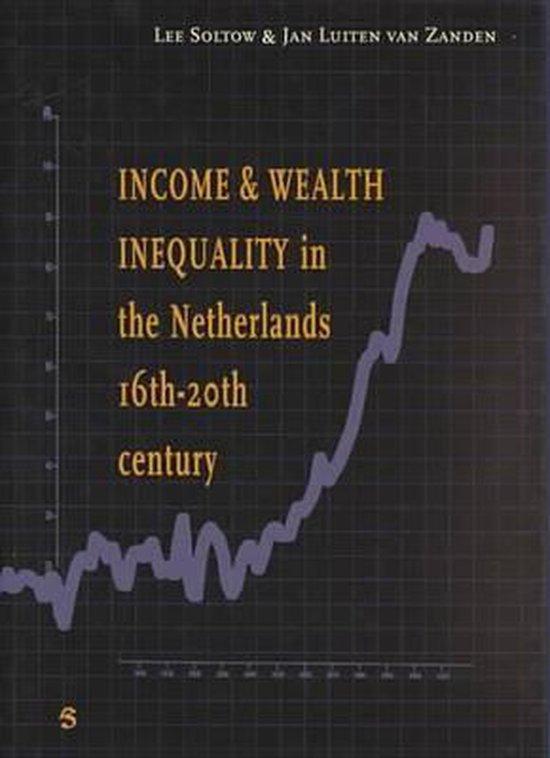
Income and wealth inequality in the Netherlands 16th-20th century
€ 29,50
The ''new inequality'' of the 1980''s and 1990''s has recently given rise to a lively debate about the relationship between economic growth and income distribution. This debate is the background of the study by Lee Soltow an Jan Luiten van Zanden, who, staying close to the sources, have mapped in some detail the long-term development of income and wealth inequality in the Netherlands between c. 1500 and the present.
Their starting point is the hypothesis of Simon Kuznets that income inequality increased during the first phase of modern economic growth, but that in the second phase, which begins in most Western countries around the turn of the twentieth century, a marked levelling out of income differences followed. The development of inequality during the Golden Age, when growth resulted in a marked increase in inequality seems to confirm this idea. However, the analysis of the connection between growth and inequality in the nineteenth and twentieth century leads them to question the Kuznets hypothesis.
Lee Soltow is professor of Economics at Ohio University (Athens).
Among his publications on the subject are: ''Distribution of wealth and income in the United States in 1978'' (1989) and ''Men and wealth in the United States 1850-1870'' (1975).
Jan Luiten van Zanden is professor of Economic and Social History at Utrecht University (the Netherlands).
Among his publications on the subject are: ''The economic history of the Netherlands 1914-1955: a small open economy in the ''long'' twentieth century'' (1998). ''The economic development of the Netherlands since 1870'' (1996) and ''The rise and decline of Holland''s economy: merchant capitalism and the labour market'' (1993).
Income and wealth inequality in the Netherlands 16th-20th century
€ 29,50
The ''new inequality'' of the 1980''s and 1990''s has recently given rise to a lively debate about the relationship between economic growth and income distribution. This debate is the background of the study by Lee Soltow an Jan Luiten van Zanden, who, staying close to the sources, have mapped in some detail the long-term development of income and wealth inequality in the Netherlands between c. 1500 and the present.
Their starting point is the hypothesis of Simon Kuznets that income inequality increased during the first phase of modern economic growth, but that in the second phase, which begins in most Western countries around the turn of the twentieth century, a marked levelling out of income differences followed. The development of inequality during the Golden Age, when growth resulted in a marked increase in inequality seems to confirm this idea. However, the analysis of the connection between growth and inequality in the nineteenth and twentieth century leads them to question the Kuznets hypothesis.
Lee Soltow is professor of Economics at Ohio University (Athens).
Among his publications on the subject are: ''Distribution of wealth and income in the United States in 1978'' (1989) and ''Men and wealth in the United States 1850-1870'' (1975).
Jan Luiten van Zanden is professor of Economic and Social History at Utrecht University (the Netherlands).
Among his publications on the subject are: ''The economic history of the Netherlands 1914-1955: a small open economy in the ''long'' twentieth century'' (1998). ''The economic development of the Netherlands since 1870'' (1996) and ''The rise and decline of Holland''s economy: merchant capitalism and the labour market'' (1993).