
Scénarios pour une nouvelle procédure pénale belge. Etude pratique des problèmes rencontrés (IRCP-reeks, nr. 50)
Sur le livre:
La nécessité de procéder à une réforme globale et à une modernisation de la procédure pénale fait consensus depuis longtemps déjà. Après l’arrêt final des travaux de la Commission Franchimont, le débat a connu un second souffle avec l’accord de gouvernement fédéral de 2011, qui réitérait l’intention de rédiger un Code d’instruction criminelle modernisé. En réponse à la note de politique générale du ministre de la Justice, le service de la Politique criminelle a rédigé fin 2012 un cahier de charges pour une « Étude pratique des points d’achoppement dans l’actuelle procédure pénale belge en vue de la rédaction d’une nouvelle procédure pénale ». Cette étude a été confiée à une équipe de recherche de l’université de Gand à l’été 2013 et finalisée à l’automne 2014. Le présent livre regroupe les résultats de l’étude. Entre-temps, le moment de réaliser une réforme de la procédure pénale – l’accord de gouvernement fédéral du 9 octobre 2014 en a encore souligné l’importance – est plus propice que jamais.
Cet ouvrage ne fait pas que relever les nombreux problèmes qui se posent dans le cadre de la procédure pénale actuelle, tels que les ressentent des acteurs comme les magistrats, les avocats et la police. L’analyse des chercheurs établit clairement qu’une réforme globale de la procédure pénale nécessite en réalité un choix politique fondamental concernant la direction de l’instruction préparatoire et le degré de participation des parties dans cette instruction préparatoire. Dès que ce choix politique sera fait, d’autres choix s’imposeront pour aborder les divers autres problèmes. C’est la raison pour laquelle les chercheurs ont développé dans ce livre quatre scénarios différents qui présentent chacun, en fonction des choix fondamentaux à opérer, une proposition globale cohérente en vue d’une procédure pénale plus efficiente.
Ce livre apporte une contribution objective et neutre au futur débat sur la réforme et constitue une lecture recommandée pour toutes les personnes qui s’intéressent pour des raisons professionnelles ou autres à l’avenir de la procédure pénale belge.
GPRC – guaranteed peer reviewed content
Bon de commande
Sur le contenu:
Contenu
Avant-Propos
Scénarios pour une nouvelle procédure pénale belge. Etude pratique des problèmes rencontrés (IRCP-reeks, nr. 50)
Sur le livre:
La nécessité de procéder à une réforme globale et à une modernisation de la procédure pénale fait consensus depuis longtemps déjà. Après l’arrêt final des travaux de la Commission Franchimont, le débat a connu un second souffle avec l’accord de gouvernement fédéral de 2011, qui réitérait l’intention de rédiger un Code d’instruction criminelle modernisé. En réponse à la note de politique générale du ministre de la Justice, le service de la Politique criminelle a rédigé fin 2012 un cahier de charges pour une « Étude pratique des points d’achoppement dans l’actuelle procédure pénale belge en vue de la rédaction d’une nouvelle procédure pénale ». Cette étude a été confiée à une équipe de recherche de l’université de Gand à l’été 2013 et finalisée à l’automne 2014. Le présent livre regroupe les résultats de l’étude. Entre-temps, le moment de réaliser une réforme de la procédure pénale – l’accord de gouvernement fédéral du 9 octobre 2014 en a encore souligné l’importance – est plus propice que jamais.
Cet ouvrage ne fait pas que relever les nombreux problèmes qui se posent dans le cadre de la procédure pénale actuelle, tels que les ressentent des acteurs comme les magistrats, les avocats et la police. L’analyse des chercheurs établit clairement qu’une réforme globale de la procédure pénale nécessite en réalité un choix politique fondamental concernant la direction de l’instruction préparatoire et le degré de participation des parties dans cette instruction préparatoire. Dès que ce choix politique sera fait, d’autres choix s’imposeront pour aborder les divers autres problèmes. C’est la raison pour laquelle les chercheurs ont développé dans ce livre quatre scénarios différents qui présentent chacun, en fonction des choix fondamentaux à opérer, une proposition globale cohérente en vue d’une procédure pénale plus efficiente.
Ce livre apporte une contribution objective et neutre au futur débat sur la réforme et constitue une lecture recommandée pour toutes les personnes qui s’intéressent pour des raisons professionnelles ou autres à l’avenir de la procédure pénale belge.
GPRC – guaranteed peer reviewed content
Bon de commande
Sur le contenu:
Contenu
Avant-Propos
Scenario’s voor een nieuwe Belgische strafprocedure. Een praktijkgericht knelpuntenonderzoek (IRCP-reeks, nr. 49)
Dit boek brengt niet alleen de talrijke knelpunten binnen de huidige strafprocedure in kaart zoals ze worden ervaren door actoren als magistraten, advocaten en politie. De analyse van de onderzoekers maakt duidelijk dat een globale hervorming van de strafprocedure in essentie een basisbeleidskeuze vergt i.v.m. de leiding van het vooronderzoek respectievelijk de mate van participatie vanwege partijen daarin. Eens die politieke keuze gemaakt, dringen verdere keuzes zich om op de diverse andere knelpunten aan te pakken. De onderzoekers hebben daarom in het boek vier verschillende scenario’s uitgewerkt die elk – afhankelijk van de te maken basiskeuzes – een coherent totaalvoorstel inhouden voor een efficiëntere strafprocedure.
Het boek levert een objectieve en neutrale bijdrage aan het komende hervormingsdebat en vormt aanbevolen lectuur voor eenieder die professioneel of anderszins geïnteresseerd is in de toekomst van de Belgische strafprocedure.
GPRC – guaranteed peer reviewed content
Scenario’s voor een nieuwe Belgische strafprocedure. Een praktijkgericht knelpuntenonderzoek (IRCP-reeks, nr. 49)
Dit boek brengt niet alleen de talrijke knelpunten binnen de huidige strafprocedure in kaart zoals ze worden ervaren door actoren als magistraten, advocaten en politie. De analyse van de onderzoekers maakt duidelijk dat een globale hervorming van de strafprocedure in essentie een basisbeleidskeuze vergt i.v.m. de leiding van het vooronderzoek respectievelijk de mate van participatie vanwege partijen daarin. Eens die politieke keuze gemaakt, dringen verdere keuzes zich om op de diverse andere knelpunten aan te pakken. De onderzoekers hebben daarom in het boek vier verschillende scenario’s uitgewerkt die elk – afhankelijk van de te maken basiskeuzes – een coherent totaalvoorstel inhouden voor een efficiëntere strafprocedure.
Het boek levert een objectieve en neutrale bijdrage aan het komende hervormingsdebat en vormt aanbevolen lectuur voor eenieder die professioneel of anderszins geïnteresseerd is in de toekomst van de Belgische strafprocedure.
GPRC – guaranteed peer reviewed content
EU Justice and Home Affairs: Institutional and policy development
Students and professionals in law, political science and criminology, and every one interested in European criminal policy making may find this book relevant or insightful.
Prof. dr. Gert Vermeulen is full professor of international and European criminal law and department chair criminal law and criminology at Ghent University, director of the Institute for International Research on Criminal Policy (IRCP) and extraordinary professor of evidence at Maastricht University.
Wendy De Bondt holds a master’s degree in law (2006) and criminology (2007) and a PhD in law (2012). She has been a member of the Institute for International Research on Criminal Policy affiliated to the Department of Penal Law and Criminology of Ghent University since 2007.
EU Justice and Home Affairs: Institutional and policy development
Students and professionals in law, political science and criminology, and every one interested in European criminal policy making may find this book relevant or insightful.
Prof. dr. Gert Vermeulen is full professor of international and European criminal law and department chair criminal law and criminology at Ghent University, director of the Institute for International Research on Criminal Policy (IRCP) and extraordinary professor of evidence at Maastricht University.
Wendy De Bondt holds a master’s degree in law (2006) and criminology (2007) and a PhD in law (2012). She has been a member of the Institute for International Research on Criminal Policy affiliated to the Department of Penal Law and Criminology of Ghent University since 2007.
The disqualification triad (IRCP-series, vol. 45)
In answer to a call from the European Commission, the authors have conducted a comparative legal analysis in the EU 27 and looked into the practical experiences with disqualifications from a domestic and a cross-border perspective. To that end, academics, policy makers and practitioners in the member states have been consulted.
Analysis reveals a wide variety in the typology of disqualifications as a sanction measure, persons to whom the disqualifications can be imposed and authorities involved. Furthermore, there are considerable differences with respect to the inclusion of disqualifications in the national criminal records databases. Linked thereto, information on foreign disqualifications is scarce and rarely used in practice.
To ensure a comprehensive and consistent policy approach, the authors have come up with a so-called disqualification triad, comprising (1) unified EU-wide disqualifications, (2) mutual recognition of disqualifications and (3) EU-wide equivalent effect of disqualifications. The functioning of the disqualification triad was further elaborated in three case studies, being public procurement disqualifications, disqualifications from working with children and driving disqualifications.
This book is essential reading for both EU and national policy makers as well as for researchers and practitioners involved.
The disqualification triad (IRCP-series, vol. 45)
In answer to a call from the European Commission, the authors have conducted a comparative legal analysis in the EU 27 and looked into the practical experiences with disqualifications from a domestic and a cross-border perspective. To that end, academics, policy makers and practitioners in the member states have been consulted.
Analysis reveals a wide variety in the typology of disqualifications as a sanction measure, persons to whom the disqualifications can be imposed and authorities involved. Furthermore, there are considerable differences with respect to the inclusion of disqualifications in the national criminal records databases. Linked thereto, information on foreign disqualifications is scarce and rarely used in practice.
To ensure a comprehensive and consistent policy approach, the authors have come up with a so-called disqualification triad, comprising (1) unified EU-wide disqualifications, (2) mutual recognition of disqualifications and (3) EU-wide equivalent effect of disqualifications. The functioning of the disqualification triad was further elaborated in three case studies, being public procurement disqualifications, disqualifications from working with children and driving disqualifications.
This book is essential reading for both EU and national policy makers as well as for researchers and practitioners involved.
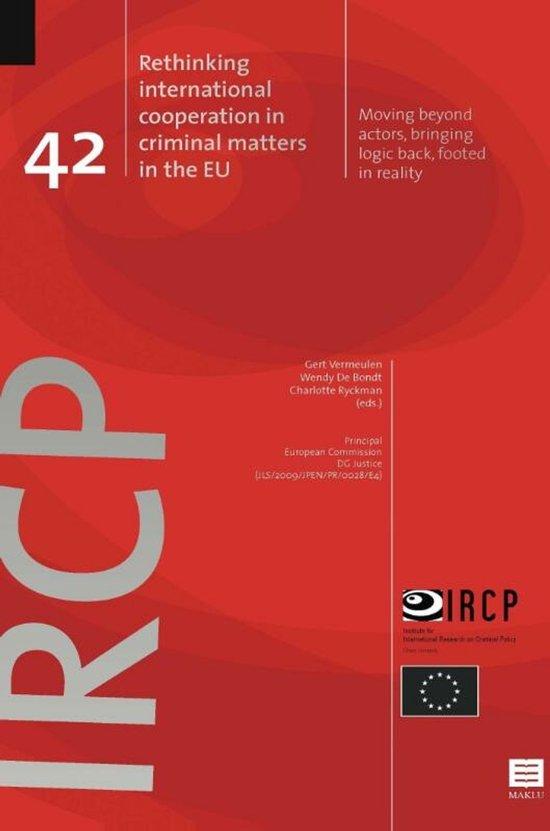
Rethinking international cooperation in criminal matters in the EU (IRCP-series, vol. 42)
In answer to a call from the European Commission, the authors have designed a comprehensive methodological framework to review the entirety of international cooperation in criminal matters, combining desktop reviews, expert consultations, member state questionnaires and focus group meetings in each of the member states to obtain a comprehensive overview of the currently experienced obstacles and future policy options that are both needed and feasible. Over 150 individuals contributed to the study, with different background, including academics, lawyers, policy makers, police, customs, intelligence services, prosecution, judiciary, correctional authorities, Ministries of Justice and Home Affairs.
This book provides an overview of the research findings and the recommendations formulated. They include but are not limited to
Essential reading for both EU policy makers and for all practitioners involved, this book represents the first overall analysis of the entirety of international cooperation in criminal matters in the EU. An analysis aiming at moving beyond actors, bringing logic back, footed in reality.
Rethinking international cooperation in criminal matters in the EU (IRCP-series, vol. 42)
In answer to a call from the European Commission, the authors have designed a comprehensive methodological framework to review the entirety of international cooperation in criminal matters, combining desktop reviews, expert consultations, member state questionnaires and focus group meetings in each of the member states to obtain a comprehensive overview of the currently experienced obstacles and future policy options that are both needed and feasible. Over 150 individuals contributed to the study, with different background, including academics, lawyers, policy makers, police, customs, intelligence services, prosecution, judiciary, correctional authorities, Ministries of Justice and Home Affairs.
This book provides an overview of the research findings and the recommendations formulated. They include but are not limited to
Essential reading for both EU policy makers and for all practitioners involved, this book represents the first overall analysis of the entirety of international cooperation in criminal matters in the EU. An analysis aiming at moving beyond actors, bringing logic back, footed in reality.
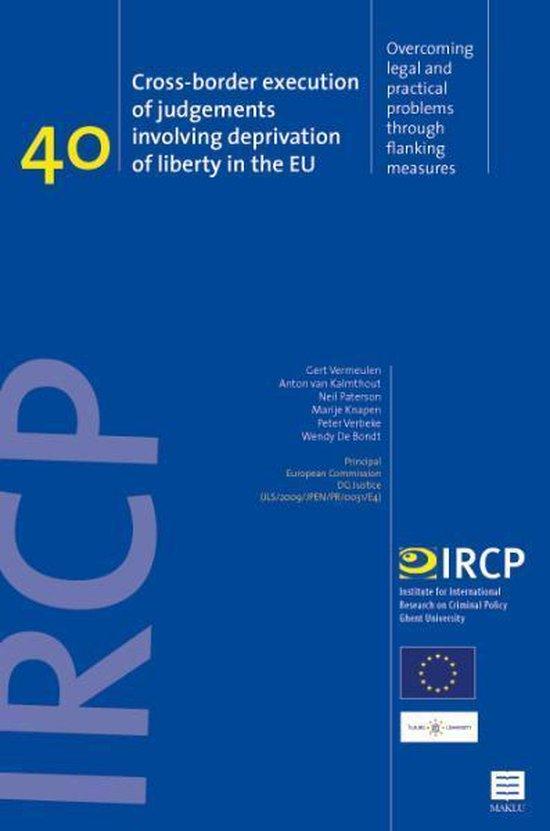
Cross-border execution of judgements involving deprivation of liberty in the EU (IRCP – series, 40)
Transferring detained people back to their respective Member State of residence and/or nationality within the mutual recognition framework is somewhat precarious in light of the often substantial variety of Member States’ legal and prison systems. In this context, and following a call for tender by the European Commission, the authors conducted the biggest study to date on Member States’ material detention conditions, early/conditional release provisions and sentence execution modalities. In addition to exploring the diversity of legal frameworks, the study also assessed practitioners’ views on cross-border execution of custodial sentences in the EU.
This book contains both the EU level legal and practitioners’ analyses as well as the high level final report to the study, confirming preliminary concerns that flanking measures are urgently needed for a proper operation of the Framework Decision.
This is essential reading for EU policy makers, judicial and law enforcement authorities and for defence lawyers throughout the Union. Undoubtedly, this book will be an asset to everyone who is involved in or taking an interest in detention issues and cross-border execution of judgements involving deprivation of liberty in the EU.
Cross-border execution of judgements involving deprivation of liberty in the EU (IRCP – series, 40)
Transferring detained people back to their respective Member State of residence and/or nationality within the mutual recognition framework is somewhat precarious in light of the often substantial variety of Member States’ legal and prison systems. In this context, and following a call for tender by the European Commission, the authors conducted the biggest study to date on Member States’ material detention conditions, early/conditional release provisions and sentence execution modalities. In addition to exploring the diversity of legal frameworks, the study also assessed practitioners’ views on cross-border execution of custodial sentences in the EU.
This book contains both the EU level legal and practitioners’ analyses as well as the high level final report to the study, confirming preliminary concerns that flanking measures are urgently needed for a proper operation of the Framework Decision.
This is essential reading for EU policy makers, judicial and law enforcement authorities and for defence lawyers throughout the Union. Undoubtedly, this book will be an asset to everyone who is involved in or taking an interest in detention issues and cross-border execution of judgements involving deprivation of liberty in the EU.

Developing an EU level offence classification system. EU study to implement the Action Plan to measure crime and criminal justice (IRCP series, 34)
In March 2007, the European Commission, DG JLS, launched a call for tender for a “Study on the development of an EU level offence classification system and an assessment of its feasibility to supporting the implementation of the Action Plan to develop an EU strategy to measure crime and criminal justice” – The Crime Statistics Project (CSP). This book contains the fi nal report of that Project, conducted by Unisys Belgium and IRCP in the course of 2008-2009.
In the context of the project, EULOCS – the EU level offence classification system – was created. Its aim is not to become yet another compelling system that requires Member States to further harmonise domestic criminal law or to adjust national data models, but to be a reference index that could serve the different needs in the wider area of justice and home affairs. According to its authors, the area of justice and home affairs could benefi t from using EULOCS as a bench-mark, increasing the internal coherence of EU’s criminal policy.
This book is essential reading for EU policy makers, judicial and law enforcement authorities throughout the Union and from a broader international context. Undoubtedly, this book will be an asset to everyone who is involved in or taking an interest in the production of meaningful and comparable data on crime and criminal justice in Europe.
Developing an EU level offence classification system. EU study to implement the Action Plan to measure crime and criminal justice (IRCP series, 34)
In March 2007, the European Commission, DG JLS, launched a call for tender for a “Study on the development of an EU level offence classification system and an assessment of its feasibility to supporting the implementation of the Action Plan to develop an EU strategy to measure crime and criminal justice” – The Crime Statistics Project (CSP). This book contains the fi nal report of that Project, conducted by Unisys Belgium and IRCP in the course of 2008-2009.
In the context of the project, EULOCS – the EU level offence classification system – was created. Its aim is not to become yet another compelling system that requires Member States to further harmonise domestic criminal law or to adjust national data models, but to be a reference index that could serve the different needs in the wider area of justice and home affairs. According to its authors, the area of justice and home affairs could benefi t from using EULOCS as a bench-mark, increasing the internal coherence of EU’s criminal policy.
This book is essential reading for EU policy makers, judicial and law enforcement authorities throughout the Union and from a broader international context. Undoubtedly, this book will be an asset to everyone who is involved in or taking an interest in the production of meaningful and comparable data on crime and criminal justice in Europe.