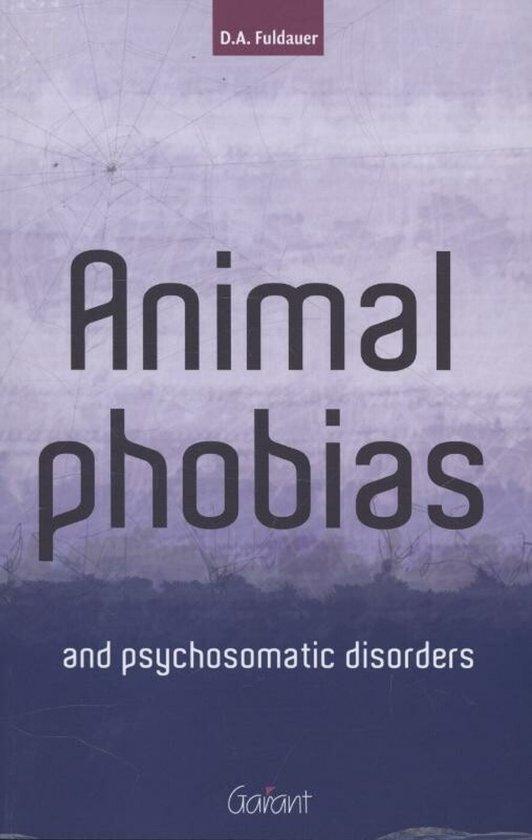
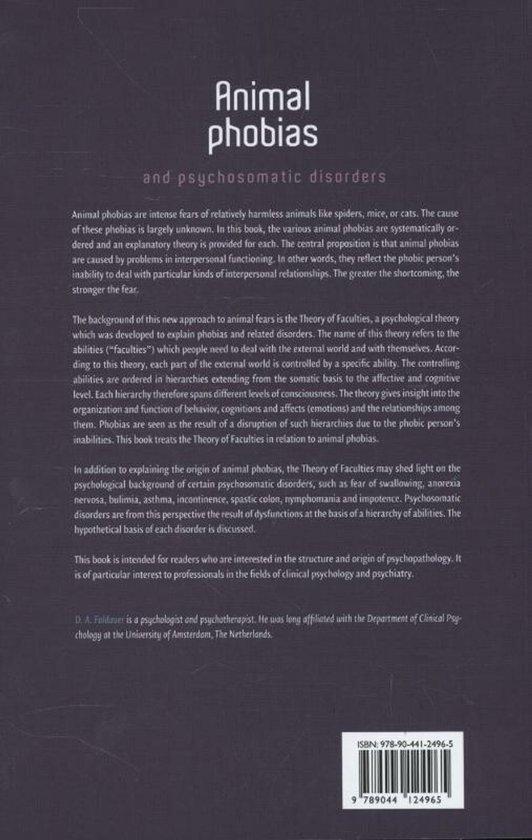
Animal phobias and psychosomatic disorders
€ 38,50
Animal phobias are intense fears of relatively harmless animals like spiders, mice, or cats. The cause
of these phobias is largely unknown. In this book, the various animal phobias are systematically ordered
and an explanatory theory is provided for each. The central proposition is that animal phobias
are caused by problems in interpersonal functioning. In other words, they reflect the phobic person’s
inability to deal with particular kinds of interpersonal relationships. The greater the shortcoming, the
stronger the fear.
The background of this new approach to animal fears is the Theory of Faculties, a psychological theory which was developed to explain phobias and related disorders. The name of this theory refers to the abilities (“faculties”) which people need to deal with the external world and with themselves. According to this theory, each part of the external world is controlled by a specific ability. The controlling abilities are ordered in hierarchies extending from the somatic basis to the affective and cognitive level. Each hierarchy therefore spans different levels of consciousness. The theory gives insight into the organization and function of behavior, cognitions and affects (emotions) and the relationships among them. Phobias are seen as the result of a disruption of such hierarchies due to the phobic person’s inabilities. This book treats the Theory of Faculties in relation to animal phobias.
In addition to explaining the origin of animal phobias, the Theory of Faculties may shed light on the psychological background of certain psychosomatic disorders, such as fear of swallowing, anorexia nervosa, bulimia, asthma, incontinence, spastic colon, nymphomania and impotence. Psychosomatic disorders are from this perspective the result of dysfunctions at the basis of a hierarchy of abilities. The hypothetical basis of each disorder is discussed.
This book is intended for readers who are interested in the structure and origin of psychopathology. It is of particular interest to professionals in the fields of clinical psychology and psychiatry.
D. A. Fuldauer is a psychologist and psychotherapist. He was long affiliated with the Department of Clinical Psychology at the University of Amsterdam, The Netherlands.
The background of this new approach to animal fears is the Theory of Faculties, a psychological theory which was developed to explain phobias and related disorders. The name of this theory refers to the abilities (“faculties”) which people need to deal with the external world and with themselves. According to this theory, each part of the external world is controlled by a specific ability. The controlling abilities are ordered in hierarchies extending from the somatic basis to the affective and cognitive level. Each hierarchy therefore spans different levels of consciousness. The theory gives insight into the organization and function of behavior, cognitions and affects (emotions) and the relationships among them. Phobias are seen as the result of a disruption of such hierarchies due to the phobic person’s inabilities. This book treats the Theory of Faculties in relation to animal phobias.
In addition to explaining the origin of animal phobias, the Theory of Faculties may shed light on the psychological background of certain psychosomatic disorders, such as fear of swallowing, anorexia nervosa, bulimia, asthma, incontinence, spastic colon, nymphomania and impotence. Psychosomatic disorders are from this perspective the result of dysfunctions at the basis of a hierarchy of abilities. The hypothetical basis of each disorder is discussed.
This book is intended for readers who are interested in the structure and origin of psychopathology. It is of particular interest to professionals in the fields of clinical psychology and psychiatry.
D. A. Fuldauer is a psychologist and psychotherapist. He was long affiliated with the Department of Clinical Psychology at the University of Amsterdam, The Netherlands.
Animal phobias and psychosomatic disorders
€ 38,50
Animal phobias are intense fears of relatively harmless animals like spiders, mice, or cats. The cause
of these phobias is largely unknown. In this book, the various animal phobias are systematically ordered
and an explanatory theory is provided for each. The central proposition is that animal phobias
are caused by problems in interpersonal functioning. In other words, they reflect the phobic person’s
inability to deal with particular kinds of interpersonal relationships. The greater the shortcoming, the
stronger the fear.
The background of this new approach to animal fears is the Theory of Faculties, a psychological theory which was developed to explain phobias and related disorders. The name of this theory refers to the abilities (“faculties”) which people need to deal with the external world and with themselves. According to this theory, each part of the external world is controlled by a specific ability. The controlling abilities are ordered in hierarchies extending from the somatic basis to the affective and cognitive level. Each hierarchy therefore spans different levels of consciousness. The theory gives insight into the organization and function of behavior, cognitions and affects (emotions) and the relationships among them. Phobias are seen as the result of a disruption of such hierarchies due to the phobic person’s inabilities. This book treats the Theory of Faculties in relation to animal phobias.
In addition to explaining the origin of animal phobias, the Theory of Faculties may shed light on the psychological background of certain psychosomatic disorders, such as fear of swallowing, anorexia nervosa, bulimia, asthma, incontinence, spastic colon, nymphomania and impotence. Psychosomatic disorders are from this perspective the result of dysfunctions at the basis of a hierarchy of abilities. The hypothetical basis of each disorder is discussed.
This book is intended for readers who are interested in the structure and origin of psychopathology. It is of particular interest to professionals in the fields of clinical psychology and psychiatry.
D. A. Fuldauer is a psychologist and psychotherapist. He was long affiliated with the Department of Clinical Psychology at the University of Amsterdam, The Netherlands.
The background of this new approach to animal fears is the Theory of Faculties, a psychological theory which was developed to explain phobias and related disorders. The name of this theory refers to the abilities (“faculties”) which people need to deal with the external world and with themselves. According to this theory, each part of the external world is controlled by a specific ability. The controlling abilities are ordered in hierarchies extending from the somatic basis to the affective and cognitive level. Each hierarchy therefore spans different levels of consciousness. The theory gives insight into the organization and function of behavior, cognitions and affects (emotions) and the relationships among them. Phobias are seen as the result of a disruption of such hierarchies due to the phobic person’s inabilities. This book treats the Theory of Faculties in relation to animal phobias.
In addition to explaining the origin of animal phobias, the Theory of Faculties may shed light on the psychological background of certain psychosomatic disorders, such as fear of swallowing, anorexia nervosa, bulimia, asthma, incontinence, spastic colon, nymphomania and impotence. Psychosomatic disorders are from this perspective the result of dysfunctions at the basis of a hierarchy of abilities. The hypothetical basis of each disorder is discussed.
This book is intended for readers who are interested in the structure and origin of psychopathology. It is of particular interest to professionals in the fields of clinical psychology and psychiatry.
D. A. Fuldauer is a psychologist and psychotherapist. He was long affiliated with the Department of Clinical Psychology at the University of Amsterdam, The Netherlands.