
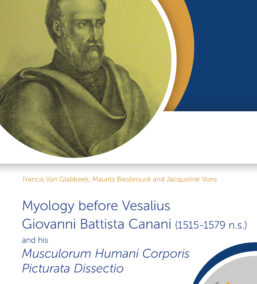
Myology before Vesalius – Giovanni Battista Canani (1515 – 1579 n.s.) and his Musculorum Humani Corporis Picturata Dissectio
€ 39,00
Giambattista Canani (1515-1579 n.s.) from Ferrara was a remarkable and leading physician-anatomist in the sixteenth century, but he is far less well known today than his contemporaries such as Vesalius, Fallopio or Colombo. His only work on the muscular anatomy of the upper limb Musculorum humani corporis picturata dissectio can in fact be considered as a masterpiece of its time, no less innovative than Vesalius’ Fabrica. The Picturata dissectio is revolutionary in its content and contains copper etchings of exceptional quality and precision. This is the result of Canani’s extensive dissections of human corpses, performed meticulously and with a determination to
discover the tiniest details of the human anatomy.
Only a few original copies of this very rare work are nowin existence, and it can only be seen in a small number of the most prestigious libraries: in Europe mostly in Italy (Bologna, Ferrara, Padua, Pavia, Milan) but also in Dresden, Glasgow, Krakow, London, Oxford, Uppsala and Vienna. The only two original copies in the United States are in the Yale University Library and the Rubenstein Library of Duke University, the latter here published in facsimile.
The study of this beautiful and historically significant work is strongly recommended.
Pre-order this book now for 39 euro + shipping

Francis van Glabbeek is Professor at the Faculty of Medicine and Health Sciences at the University of Antwerp. He is an orthopaedic surgeon and Assistant Head of the Orthopaedics and Trauma Department of Antwerp University Hospital, specialising in the upper limb. Within the faculty of medicine, he is responsible for musculoskeletal anatomy and the history of medicine.
Maurits Biesbrouck published a Dutch translation of the first volume of the 1543 Fabrica by Vesalius, as well as a Vesalius bibliography and a summary and discussion of the editions of his works, both of which are updated every year at www.andreasvesalius.be.
Jacqueline Vons Professor Emeritus of classical languages at Université François Rabelais in Tours and a member of the Académie des sciences, belles-lettres et arts de Touraine. Together with Prof. Stephane Velut, Professor of anatomy at the same university, she published the first French translation of Vesalius’s Epitome and is currently working for the Interuniversity Library of Medicine (BIUM) in Paris on the French translation of Vesalius’s 1543 Fabrica.
Only a few original copies of this very rare work are nowin existence, and it can only be seen in a small number of the most prestigious libraries: in Europe mostly in Italy (Bologna, Ferrara, Padua, Pavia, Milan) but also in Dresden, Glasgow, Krakow, London, Oxford, Uppsala and Vienna. The only two original copies in the United States are in the Yale University Library and the Rubenstein Library of Duke University, the latter here published in facsimile.
The study of this beautiful and historically significant work is strongly recommended.
Pre-order this book now for 39 euro + shipping
| Delivery Location |
| Belgium / The Netherlands €44,00 EUR EU (outside Belgium /Netherlands) €49,00 EUR World (outside EU) €58,00 EUR |
Francis van Glabbeek is Professor at the Faculty of Medicine and Health Sciences at the University of Antwerp. He is an orthopaedic surgeon and Assistant Head of the Orthopaedics and Trauma Department of Antwerp University Hospital, specialising in the upper limb. Within the faculty of medicine, he is responsible for musculoskeletal anatomy and the history of medicine.
Maurits Biesbrouck published a Dutch translation of the first volume of the 1543 Fabrica by Vesalius, as well as a Vesalius bibliography and a summary and discussion of the editions of his works, both of which are updated every year at www.andreasvesalius.be.
Jacqueline Vons Professor Emeritus of classical languages at Université François Rabelais in Tours and a member of the Académie des sciences, belles-lettres et arts de Touraine. Together with Prof. Stephane Velut, Professor of anatomy at the same university, she published the first French translation of Vesalius’s Epitome and is currently working for the Interuniversity Library of Medicine (BIUM) in Paris on the French translation of Vesalius’s 1543 Fabrica.
Myology before Vesalius – Giovanni Battista Canani (1515 – 1579 n.s.) and his Musculorum Humani Corporis Picturata Dissectio
€ 39,00
Giambattista Canani (1515-1579 n.s.) from Ferrara was a remarkable and leading physician-anatomist in the sixteenth century, but he is far less well known today than his contemporaries such as Vesalius, Fallopio or Colombo. His only work on the muscular anatomy of the upper limb Musculorum humani corporis picturata dissectio can in fact be considered as a masterpiece of its time, no less innovative than Vesalius’ Fabrica. The Picturata dissectio is revolutionary in its content and contains copper etchings of exceptional quality and precision. This is the result of Canani’s extensive dissections of human corpses, performed meticulously and with a determination to
discover the tiniest details of the human anatomy.
Only a few original copies of this very rare work are nowin existence, and it can only be seen in a small number of the most prestigious libraries: in Europe mostly in Italy (Bologna, Ferrara, Padua, Pavia, Milan) but also in Dresden, Glasgow, Krakow, London, Oxford, Uppsala and Vienna. The only two original copies in the United States are in the Yale University Library and the Rubenstein Library of Duke University, the latter here published in facsimile.
The study of this beautiful and historically significant work is strongly recommended.
Pre-order this book now for 39 euro + shipping
Francis van Glabbeek is Professor at the Faculty of Medicine and Health Sciences at the University of Antwerp. He is an orthopaedic surgeon and Assistant Head of the Orthopaedics and Trauma Department of Antwerp University Hospital, specialising in the upper limb. Within the faculty of medicine, he is responsible for musculoskeletal anatomy and the history of medicine.
Maurits Biesbrouck published a Dutch translation of the first volume of the 1543 Fabrica by Vesalius, as well as a Vesalius bibliography and a summary and discussion of the editions of his works, both of which are updated every year at www.andreasvesalius.be.
Jacqueline Vons Professor Emeritus of classical languages at Université François Rabelais in Tours and a member of the Académie des sciences, belles-lettres et arts de Touraine. Together with Prof. Stephane Velut, Professor of anatomy at the same university, she published the first French translation of Vesalius’s Epitome and is currently working for the Interuniversity Library of Medicine (BIUM) in Paris on the French translation of Vesalius’s 1543 Fabrica.
Only a few original copies of this very rare work are nowin existence, and it can only be seen in a small number of the most prestigious libraries: in Europe mostly in Italy (Bologna, Ferrara, Padua, Pavia, Milan) but also in Dresden, Glasgow, Krakow, London, Oxford, Uppsala and Vienna. The only two original copies in the United States are in the Yale University Library and the Rubenstein Library of Duke University, the latter here published in facsimile.
The study of this beautiful and historically significant work is strongly recommended.
Pre-order this book now for 39 euro + shipping
| Delivery Location |
| Belgium / The Netherlands €44,00 EUR EU (outside Belgium /Netherlands) €49,00 EUR World (outside EU) €58,00 EUR |
Francis van Glabbeek is Professor at the Faculty of Medicine and Health Sciences at the University of Antwerp. He is an orthopaedic surgeon and Assistant Head of the Orthopaedics and Trauma Department of Antwerp University Hospital, specialising in the upper limb. Within the faculty of medicine, he is responsible for musculoskeletal anatomy and the history of medicine.
Maurits Biesbrouck published a Dutch translation of the first volume of the 1543 Fabrica by Vesalius, as well as a Vesalius bibliography and a summary and discussion of the editions of his works, both of which are updated every year at www.andreasvesalius.be.
Jacqueline Vons Professor Emeritus of classical languages at Université François Rabelais in Tours and a member of the Académie des sciences, belles-lettres et arts de Touraine. Together with Prof. Stephane Velut, Professor of anatomy at the same university, she published the first French translation of Vesalius’s Epitome and is currently working for the Interuniversity Library of Medicine (BIUM) in Paris on the French translation of Vesalius’s 1543 Fabrica.

Een onstuitbaar verlangen. De werking van de ziel in onze relaties.
€ 24,90
Waarom gaan we voortdurend relaties aan? Waar komt toch dat onstuitbare verlangen vandaan om ons steeds weer met een ander te willen verbinden?
Dit boek laat zijn licht schijnen op de bron van dit verlangen, en op de invloed van de ziel op onze relaties. We ontvangen in onze alledaagse situaties voortdurend aanwijzingen van de ziel om naar de grote Eenheid toe te groeien. Het mannelijke en vrouwelijke vormen samen deze Eenheid, maar we voelen deze Eenheid in onze relaties vaak niet. We worstelen heel wat af, omdat ons ego de overhand heeft op ons innerlijk verlangen. Daardoor slaan we de plank nogal eens mis.Wanneer we hiernaar kijken door de ogen van de ziel groeien onze inzichten en groeit ook onze liefde voor de ander.
Joan Slagers is psychosociaal therapeute, evolutiecoach en mindfullnesstrainster. Ze heeft een praktijk voor relatieconsulten en coachingsgesprekken, en geeft al vele jaren lezingen, workshops en cursussen over bewustwording en zingeving, de mechanismen van de ziel, relaties en het mannelijke en vrouwelijke.
Dit boek laat zijn licht schijnen op de bron van dit verlangen, en op de invloed van de ziel op onze relaties. We ontvangen in onze alledaagse situaties voortdurend aanwijzingen van de ziel om naar de grote Eenheid toe te groeien. Het mannelijke en vrouwelijke vormen samen deze Eenheid, maar we voelen deze Eenheid in onze relaties vaak niet. We worstelen heel wat af, omdat ons ego de overhand heeft op ons innerlijk verlangen. Daardoor slaan we de plank nogal eens mis.Wanneer we hiernaar kijken door de ogen van de ziel groeien onze inzichten en groeit ook onze liefde voor de ander.
Joan Slagers is psychosociaal therapeute, evolutiecoach en mindfullnesstrainster. Ze heeft een praktijk voor relatieconsulten en coachingsgesprekken, en geeft al vele jaren lezingen, workshops en cursussen over bewustwording en zingeving, de mechanismen van de ziel, relaties en het mannelijke en vrouwelijke.
Een onstuitbaar verlangen. De werking van de ziel in onze relaties.
€ 24,90
Waarom gaan we voortdurend relaties aan? Waar komt toch dat onstuitbare verlangen vandaan om ons steeds weer met een ander te willen verbinden?
Dit boek laat zijn licht schijnen op de bron van dit verlangen, en op de invloed van de ziel op onze relaties. We ontvangen in onze alledaagse situaties voortdurend aanwijzingen van de ziel om naar de grote Eenheid toe te groeien. Het mannelijke en vrouwelijke vormen samen deze Eenheid, maar we voelen deze Eenheid in onze relaties vaak niet. We worstelen heel wat af, omdat ons ego de overhand heeft op ons innerlijk verlangen. Daardoor slaan we de plank nogal eens mis.Wanneer we hiernaar kijken door de ogen van de ziel groeien onze inzichten en groeit ook onze liefde voor de ander.
Joan Slagers is psychosociaal therapeute, evolutiecoach en mindfullnesstrainster. Ze heeft een praktijk voor relatieconsulten en coachingsgesprekken, en geeft al vele jaren lezingen, workshops en cursussen over bewustwording en zingeving, de mechanismen van de ziel, relaties en het mannelijke en vrouwelijke.
Dit boek laat zijn licht schijnen op de bron van dit verlangen, en op de invloed van de ziel op onze relaties. We ontvangen in onze alledaagse situaties voortdurend aanwijzingen van de ziel om naar de grote Eenheid toe te groeien. Het mannelijke en vrouwelijke vormen samen deze Eenheid, maar we voelen deze Eenheid in onze relaties vaak niet. We worstelen heel wat af, omdat ons ego de overhand heeft op ons innerlijk verlangen. Daardoor slaan we de plank nogal eens mis.Wanneer we hiernaar kijken door de ogen van de ziel groeien onze inzichten en groeit ook onze liefde voor de ander.
Joan Slagers is psychosociaal therapeute, evolutiecoach en mindfullnesstrainster. Ze heeft een praktijk voor relatieconsulten en coachingsgesprekken, en geeft al vele jaren lezingen, workshops en cursussen over bewustwording en zingeving, de mechanismen van de ziel, relaties en het mannelijke en vrouwelijke.

Naar eigen beeld en gelijkenis. Ras, religie, volk in nazi-Duitsland en het inquisitoriale Spanje.
€ 22,00
In een wereld van groeiende mobiliteit en diversiteit staat de sociale cohesie onder druk. Dit boek schetst een indringend beeld van de excessen waartoe het streven naar een homogene natiestaat kan leiden. In Europese context en ook op wereldvlak staan het nazisme en de Spaanse Inquisitie symbool voor een beleid waarbij ras en religie de absolute leidraad zijn geweest van het proces van natievorming.
De confrontatie tussen beide gevalstudies – met de historische ijkpunten 1492 en 1942 als elkaars spiegelbeeld – onthult de specifieke kenmerken van een discours, mens- en maatschappijbeeld waarin geen plaats is voor etnische, culturele of ideologische diversiteit.
Ras, religie, volk zijn de sleutelbegrippen van de analyse. Wat gebeurt er wanneer een volk, zoals Narcissus, verliefd is op zijn eigenbeeld? Wat gebeurt er wanneer het beleid erop gericht is de hele natie te kneden naar het beeld en gelijkenis van het eigen volk?
De mechanismen die het boek analyseert, zijn tijdloos en herkenbaar in hedendaagse situaties van politiek geweld.
Christiane Stallaert is hispaniste en antropologe. Zij is hoogleraar Spaanse en Latijns-Amerikaanse Studies en Interculturele Communicatie aan de Universiteit Antwerpen. Haar onderzoek is gericht op processen van etniciteit, nationalisme en interculturaliteit. Een eerdere versie van dit boek verscheen in het Spaans met als titel Ni una gota de sangre impura. La España inquisitorial y la Alemania nazi cara a cara (2006).
Ras, religie, volk zijn de sleutelbegrippen van de analyse. Wat gebeurt er wanneer een volk, zoals Narcissus, verliefd is op zijn eigenbeeld? Wat gebeurt er wanneer het beleid erop gericht is de hele natie te kneden naar het beeld en gelijkenis van het eigen volk?
De mechanismen die het boek analyseert, zijn tijdloos en herkenbaar in hedendaagse situaties van politiek geweld.
Christiane Stallaert is hispaniste en antropologe. Zij is hoogleraar Spaanse en Latijns-Amerikaanse Studies en Interculturele Communicatie aan de Universiteit Antwerpen. Haar onderzoek is gericht op processen van etniciteit, nationalisme en interculturaliteit. Een eerdere versie van dit boek verscheen in het Spaans met als titel Ni una gota de sangre impura. La España inquisitorial y la Alemania nazi cara a cara (2006).
Naar eigen beeld en gelijkenis. Ras, religie, volk in nazi-Duitsland en het inquisitoriale Spanje.
€ 22,00
In een wereld van groeiende mobiliteit en diversiteit staat de sociale cohesie onder druk. Dit boek schetst een indringend beeld van de excessen waartoe het streven naar een homogene natiestaat kan leiden. In Europese context en ook op wereldvlak staan het nazisme en de Spaanse Inquisitie symbool voor een beleid waarbij ras en religie de absolute leidraad zijn geweest van het proces van natievorming.
De confrontatie tussen beide gevalstudies – met de historische ijkpunten 1492 en 1942 als elkaars spiegelbeeld – onthult de specifieke kenmerken van een discours, mens- en maatschappijbeeld waarin geen plaats is voor etnische, culturele of ideologische diversiteit.
Ras, religie, volk zijn de sleutelbegrippen van de analyse. Wat gebeurt er wanneer een volk, zoals Narcissus, verliefd is op zijn eigenbeeld? Wat gebeurt er wanneer het beleid erop gericht is de hele natie te kneden naar het beeld en gelijkenis van het eigen volk?
De mechanismen die het boek analyseert, zijn tijdloos en herkenbaar in hedendaagse situaties van politiek geweld.
Christiane Stallaert is hispaniste en antropologe. Zij is hoogleraar Spaanse en Latijns-Amerikaanse Studies en Interculturele Communicatie aan de Universiteit Antwerpen. Haar onderzoek is gericht op processen van etniciteit, nationalisme en interculturaliteit. Een eerdere versie van dit boek verscheen in het Spaans met als titel Ni una gota de sangre impura. La España inquisitorial y la Alemania nazi cara a cara (2006).
Ras, religie, volk zijn de sleutelbegrippen van de analyse. Wat gebeurt er wanneer een volk, zoals Narcissus, verliefd is op zijn eigenbeeld? Wat gebeurt er wanneer het beleid erop gericht is de hele natie te kneden naar het beeld en gelijkenis van het eigen volk?
De mechanismen die het boek analyseert, zijn tijdloos en herkenbaar in hedendaagse situaties van politiek geweld.
Christiane Stallaert is hispaniste en antropologe. Zij is hoogleraar Spaanse en Latijns-Amerikaanse Studies en Interculturele Communicatie aan de Universiteit Antwerpen. Haar onderzoek is gericht op processen van etniciteit, nationalisme en interculturaliteit. Een eerdere versie van dit boek verscheen in het Spaans met als titel Ni una gota de sangre impura. La España inquisitorial y la Alemania nazi cara a cara (2006).