

Alternativas al sistema de justicia criminal latinoamericano – RIDP libri 4
€ 39,00
On 5 and 6 August 2019 the Argentinian and Brazilian Groups of the AIDP organized the Vth Symposium of Young Penalists, 20 years after establishing a Young Penalist section within the AIDP, in 1999 in Budapest. The Symposium, held at Buenos Aires University under the title “Alternatives to the Latin American Criminal Justice System”, focused on the topics society, economy and science.
This book collects the selected papers, reflecting perspectives from Brazil, Uruguay, Peru, Mexico, Argentina and Spain.
This book collects the selected papers, reflecting perspectives from Brazil, Uruguay, Peru, Mexico, Argentina and Spain.
Alternativas al sistema de justicia criminal latinoamericano – RIDP libri 4
€ 39,00
On 5 and 6 August 2019 the Argentinian and Brazilian Groups of the AIDP organized the Vth Symposium of Young Penalists, 20 years after establishing a Young Penalist section within the AIDP, in 1999 in Budapest. The Symposium, held at Buenos Aires University under the title “Alternatives to the Latin American Criminal Justice System”, focused on the topics society, economy and science.
This book collects the selected papers, reflecting perspectives from Brazil, Uruguay, Peru, Mexico, Argentina and Spain.
This book collects the selected papers, reflecting perspectives from Brazil, Uruguay, Peru, Mexico, Argentina and Spain.

Free Gathering and movement of evidence in criminal matters in the EU. Thinking beyond borders, striving for balance, in search of coherence
€ 17,00
The landscape of cross-border evidence gathering in criminal matters in the EU has become blurred. Non-traditional actors, such as administrative authorities and intelligence services, have joined traditional judicial and law enforcement authorities in a domain which used to be looked upon as predominantly judicial cooperation territory. Criminal justice and administrative finalities run the risk of being constantly mixed up. This creates problems in light of the separation of powers, adequate legal and procedural protection in criminal matters and data protection.
Gert Vermeulen believes that restoring the balance requires stepping away from traditional authority-based thinking and policy-making. He suggests to embrace ‘criminal justice finality’ as the key normative marker for EU cross-border intelligence, information and evidence gathering and exchange in criminal matters. The traditional distinction between judicial and police cooperation in criminal matters can no longer be upheld, he concludes. He argues that the distinction is largely artificial, creates confusion and produces inconsistencies, thus hindering the establishment and further development of a coherent EU criminal law policy.
Vermeulen also challenges the envisaged roll-out of the mutual recognition principle in the context of cross-border evidence gathering. He is in particular concerned that it would prompt an inacceptable burden upon criminal justice systems either financially or in terms of operational capacity. In order to systemically prevent admissibility problems of cross-border evidence in courts throughout the EU, he finally pleas for a free movement regime for evidence, based on common minimum procedural standards according to which it must have been gathered.
Prof. dr. Gert Vermeulen is professor of international and European criminal law at Ghent University, director of the Institute for International Research on Criminal Policy (IRCP) and extraordinary professor of evidence law at Maastricht University.
Gert Vermeulen believes that restoring the balance requires stepping away from traditional authority-based thinking and policy-making. He suggests to embrace ‘criminal justice finality’ as the key normative marker for EU cross-border intelligence, information and evidence gathering and exchange in criminal matters. The traditional distinction between judicial and police cooperation in criminal matters can no longer be upheld, he concludes. He argues that the distinction is largely artificial, creates confusion and produces inconsistencies, thus hindering the establishment and further development of a coherent EU criminal law policy.
Vermeulen also challenges the envisaged roll-out of the mutual recognition principle in the context of cross-border evidence gathering. He is in particular concerned that it would prompt an inacceptable burden upon criminal justice systems either financially or in terms of operational capacity. In order to systemically prevent admissibility problems of cross-border evidence in courts throughout the EU, he finally pleas for a free movement regime for evidence, based on common minimum procedural standards according to which it must have been gathered.
Prof. dr. Gert Vermeulen is professor of international and European criminal law at Ghent University, director of the Institute for International Research on Criminal Policy (IRCP) and extraordinary professor of evidence law at Maastricht University.
Free Gathering and movement of evidence in criminal matters in the EU. Thinking beyond borders, striving for balance, in search of coherence
€ 17,00
The landscape of cross-border evidence gathering in criminal matters in the EU has become blurred. Non-traditional actors, such as administrative authorities and intelligence services, have joined traditional judicial and law enforcement authorities in a domain which used to be looked upon as predominantly judicial cooperation territory. Criminal justice and administrative finalities run the risk of being constantly mixed up. This creates problems in light of the separation of powers, adequate legal and procedural protection in criminal matters and data protection.
Gert Vermeulen believes that restoring the balance requires stepping away from traditional authority-based thinking and policy-making. He suggests to embrace ‘criminal justice finality’ as the key normative marker for EU cross-border intelligence, information and evidence gathering and exchange in criminal matters. The traditional distinction between judicial and police cooperation in criminal matters can no longer be upheld, he concludes. He argues that the distinction is largely artificial, creates confusion and produces inconsistencies, thus hindering the establishment and further development of a coherent EU criminal law policy.
Vermeulen also challenges the envisaged roll-out of the mutual recognition principle in the context of cross-border evidence gathering. He is in particular concerned that it would prompt an inacceptable burden upon criminal justice systems either financially or in terms of operational capacity. In order to systemically prevent admissibility problems of cross-border evidence in courts throughout the EU, he finally pleas for a free movement regime for evidence, based on common minimum procedural standards according to which it must have been gathered.
Prof. dr. Gert Vermeulen is professor of international and European criminal law at Ghent University, director of the Institute for International Research on Criminal Policy (IRCP) and extraordinary professor of evidence law at Maastricht University.
Gert Vermeulen believes that restoring the balance requires stepping away from traditional authority-based thinking and policy-making. He suggests to embrace ‘criminal justice finality’ as the key normative marker for EU cross-border intelligence, information and evidence gathering and exchange in criminal matters. The traditional distinction between judicial and police cooperation in criminal matters can no longer be upheld, he concludes. He argues that the distinction is largely artificial, creates confusion and produces inconsistencies, thus hindering the establishment and further development of a coherent EU criminal law policy.
Vermeulen also challenges the envisaged roll-out of the mutual recognition principle in the context of cross-border evidence gathering. He is in particular concerned that it would prompt an inacceptable burden upon criminal justice systems either financially or in terms of operational capacity. In order to systemically prevent admissibility problems of cross-border evidence in courts throughout the EU, he finally pleas for a free movement regime for evidence, based on common minimum procedural standards according to which it must have been gathered.
Prof. dr. Gert Vermeulen is professor of international and European criminal law at Ghent University, director of the Institute for International Research on Criminal Policy (IRCP) and extraordinary professor of evidence law at Maastricht University.
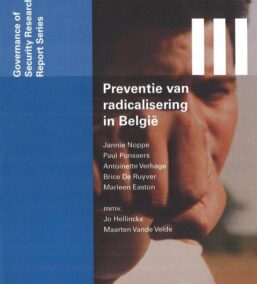
Preventie van radicalisering in België (Governance of Security Research Report Series Vol. III)
€ 32,00
Radicalisering wordt omschreven als een procesmatig
fenomeen; personen die dit proces doormaken, kunnen
hierbij verschillende stadia doorlopen, gaande van
radicalisme over extremisme tot terrorisme. Natuurlijk
mondt het proces slechts in uitzonderlijke gevallen
uit in terroristische daden. Dit betekent echter niet
dat preventief ingrijpen in de eerste fasen van dit
radicaliseringsproces niet van het grootste belang is.
Dit ingrijpen veronderstelt echter dat we deze fasen
ook kunnen herkennen en identificeren.
In opdracht van de FOD Binnenlandse Zaken voerde de onderzoeksgroep Governance of Security (UGent/ Hogent) dan ook een onderzoek naar signalen en triggers die vroegtijdig kunnen wijzen op een proces van radicalisering.
In dit boek worden de resultaten weergegeven van dit onderzoek, dat als één van de eerste empirische onderzoeken in België ingaat op het fenomeen radicalisering en de processen en mechanismen die hiermee gepaard gaan.
In opdracht van de FOD Binnenlandse Zaken voerde de onderzoeksgroep Governance of Security (UGent/ Hogent) dan ook een onderzoek naar signalen en triggers die vroegtijdig kunnen wijzen op een proces van radicalisering.
In dit boek worden de resultaten weergegeven van dit onderzoek, dat als één van de eerste empirische onderzoeken in België ingaat op het fenomeen radicalisering en de processen en mechanismen die hiermee gepaard gaan.
Preventie van radicalisering in België (Governance of Security Research Report Series Vol. III)
€ 32,00
Radicalisering wordt omschreven als een procesmatig
fenomeen; personen die dit proces doormaken, kunnen
hierbij verschillende stadia doorlopen, gaande van
radicalisme over extremisme tot terrorisme. Natuurlijk
mondt het proces slechts in uitzonderlijke gevallen
uit in terroristische daden. Dit betekent echter niet
dat preventief ingrijpen in de eerste fasen van dit
radicaliseringsproces niet van het grootste belang is.
Dit ingrijpen veronderstelt echter dat we deze fasen
ook kunnen herkennen en identificeren.
In opdracht van de FOD Binnenlandse Zaken voerde de onderzoeksgroep Governance of Security (UGent/ Hogent) dan ook een onderzoek naar signalen en triggers die vroegtijdig kunnen wijzen op een proces van radicalisering.
In dit boek worden de resultaten weergegeven van dit onderzoek, dat als één van de eerste empirische onderzoeken in België ingaat op het fenomeen radicalisering en de processen en mechanismen die hiermee gepaard gaan.
In opdracht van de FOD Binnenlandse Zaken voerde de onderzoeksgroep Governance of Security (UGent/ Hogent) dan ook een onderzoek naar signalen en triggers die vroegtijdig kunnen wijzen op een proces van radicalisering.
In dit boek worden de resultaten weergegeven van dit onderzoek, dat als één van de eerste empirische onderzoeken in België ingaat op het fenomeen radicalisering en de processen en mechanismen die hiermee gepaard gaan.