
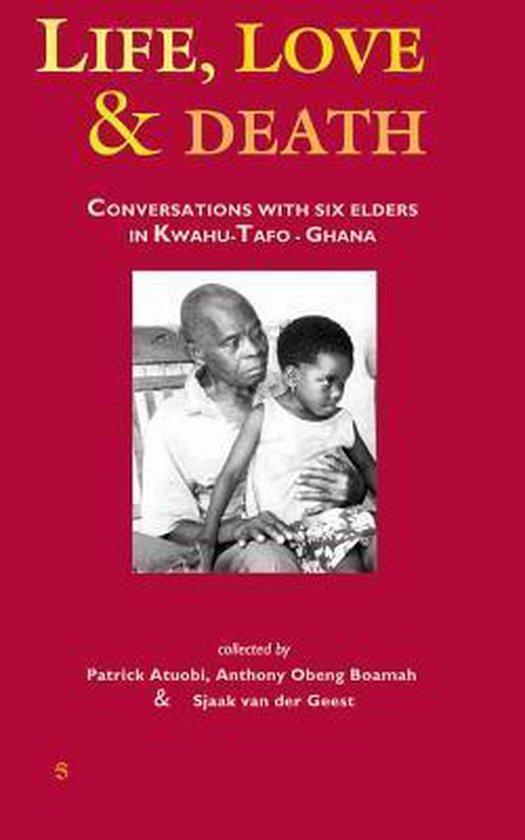
Life, love and death. Conversations with six elders in Kwahu-Tafo – Ghana
€ 7,50
This book records the wisdom of six elders in Kwahu-Tafo, a rural town in the South of Ghana. It brings to the fore the beauty of old age.
This book records the wisdom of six elders in Kwahu-Tafo, a rural town in the South of Ghana. It brings to the fore the beauty of old age.
Boek informatie
ISBN 13
9789055892617
Aantal pagina's
36
Auteur(s)
P. Atuobi, A. Obeng & S. van der Geest
NUR
761 - Culturele antropologie
Gerelateerde producten
Geen voorraad

Vietnamese society in transition. (Frans- en Engelstalig) The politics of change and reform.
€ 29,50
In this bilingual publication academics from various disciplines and countries have been brought together to discuss agricultural engineering, economic development, religion, education, and gender in colonial and post-colonial Vietnam. Most of them are taking an insiders position. The emphasis of the book lies on the postwar societal and cultural transformation.
Geen voorraad
Vietnamese society in transition. (Frans- en Engelstalig) The politics of change and reform.
€ 29,50
In this bilingual publication academics from various disciplines and countries have been brought together to discuss agricultural engineering, economic development, religion, education, and gender in colonial and post-colonial Vietnam. Most of them are taking an insiders position. The emphasis of the book lies on the postwar societal and cultural transformation.
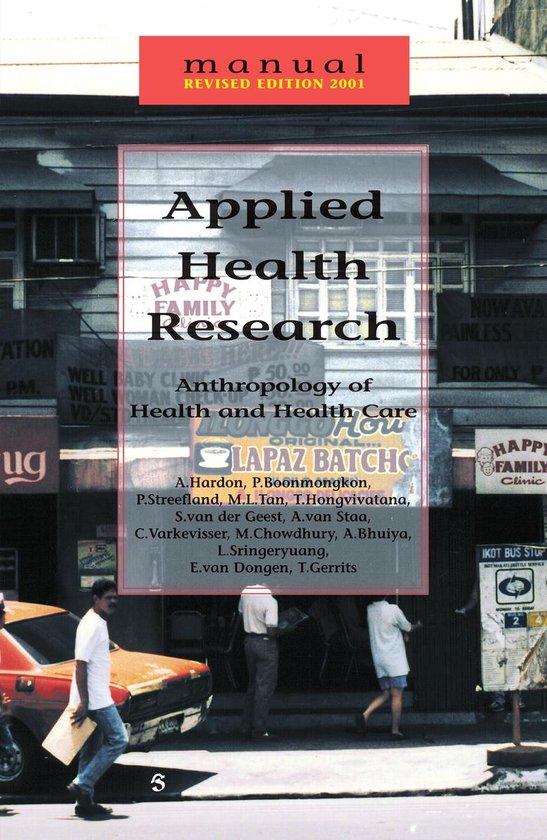
Applied Health Research. Anthropology of Health Care
€ 28,00
There is increasing recognition that socio-economic and cultural factors are prime determinants of health and health care. What factors contribute to the acceptance of community health financing or a vaccination program? What are the needs of the growing group of elderly people or psychatric patients? What social and cultural factors should be taken into account to operationalize all ambitious plans to improve reproductive health care? These are only some of the questions health professionals and health planners are confronted with.
Anthropological research can be a tremendous support to health programmes, by giving insights in the perspective of recipients and providers of health programmes and health care, and also by providing managers and implementors of these programmes with mechanisms and strategies that could lead to a reorientation of health care programmes and policies towards the actual needs of the target group.
The need for training in anthropology of health and health care has been expressed by social scientists involved in multi-disciplinary health research projects, and public health staff at different levels, who are involved in providing health education and primary health care and who - in implementing the health programmes - are confronted with difficulties related to the socio-cultural context in which they work.
It is for this reason that the International Course in Anthropology of Health and Health Care has been developed. This course has been designed for research officers of public health institutes, coordinators of community health care programmes, project staff, responsible for the implementation of various health programmes, public health professionals, social science lecturers at universities, and junior social scientists, who intend to specialize in Anthropology of Health and Health Care.
The course takes a multi-disciplinary approach and focuses on a number of important problem areas and issues, such as vaccination, reproductive health and AIDS, equity and community health financing, self-care and the use and distribution of pharmaceuticals.
The manual in its earlier editions has been used since years for teaching in the field of applied medical anthropology and public health in academic institutions worldwide.
Applied Health Research. Anthropology of Health Care
€ 28,00
There is increasing recognition that socio-economic and cultural factors are prime determinants of health and health care. What factors contribute to the acceptance of community health financing or a vaccination program? What are the needs of the growing group of elderly people or psychatric patients? What social and cultural factors should be taken into account to operationalize all ambitious plans to improve reproductive health care? These are only some of the questions health professionals and health planners are confronted with.
Anthropological research can be a tremendous support to health programmes, by giving insights in the perspective of recipients and providers of health programmes and health care, and also by providing managers and implementors of these programmes with mechanisms and strategies that could lead to a reorientation of health care programmes and policies towards the actual needs of the target group.
The need for training in anthropology of health and health care has been expressed by social scientists involved in multi-disciplinary health research projects, and public health staff at different levels, who are involved in providing health education and primary health care and who - in implementing the health programmes - are confronted with difficulties related to the socio-cultural context in which they work.
It is for this reason that the International Course in Anthropology of Health and Health Care has been developed. This course has been designed for research officers of public health institutes, coordinators of community health care programmes, project staff, responsible for the implementation of various health programmes, public health professionals, social science lecturers at universities, and junior social scientists, who intend to specialize in Anthropology of Health and Health Care.
The course takes a multi-disciplinary approach and focuses on a number of important problem areas and issues, such as vaccination, reproductive health and AIDS, equity and community health financing, self-care and the use and distribution of pharmaceuticals.
The manual in its earlier editions has been used since years for teaching in the field of applied medical anthropology and public health in academic institutions worldwide.
Geen voorraad
Money be man
€ 12,39
Health care policy should be based on understanding of what takes place at the community level. This study explores how people in a coastal village in Ghana perceive and use modern pharmaceuticals. In this G speaking community, 35 kilometers from the capital, there are no proper health care facilities. Most people purchase their medicines in two drugstores which sell products that they are not supposed to sell according to government rules. The author focuses on local perceptions of anatomy and etiology and on people's health expenditure. His book is a search for- the social and cultural basis of the popularity of pharmaceuticals. "Money be man", an inscription on a local lorry, captures the villagers' main concern: without money one cannot remain healthy.
Geen voorraad
Money be man
€ 12,39
Health care policy should be based on understanding of what takes place at the community level. This study explores how people in a coastal village in Ghana perceive and use modern pharmaceuticals. In this G speaking community, 35 kilometers from the capital, there are no proper health care facilities. Most people purchase their medicines in two drugstores which sell products that they are not supposed to sell according to government rules. The author focuses on local perceptions of anatomy and etiology and on people's health expenditure. His book is a search for- the social and cultural basis of the popularity of pharmaceuticals. "Money be man", an inscription on a local lorry, captures the villagers' main concern: without money one cannot remain healthy.
Wat is journalistiek?
€ 24,90
Wat is journalistiek? is een onmisbare aanvulling op de bestaande Nederlandse literatuur over het vak en haar beroepsoefenaren en is vooral bedoeld voor journalisten en iedereen die oprecht geïnteresseerd is in het denken en doen van zij, die elke dag voor ons nieuws over de wereld verantwoordelijk zijn.
Mark Deuze is journalist en communicatiewetenschapper en was verbonden aan de afdeling Communicatiewetenschap van de Universiteit van Amsterdam. Momenteel is hij verbonden aan de Indiana University School of Journalism in Bloomington (USA).
Wat is journalistiek?
€ 24,90
Wat is journalistiek? is een onmisbare aanvulling op de bestaande Nederlandse literatuur over het vak en haar beroepsoefenaren en is vooral bedoeld voor journalisten en iedereen die oprecht geïnteresseerd is in het denken en doen van zij, die elke dag voor ons nieuws over de wereld verantwoordelijk zijn.
Mark Deuze is journalist en communicatiewetenschapper en was verbonden aan de afdeling Communicatiewetenschap van de Universiteit van Amsterdam. Momenteel is hij verbonden aan de Indiana University School of Journalism in Bloomington (USA).