
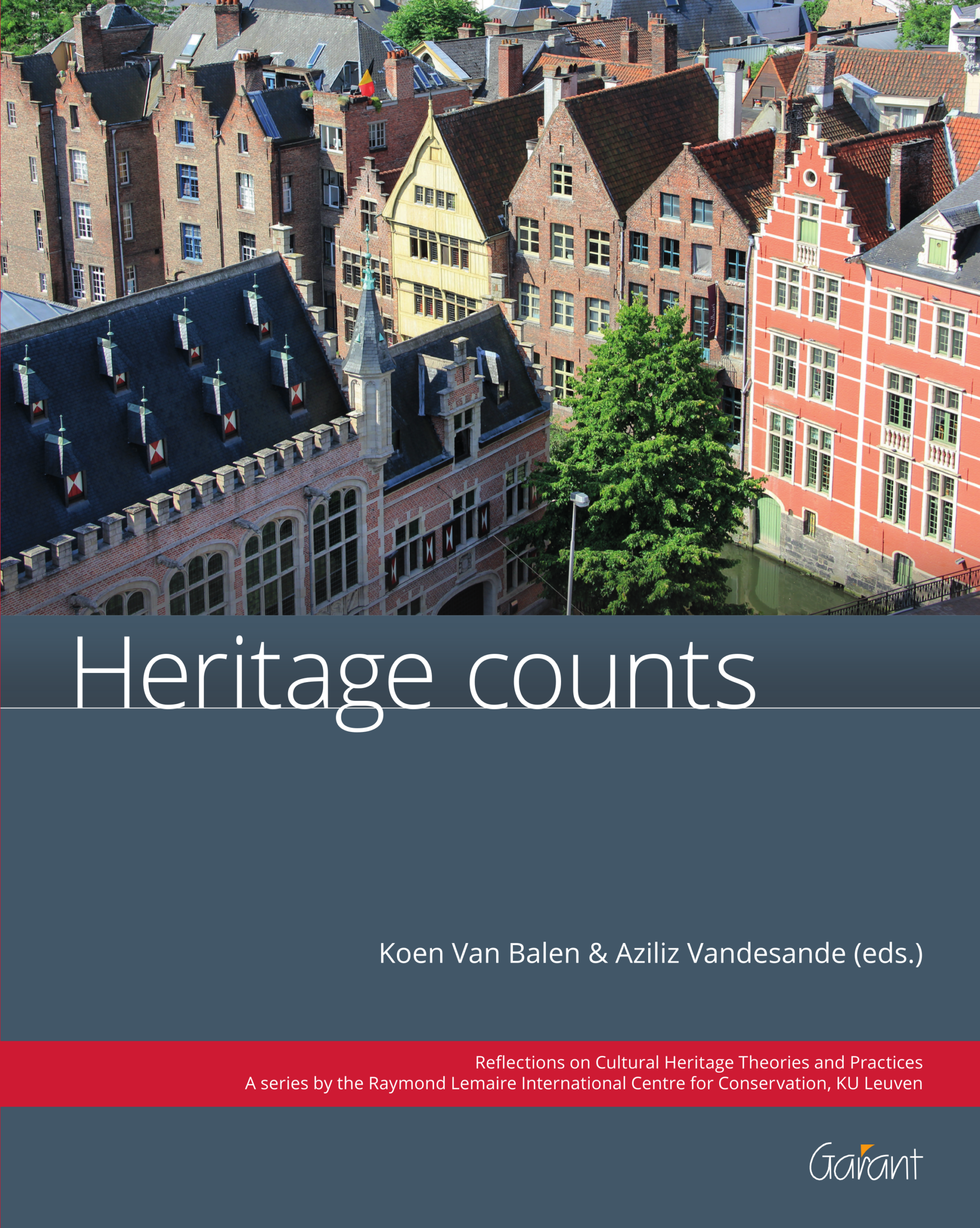
Heritage Counts
€ 50,40
The idea of heritage as a “capital of irreplaceable cultural, social and economic value”
was already present in the European Charter of the Architectural Heritage, adopted
by the Council of Europe in 1975 (par.3). Today, this discourse is getting incr… meer
Op voorraad
The idea of heritage as a “capital of irreplaceable cultural, social and economic value”
was already present in the European Charter of the Architectural Heritage, adopted
by the Council of Europe in 1975 (par.3). Today, this discourse is getting increasing
attention on the research agenda. Some argue that, although heritage is always valued
highly, the current interest in the impact of heritage is caused by the democratisation of
heritage and the increased importance of heritage in today’s society. Others argue that
a universal scarcity of funds for heritage management and conservation is the reason
to give it its proper attention.
Therefore, the Raymond Lemaire International Centre for Conservation (University
of Leuven) considered “Heritage Counts” a relevant and timely topic for its yearly
international conference, the “thematic week”. This edition twins with the “Cultural
Heritage Counts for Europe” project, funded by the EU Culture Programme. The opening
day of the conference was co-organised by the lead partner of this project, EUROPA
NOSTRA, and brought together European policymakers and international researchers
involved in cultural heritage.
This volume specifically reports on the lectures and fruitful debates on heritage impact
during the 2015 thematic week. It was observed that evolutions in discourse and policy
hold a significant prospect, which also entail an increasing demand for shared insights
and formation. In response, this publication reflects on heritage impact by providing
research, case studies and reflections that can serve as baseline records, guidance –
and hopefully inspiration. The findings are subdivided in three main chapters: “Framing
the paradigm”, “Impact assessments: research, methods and practice” and “Linking
management, conservation and sustainable development”.
Aanvullende informatie
| Afmetingen | 25 cm |
|---|
Boek informatie
Gerelateerde producten

Tijdschrift Geschiedenis der Geneeskunde – JRG 3 1997 – NR 4
Het tijdschrift dat zich bezighoudt met de geschiedenis van de geneeskunde, de farmacie, de verpleging, enz. Naast rijkelijk geïllustreerde artikelen over algemeen historische thema’s handelen kortere bijdragen over specifieke onderwerpen uit de geschiedenis van de geneeskunde in de Noordelijke en de Zuidelijke Nederlanden. In elk nummer is een uitgebreid aantal boekbesprekingen uit deze discipline opgenomen.
Hoofdredacteurs: H. Beukers & R. Van Hee
Verschijnt tweemaandelijks = 6 nummers van 64 blz., formaat 21 x 28 cm., per jaargang, vierkleurendruk.
Abonnementen (8ste jaargang, 2002-2003):
- particulieren: € 49,00
- studenten: € 39,00
- instellingen: € 59,00
Tijdschrift Geschiedenis der Geneeskunde – JRG 3 1997 – NR 4
Het tijdschrift dat zich bezighoudt met de geschiedenis van de geneeskunde, de farmacie, de verpleging, enz. Naast rijkelijk geïllustreerde artikelen over algemeen historische thema’s handelen kortere bijdragen over specifieke onderwerpen uit de geschiedenis van de geneeskunde in de Noordelijke en de Zuidelijke Nederlanden. In elk nummer is een uitgebreid aantal boekbesprekingen uit deze discipline opgenomen.
Hoofdredacteurs: H. Beukers & R. Van Hee
Verschijnt tweemaandelijks = 6 nummers van 64 blz., formaat 21 x 28 cm., per jaargang, vierkleurendruk.
Abonnementen (8ste jaargang, 2002-2003):
- particulieren: € 49,00
- studenten: € 39,00
- instellingen: € 59,00
Kleio – Tijdschrift voor oude talen en cultuur – Jrg. 32 – nr 2.
Kleio brengt bijdragen over didactiek en methodiek van het Latijn, het Grieks, antieke cultuur, het voortleven van de oudheid, enz. Het tijdschrift is in de eerste plaats geschreven voor leerkrachten oude talen en antieke cultuur uit het Belgische en Nederlandse secundair onderwijs.
Uiteraard vinden ook alle anderen met interesse voor de Oudheid in Kleio een boeiend tijdschrift.
Hoofdredacteur: L. Van der Stockt
Verschijnt driemaandelijks = 4 nummers van 48 blz., formaat 17 x 24 cm., per jaargang.
Abonnementen (31ste jaargang, 2002-2003):
- particulieren: € 14,00
- studenten: € 11,00
- instellingen: € 17,00
Kleio – Tijdschrift voor oude talen en cultuur – Jrg. 32 – nr 2.
Kleio brengt bijdragen over didactiek en methodiek van het Latijn, het Grieks, antieke cultuur, het voortleven van de oudheid, enz. Het tijdschrift is in de eerste plaats geschreven voor leerkrachten oude talen en antieke cultuur uit het Belgische en Nederlandse secundair onderwijs.
Uiteraard vinden ook alle anderen met interesse voor de Oudheid in Kleio een boeiend tijdschrift.
Hoofdredacteur: L. Van der Stockt
Verschijnt driemaandelijks = 4 nummers van 48 blz., formaat 17 x 24 cm., per jaargang.
Abonnementen (31ste jaargang, 2002-2003):
- particulieren: € 14,00
- studenten: € 11,00
- instellingen: € 17,00