
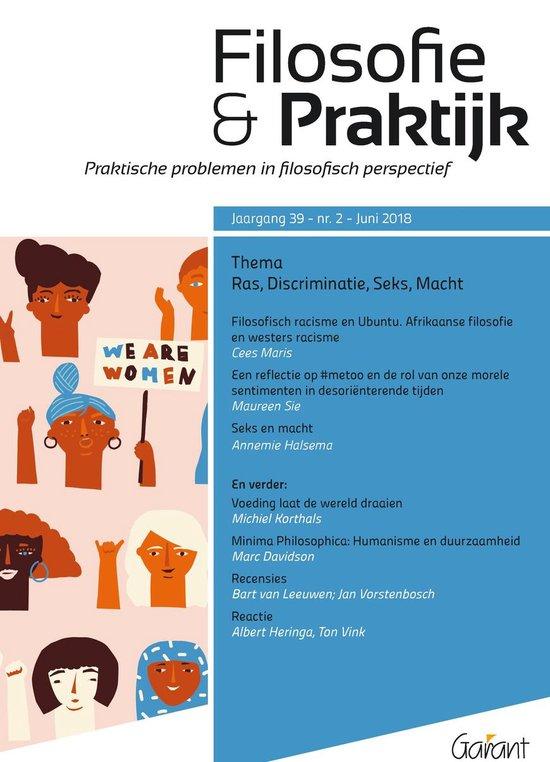
Tijdschrift Filosofie & Praktijk- Jrg.39 (Juni 2018) Nr.2. Ras, Discriminatie, Seks, Macht
Inhoud
-Filosofisch racisme en Ubuntu. Afrikaanse filosofie en westers racisme (1) - Cees Maris
-Een reflectie op #metoo en de rol van onze morele sentimenten in desoriënterende tijden - Maureen Sie
-Sex en macht - Annemie Halsema
-Minima Philosophica: Humanisme en duurzaamheid - Marc Davidson
-Voeding laat de wereld draaien - Michiel Korthals
-Consument in narco-staat. Is drugsgebruik wel normaal? - Cees Maris
-Boekbespreking: Sybe Schaap, Rechtsstaat in verval - Bart van Leeuwen
-Boekbespreking: ISVW De woorden van… - Jan Vorstenbosch
-Reactie & Nawoord - Albert Heringa, Ton Vink
-Column: De student een flaneur, de universiteit een passage - Bart van Leeuwen
-Signalementen
Tijdschrift Filosofie & Praktijk- Jrg.39 (Juni 2018) Nr.2. Ras, Discriminatie, Seks, Macht
Inhoud
-Filosofisch racisme en Ubuntu. Afrikaanse filosofie en westers racisme (1) - Cees Maris
-Een reflectie op #metoo en de rol van onze morele sentimenten in desoriënterende tijden - Maureen Sie
-Sex en macht - Annemie Halsema
-Minima Philosophica: Humanisme en duurzaamheid - Marc Davidson
-Voeding laat de wereld draaien - Michiel Korthals
-Consument in narco-staat. Is drugsgebruik wel normaal? - Cees Maris
-Boekbespreking: Sybe Schaap, Rechtsstaat in verval - Bart van Leeuwen
-Boekbespreking: ISVW De woorden van… - Jan Vorstenbosch
-Reactie & Nawoord - Albert Heringa, Ton Vink
-Column: De student een flaneur, de universiteit een passage - Bart van Leeuwen
-Signalementen
European Journal of Policing Studies – Jaargang – 5/4 (2017)- Changes in policing to improve service delivery
Contents:
Introduction
Antoinette Verhage, Lieselot Bisschop and Wim Hardyns
br>
Articles
How to Police a Porous Fortress?
Monica den Boer (1)
Abstract
The purpose of this article is to provide an overview of the way in which the European Union has gradually but steadily built a security architecture based on the control of mobility and borders. Different logics of policing are interwoven in several projects, which are strongly interdependent with technological innovation. Furthermore, the European policing of mobility is primarily performed by mounting surveillance – both inside and beyond European borders – by means of which all forms of movement (transactions, travelling, etc.) are subjected to intensive monitoring by multiple actors who are interlinked through strategies and systems. The main finding is that border policing is shifting in a fundamental way from fixed to fluid, from territorial to virtual, and from physical to technological. Hence, paradoxically, though mobility is strongly promoted as one of the main virtues of the European Union, Europe’s precautionary protection may be at ill-ease with the free movement of people. The article seeks to stimulate the knowledge and debate about deeper shifts in Europe’s security apparatus and develops this from a law enforcement perspective.
Keywords: Europe; borders; security; mobility; technology
(1) Academic Dean at the Police Academy of The Netherlands, Member of the Committee on European Integration of the Advisory Council on International Affairs and Visiting Professor at the College of Europe in Bruges.
Police Science in Germany: History and New Perspectives
Joachim Kersten (1) and Ansgar Burchard (2)
Abstract
In the German speaking academic world Police Science (Polizeiwissenschaft) is a fairly new and little known area of social science. Accordingly, the academic status of police science is anything but firmly established but rather at a ‘hybrid’ stage of development. The very combination of policing and academic study/research seems to remain largely incompatible not only to police managers but also to main stream sociology. German police science differs substantially from the Anglo-American-Australian approach. One main difference pertains to legal traditions, others are due to historical and cultural developments that will be taken up in this descriptive essay. However, Anglo-American-Australian police theories have a lot to offer to German and European police scientists and this will be demonstrated. For a future common approach to an evolving European police science similar descriptions will be required from other European countries to establish a comparative foundation of joint EU police studies. Some of the principal dimensions of such a comparison will be sketched in this essay. It concludes with a presentation of empirically based police studies carried out by instructors and Master students at the newly founded German Police University in Münster. Topics are media coverage of clashes between police and demonstrators, a typology of third party intervention in cases of assault in public places and COREPOL (EU FP7), a comparative security research project aiming at an improvement of police-minority relations through means of restorative justice programs.
Keywords: Police Science in Germany; accountability; YouTube; public relations; Facebook; civil courage; violent assaults
(1) Professor and Head of Department of the Department of Police Science at the German Police University (Germany), DAAD Professor at Northwestern University, and guest professor in Maastricht/NL, in Sydney/Australia, and in Tokyo/Japan.
(2) Senior Researcher for ‘COREPOL’ (EU FP7).
European Journal of Policing Studies – Jaargang – 5/4 (2017)- Changes in policing to improve service delivery
Contents:
Introduction
Antoinette Verhage, Lieselot Bisschop and Wim Hardyns
br>
Articles
How to Police a Porous Fortress?
Monica den Boer (1)
Abstract
The purpose of this article is to provide an overview of the way in which the European Union has gradually but steadily built a security architecture based on the control of mobility and borders. Different logics of policing are interwoven in several projects, which are strongly interdependent with technological innovation. Furthermore, the European policing of mobility is primarily performed by mounting surveillance – both inside and beyond European borders – by means of which all forms of movement (transactions, travelling, etc.) are subjected to intensive monitoring by multiple actors who are interlinked through strategies and systems. The main finding is that border policing is shifting in a fundamental way from fixed to fluid, from territorial to virtual, and from physical to technological. Hence, paradoxically, though mobility is strongly promoted as one of the main virtues of the European Union, Europe’s precautionary protection may be at ill-ease with the free movement of people. The article seeks to stimulate the knowledge and debate about deeper shifts in Europe’s security apparatus and develops this from a law enforcement perspective.
Keywords: Europe; borders; security; mobility; technology
(1) Academic Dean at the Police Academy of The Netherlands, Member of the Committee on European Integration of the Advisory Council on International Affairs and Visiting Professor at the College of Europe in Bruges.
Police Science in Germany: History and New Perspectives
Joachim Kersten (1) and Ansgar Burchard (2)
Abstract
In the German speaking academic world Police Science (Polizeiwissenschaft) is a fairly new and little known area of social science. Accordingly, the academic status of police science is anything but firmly established but rather at a ‘hybrid’ stage of development. The very combination of policing and academic study/research seems to remain largely incompatible not only to police managers but also to main stream sociology. German police science differs substantially from the Anglo-American-Australian approach. One main difference pertains to legal traditions, others are due to historical and cultural developments that will be taken up in this descriptive essay. However, Anglo-American-Australian police theories have a lot to offer to German and European police scientists and this will be demonstrated. For a future common approach to an evolving European police science similar descriptions will be required from other European countries to establish a comparative foundation of joint EU police studies. Some of the principal dimensions of such a comparison will be sketched in this essay. It concludes with a presentation of empirically based police studies carried out by instructors and Master students at the newly founded German Police University in Münster. Topics are media coverage of clashes between police and demonstrators, a typology of third party intervention in cases of assault in public places and COREPOL (EU FP7), a comparative security research project aiming at an improvement of police-minority relations through means of restorative justice programs.
Keywords: Police Science in Germany; accountability; YouTube; public relations; Facebook; civil courage; violent assaults
(1) Professor and Head of Department of the Department of Police Science at the German Police University (Germany), DAAD Professor at Northwestern University, and guest professor in Maastricht/NL, in Sydney/Australia, and in Tokyo/Japan.
(2) Senior Researcher for ‘COREPOL’ (EU FP7).
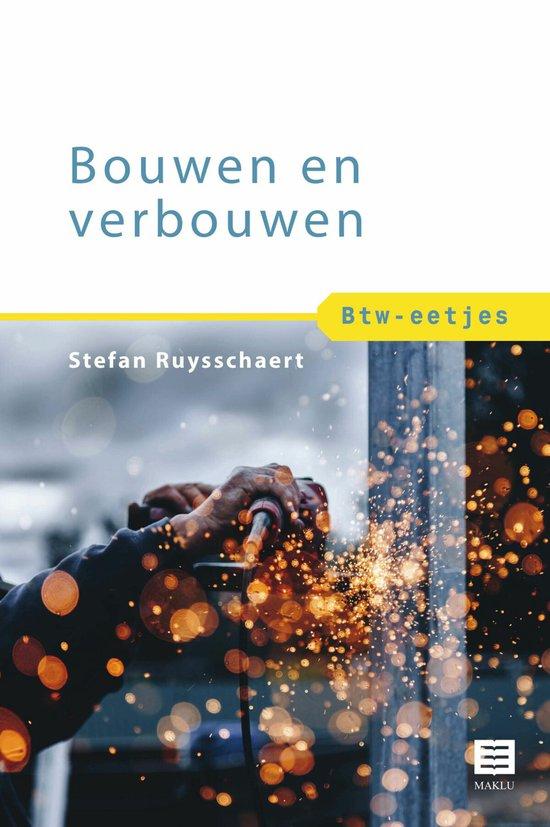
Btw-eetjes. Bouwen en verbouwen
Het antwoord op de vraag wordt telkens bondig en klaar geformuleerd zonder aan inhoudelijke kwaliteit en volledigheid in te boeten.
Stefan Ruysschaert heeft een economische vooropleiding genoten (UGent). Hij is adviseur bij de Federale Overheidsdienst Financiën. Hij is auteur van talrijke bijdragen op fiscaal vlak in toonaangevende tijdschriften en boeken. Hij is o.a. redactielid van Fiscalnet en het Tijdschrift Huur. Hij is professor aan de faculteit Economie van de UGent, vakgroep Accountancy, bedrijfsfinanciering en fiscaliteit waar hij het vak btw doceert en is lid van de stagecommissie van het BIBF.
Btw-eetjes. Bouwen en verbouwen
Het antwoord op de vraag wordt telkens bondig en klaar geformuleerd zonder aan inhoudelijke kwaliteit en volledigheid in te boeten.
Stefan Ruysschaert heeft een economische vooropleiding genoten (UGent). Hij is adviseur bij de Federale Overheidsdienst Financiën. Hij is auteur van talrijke bijdragen op fiscaal vlak in toonaangevende tijdschriften en boeken. Hij is o.a. redactielid van Fiscalnet en het Tijdschrift Huur. Hij is professor aan de faculteit Economie van de UGent, vakgroep Accountancy, bedrijfsfinanciering en fiscaliteit waar hij het vak btw doceert en is lid van de stagecommissie van het BIBF.