
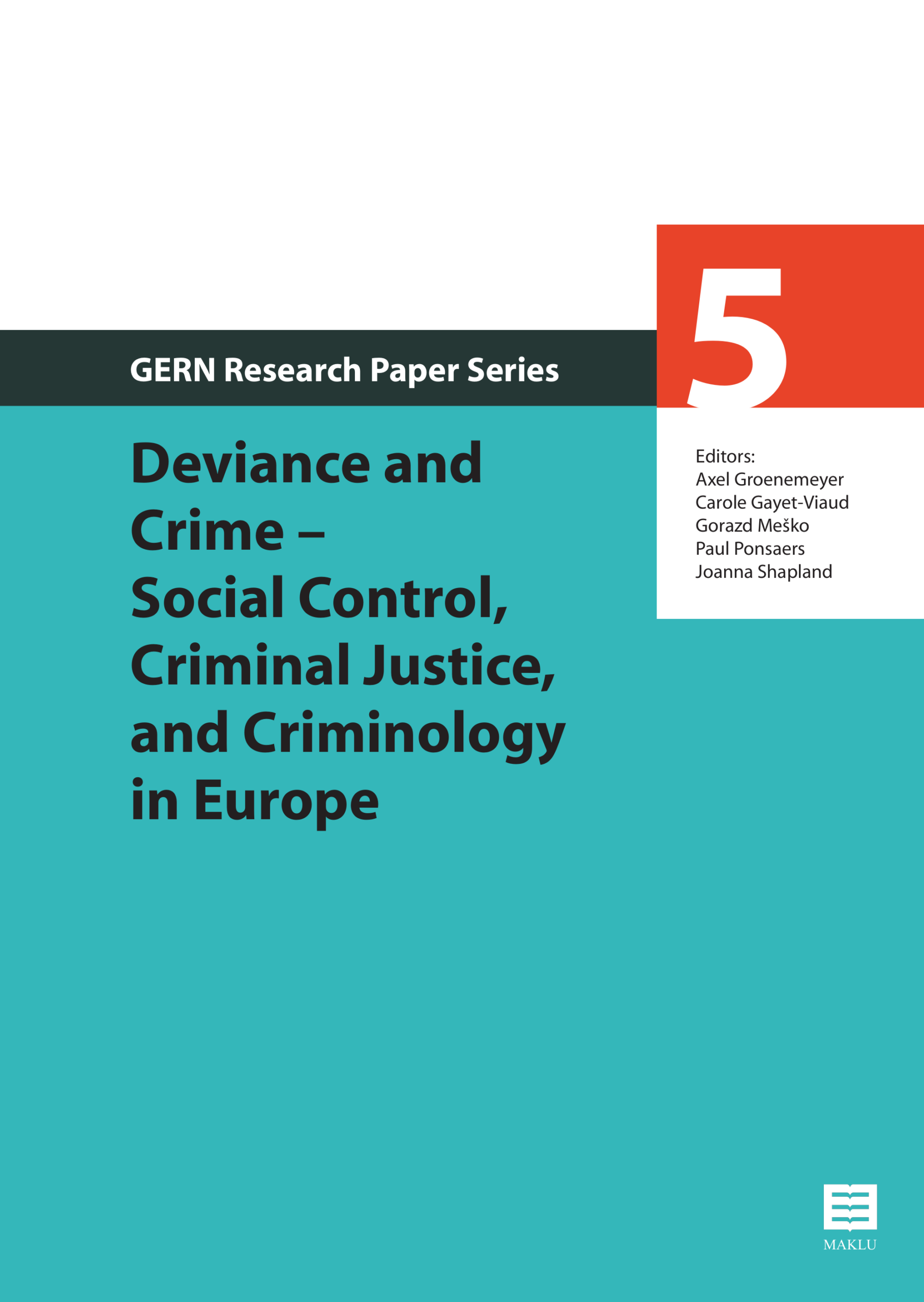
Deviance and Crime – Social Control, Criminal Justice and Criminology in Europe (GERN Research Paper Series, nr 5)
With the inauguration of this Research Paper Series, GERN intends to monitor and disseminate cutting-edge studies into European security issues, reflecting the result of doctoral research in the framework of the GERN. The series provides an excellent platform from which to survey key emergent topics in the field. With this series the editors and authors are contributing to a better understanding of contemporary questions, presenting recent research results and scientific reflection, by devising new approaches and by re-evaluating the heritage of social sciences in this domain. It implies a new openness with regard to other disciplines and to the normative questions arising from the constructions of deviance and crime, the commission of criminal acts, its consequences and its development, as well as the application of deviance categories and the social or formal reaction to it by actors in the criminal justice system and beyond.
This is the fifth volume stemming from the annual doctoral conferences organized by the GERN in September 2016 in Dortmund, Germany. The selected theme for this Summer School was “Deviance and Crime – Social Control, Criminal Justice, and Criminology in Europe”; reflecting the variety of theoretical frameworks and methodologies covered by the current PhD theses in the field of criminal justice and deviance as well as fresh and new perspectives on deviant and criminal careers, on the history of restorative justice and on crime as the central theoretical concept in criminology.
Deviance and Crime – Social Control, Criminal Justice and Criminology in Europe (GERN Research Paper Series, nr 5)
With the inauguration of this Research Paper Series, GERN intends to monitor and disseminate cutting-edge studies into European security issues, reflecting the result of doctoral research in the framework of the GERN. The series provides an excellent platform from which to survey key emergent topics in the field. With this series the editors and authors are contributing to a better understanding of contemporary questions, presenting recent research results and scientific reflection, by devising new approaches and by re-evaluating the heritage of social sciences in this domain. It implies a new openness with regard to other disciplines and to the normative questions arising from the constructions of deviance and crime, the commission of criminal acts, its consequences and its development, as well as the application of deviance categories and the social or formal reaction to it by actors in the criminal justice system and beyond.
This is the fifth volume stemming from the annual doctoral conferences organized by the GERN in September 2016 in Dortmund, Germany. The selected theme for this Summer School was “Deviance and Crime – Social Control, Criminal Justice, and Criminology in Europe”; reflecting the variety of theoretical frameworks and methodologies covered by the current PhD theses in the field of criminal justice and deviance as well as fresh and new perspectives on deviant and criminal careers, on the history of restorative justice and on crime as the central theoretical concept in criminology.

Abonnement Cahiers Politiestudies (CPS) – 2017 (4 publicaties per jaar)
De Cahiers Politiestudies is een kwartaalreeks die zich richt op hoogstaande, kwalitatieve bijdragen over politiële vraagstukken en fenomenen die de politie interesseren.
De Cahiers Politiestudies verschijnen trimesterieel (4 themanummers per jaar). Een jaarabonnement kost € 115,- (excl. verzendkosten). Een abonnement kan jaarlijks worden opgezegd vóór 1 december van de lopende jaargang.
De kwartaalreeks is multidisciplinair opgezet, waarbij criminologie een prominente plaats krijgt naast andere disciplines. In deze reeks vinden, naast Nederlandstalige publicaties, ook Engelstalige bijdragen hun plaats. De reeks wordt begeleid door een internationale redactieraad. De redactieraad waakt over de kwaliteit van de ingediende manuscripten dankzij een internationale double blind peerreview-procedure en ontwikkelt een proactief beleid met het oog op het samenstellen van thematische volumes. Daartoe worden gasteditoren in België en Nederland aangezocht.
Doelgroep
Zowel wetenschappers (academici, beleidsondersteunende onderzoekers, opleidingscentra en bibliotheken) als practici afkomstig uit politie, justitie en belendende domeinen vinden hier een forum. Na vijf jaar werking zijn de Cahiers Politiestudies uitgegroeid tot betekenisvolle thematische naslagwerken, met zowel wetenschappelijke als praktijkgerichte bijdragen die voor de politie en voor ruimere beroepskringen en academici een onmisbaar instrument zijn. Een instrument dat een degelijk en professioneel overzicht biedt over een eigentijds thema.
Folder
Voorbije nummers
- Cahier 45: Herinneren en vergeten in de politie
M. De Waele, J. Noppe, H. Moors, A. Garssen (eds.) - Cahier 44: Vervloeiing interne en externe veiligheid
M. De Waele, J. Noppe, H. Moors, A. Garssen (eds.) - Cahier 43: Eigenrichting
M. De Waele, J. Noppe, H. Moors, A. Garssen (eds.) - Cahier 42: Aanpak van gewelddadige radicalisering
M. De Waele, J. Noppe, H. Moors, A. Garssen (eds.) - Cahier 41: Meten is weten
E. Devroe, E. De Raedt, H. Elffers, D. Schaap (red.) - Cahier 40: Politie en
gezondheidszorg
L.G. Moor, W. Vanderplasschen, A. van Dijk (eds.) - Cahier 39: Criminele
organisaties en organisatiecriminaliteit
A. Verhage, A. Jorissen, R. Prins, J. Jaspers (eds.) - Cahier 38: Groene
criminologie en veiligheidszorg
J. Janssen, T. Boekhout van Solinge, L. Bisschop, P. De Baets (eds.) - Cahier 37:
Verantwoording en politie
J. Terpstra, A. Duchatelet, J. Janssens, D. Van Ryckeghem & P. Versteegh (eds.) - Cahier 36: Outsourcing
policing
P. Ponsaers, E. De Raedt, L. Wondergem & L. Gunther Moor (eds.) - Cahier 35: Ethnic
profiling en interne diversiteit bij de politie
L. Gunther Moor, J. Janssen, M. Easton & A. Verhage (eds.) - Cahier 34: Jongeren en
politie
S. De Kimpe, J. Noorda & H. Ferwerda (eds.) - Cahier 33: De toekomst
van de politie
E. Devroe, K. van der Vijver, W. Hardyns & A. van Dijk (eds.) - Cahier 32: Democratische
politie
M. De Waele, B. van Stokkom, T. Kansil & H. Berkmoes (eds.) - Cahier 31: Het gezag van
de politie
L. Gunther Moor, P. Ponsaers, M. de Vries & M. Easton - Cahier 30: Politie en
haar maatschappelijke partners
P. Ponsaers, L. Gunther Moor, W. D''haese, M. Eysink Smeets (eds.) - Cahier 29: Illegale en
informele economie
D. Boels, L. Bisschop, E. Kleemans, K. van der Vijver (eds.) - Cahier 28: Vernieuwing
in de opsporing
P. Ponsaers, J. Terpstra, C. De Poot, M. Bockstaele, L. Gunther Moor (eds.) - Cahier 27: Mensenrechten
en politie
J. Noppe, V. Pashley, P. De Hert, W. Huisman (eds.) - Cahier 26:
Schaalveranderingen
E. Devroe, P. Ponsaers, M. Easton, L. Cachet, G. Meershoek (eds.) - Cahier 25:
Tides and currents in police theories
E. Devroe, P. Ponsaers, L. Gunther Moor, J. Greene, L. Skinns, L. Bisschop, A. Verhage, M. Bacon (eds.) - Cahier 24:
Integriteit en deontologie
A. De Schrijver, E. Kolthoff, K. Lasthuizen, P. Van Parys, E. Devroe (eds.) - Cahier 23: Geweld en
politie
Gerwinde Vynckier, Willem de Haan, Otto Adang, Franky Goossens (eds.) - Cahier 22:
Professionalisering en socialisatie
S. de Kimpe, L.G. Moor, F. Vlek, P. van Reenen (eds.) - Cahier 21: Proces-
verbaal, aangifte en forensisch onderzoek
L. Smets, J. De Kinder, L.G. Moor (eds.) - Cahier 20: Technology-
led policing
E. De Pauw, P. Ponsaers, K. van der Vijver, W. Bruggeman, P. Deelman (eds.) - Cahier 19:
Burgerparticipatie
L.G. Moor, F. Hutsebaut, P. van Os, D. Van Rijckeghem (eds.) - Cahier 18: Social
disorder
L.G. Moor, F. Hutsebaut, P. van Os, D. Van Rijckeghem (eds.) - Cahier 17: Evidence
based policing
E. De Wree, E. Devroe, W. Broer & P. van der Laan (eds.) - Cahier 16: Policing in
Europe
A. Verhage, P. Deelman, E. Muylaert, J. Terpstra & P. Van Parys (eds.) - Cahier 15: Policing
multiple communities
F. Bovenkerk, M. Easton, L.G. Moor & P. Ponsaers (eds.) - Cahier 14:
Politieleiderschap
L. Bisschop, K. Buijnink, S. De Kimpe & M. Noordegraaf (eds.) - Cahier 13:
Wat doet de politie?
I. Verwee, E. Hendrickx & F. Vlek (eds.) - Cahier 12: De relatie in
de strafrechtsketen tussen politie, parket, onderzoeksrechter en rechtbank
M. Vanderhallen, G. Vervaeke & E. Jaspaert (eds.) - Cahier 11: Restorative
policing
L.G. Moor, T. Peters, P. Ponsaers, J. Shapland, B. van Stokkom (eds.) - Cahier 10: Politionele
bestuurlijke informatiestromen
G. Vynckier, M. Easton, S. De Kimpe (eds.)
Abonnement Cahiers Politiestudies (CPS) – 2017 (4 publicaties per jaar)
De Cahiers Politiestudies is een kwartaalreeks die zich richt op hoogstaande, kwalitatieve bijdragen over politiële vraagstukken en fenomenen die de politie interesseren.
De Cahiers Politiestudies verschijnen trimesterieel (4 themanummers per jaar). Een jaarabonnement kost € 115,- (excl. verzendkosten). Een abonnement kan jaarlijks worden opgezegd vóór 1 december van de lopende jaargang.
De kwartaalreeks is multidisciplinair opgezet, waarbij criminologie een prominente plaats krijgt naast andere disciplines. In deze reeks vinden, naast Nederlandstalige publicaties, ook Engelstalige bijdragen hun plaats. De reeks wordt begeleid door een internationale redactieraad. De redactieraad waakt over de kwaliteit van de ingediende manuscripten dankzij een internationale double blind peerreview-procedure en ontwikkelt een proactief beleid met het oog op het samenstellen van thematische volumes. Daartoe worden gasteditoren in België en Nederland aangezocht.
Doelgroep
Zowel wetenschappers (academici, beleidsondersteunende onderzoekers, opleidingscentra en bibliotheken) als practici afkomstig uit politie, justitie en belendende domeinen vinden hier een forum. Na vijf jaar werking zijn de Cahiers Politiestudies uitgegroeid tot betekenisvolle thematische naslagwerken, met zowel wetenschappelijke als praktijkgerichte bijdragen die voor de politie en voor ruimere beroepskringen en academici een onmisbaar instrument zijn. Een instrument dat een degelijk en professioneel overzicht biedt over een eigentijds thema.
Folder
Voorbije nummers
- Cahier 45: Herinneren en vergeten in de politie
M. De Waele, J. Noppe, H. Moors, A. Garssen (eds.) - Cahier 44: Vervloeiing interne en externe veiligheid
M. De Waele, J. Noppe, H. Moors, A. Garssen (eds.) - Cahier 43: Eigenrichting
M. De Waele, J. Noppe, H. Moors, A. Garssen (eds.) - Cahier 42: Aanpak van gewelddadige radicalisering
M. De Waele, J. Noppe, H. Moors, A. Garssen (eds.) - Cahier 41: Meten is weten
E. Devroe, E. De Raedt, H. Elffers, D. Schaap (red.) - Cahier 40: Politie en
gezondheidszorg
L.G. Moor, W. Vanderplasschen, A. van Dijk (eds.) - Cahier 39: Criminele
organisaties en organisatiecriminaliteit
A. Verhage, A. Jorissen, R. Prins, J. Jaspers (eds.) - Cahier 38: Groene
criminologie en veiligheidszorg
J. Janssen, T. Boekhout van Solinge, L. Bisschop, P. De Baets (eds.) - Cahier 37:
Verantwoording en politie
J. Terpstra, A. Duchatelet, J. Janssens, D. Van Ryckeghem & P. Versteegh (eds.) - Cahier 36: Outsourcing
policing
P. Ponsaers, E. De Raedt, L. Wondergem & L. Gunther Moor (eds.) - Cahier 35: Ethnic
profiling en interne diversiteit bij de politie
L. Gunther Moor, J. Janssen, M. Easton & A. Verhage (eds.) - Cahier 34: Jongeren en
politie
S. De Kimpe, J. Noorda & H. Ferwerda (eds.) - Cahier 33: De toekomst
van de politie
E. Devroe, K. van der Vijver, W. Hardyns & A. van Dijk (eds.) - Cahier 32: Democratische
politie
M. De Waele, B. van Stokkom, T. Kansil & H. Berkmoes (eds.) - Cahier 31: Het gezag van
de politie
L. Gunther Moor, P. Ponsaers, M. de Vries & M. Easton - Cahier 30: Politie en
haar maatschappelijke partners
P. Ponsaers, L. Gunther Moor, W. D''haese, M. Eysink Smeets (eds.) - Cahier 29: Illegale en
informele economie
D. Boels, L. Bisschop, E. Kleemans, K. van der Vijver (eds.) - Cahier 28: Vernieuwing
in de opsporing
P. Ponsaers, J. Terpstra, C. De Poot, M. Bockstaele, L. Gunther Moor (eds.) - Cahier 27: Mensenrechten
en politie
J. Noppe, V. Pashley, P. De Hert, W. Huisman (eds.) - Cahier 26:
Schaalveranderingen
E. Devroe, P. Ponsaers, M. Easton, L. Cachet, G. Meershoek (eds.) - Cahier 25:
Tides and currents in police theories
E. Devroe, P. Ponsaers, L. Gunther Moor, J. Greene, L. Skinns, L. Bisschop, A. Verhage, M. Bacon (eds.) - Cahier 24:
Integriteit en deontologie
A. De Schrijver, E. Kolthoff, K. Lasthuizen, P. Van Parys, E. Devroe (eds.) - Cahier 23: Geweld en
politie
Gerwinde Vynckier, Willem de Haan, Otto Adang, Franky Goossens (eds.) - Cahier 22:
Professionalisering en socialisatie
S. de Kimpe, L.G. Moor, F. Vlek, P. van Reenen (eds.) - Cahier 21: Proces-
verbaal, aangifte en forensisch onderzoek
L. Smets, J. De Kinder, L.G. Moor (eds.) - Cahier 20: Technology-
led policing
E. De Pauw, P. Ponsaers, K. van der Vijver, W. Bruggeman, P. Deelman (eds.) - Cahier 19:
Burgerparticipatie
L.G. Moor, F. Hutsebaut, P. van Os, D. Van Rijckeghem (eds.) - Cahier 18: Social
disorder
L.G. Moor, F. Hutsebaut, P. van Os, D. Van Rijckeghem (eds.) - Cahier 17: Evidence
based policing
E. De Wree, E. Devroe, W. Broer & P. van der Laan (eds.) - Cahier 16: Policing in
Europe
A. Verhage, P. Deelman, E. Muylaert, J. Terpstra & P. Van Parys (eds.) - Cahier 15: Policing
multiple communities
F. Bovenkerk, M. Easton, L.G. Moor & P. Ponsaers (eds.) - Cahier 14:
Politieleiderschap
L. Bisschop, K. Buijnink, S. De Kimpe & M. Noordegraaf (eds.) - Cahier 13:
Wat doet de politie?
I. Verwee, E. Hendrickx & F. Vlek (eds.) - Cahier 12: De relatie in
de strafrechtsketen tussen politie, parket, onderzoeksrechter en rechtbank
M. Vanderhallen, G. Vervaeke & E. Jaspaert (eds.) - Cahier 11: Restorative
policing
L.G. Moor, T. Peters, P. Ponsaers, J. Shapland, B. van Stokkom (eds.) - Cahier 10: Politionele
bestuurlijke informatiestromen
G. Vynckier, M. Easton, S. De Kimpe (eds.)
Crime and order, criminal justice experiences and desistance (GERN Research Paper Series, nr 4)
GERN (Groupement Européen de Recherches sur les Normativités) is a large con-sortium of scientific researchers in the domain of deviance and social control, more precisely studying delinquency, penal institutions, public policies of security and the importance of penal questions in society. The consortium is multidisciplinary.
Today GERN is a scientific network present in ten European countries and abroad, uniting researchers of different disciplines. Each year the GERN organizes a doctoral summer school, giving PhD students from the consortium the opportunity to present and discuss their ongoing projects and research results as well as meet young and senior researchers.
This is the fourth volume stemming from the annual doctoral conferences organized by the GERN. Last edition of the Summer School was held in September 2015 in Paris. The selected theme for this Summer School was “Crime and order, criminal justice experiences and desistance”, reflecting the variety of theoretical frameworks and methodologies covered by the current PhD theses in the field of criminal justice and deviance as well as the fresh and new perspectives on subjective experiences of the criminal justice system and trajectories of desistance.
Critical thinking differs from magic reasoning, common sense, and speculation. Scientific evidence contrasts with belief, immediate and apparent knowledge, illusion and opinion. This is particularly true for the science of crime, criminology and more generally social sciences research on criminal justice issues. With the inauguration of this Research Paper Series, GERN intends to monitor and disseminate cutting-edge studies into European security issues, reflecting the result of doctoral research in the framework of the GERN. The series provides an excellent platform from which to survey key emergent topics in the field. With this series the editors and authors are contributing to a better understanding of contemporary questions, presenting recent research results and scientific reflection, by devising new approaches and by re-evaluating the heritage of social sciences in this domain. It implies a new openness with regard to other disciplines and to the normative questions arising from the commission of crime and the formal reaction to it by actors in the criminal justice system and beyond.
Crime and order, criminal justice experiences and desistance (GERN Research Paper Series, nr 4)
GERN (Groupement Européen de Recherches sur les Normativités) is a large con-sortium of scientific researchers in the domain of deviance and social control, more precisely studying delinquency, penal institutions, public policies of security and the importance of penal questions in society. The consortium is multidisciplinary.
Today GERN is a scientific network present in ten European countries and abroad, uniting researchers of different disciplines. Each year the GERN organizes a doctoral summer school, giving PhD students from the consortium the opportunity to present and discuss their ongoing projects and research results as well as meet young and senior researchers.
This is the fourth volume stemming from the annual doctoral conferences organized by the GERN. Last edition of the Summer School was held in September 2015 in Paris. The selected theme for this Summer School was “Crime and order, criminal justice experiences and desistance”, reflecting the variety of theoretical frameworks and methodologies covered by the current PhD theses in the field of criminal justice and deviance as well as the fresh and new perspectives on subjective experiences of the criminal justice system and trajectories of desistance.
Critical thinking differs from magic reasoning, common sense, and speculation. Scientific evidence contrasts with belief, immediate and apparent knowledge, illusion and opinion. This is particularly true for the science of crime, criminology and more generally social sciences research on criminal justice issues. With the inauguration of this Research Paper Series, GERN intends to monitor and disseminate cutting-edge studies into European security issues, reflecting the result of doctoral research in the framework of the GERN. The series provides an excellent platform from which to survey key emergent topics in the field. With this series the editors and authors are contributing to a better understanding of contemporary questions, presenting recent research results and scientific reflection, by devising new approaches and by re-evaluating the heritage of social sciences in this domain. It implies a new openness with regard to other disciplines and to the normative questions arising from the commission of crime and the formal reaction to it by actors in the criminal justice system and beyond.
Recherchemanagement. Sturen naar kwaliteitsvol opsporingswerk (Reeks Dienst voor het strafrechtelijk beleid, nr. 12)
Dit boek geeft beschrijft het recherchemanagement ná de politiehervorming, meer bepaald inzake het gespecialiseerde opsporingswerk dat verricht wordt in de gerechtelijke diensten van de arrondissementen (GDA’s) van de federale politie. Hierbij ligt de klemtoon op de kwaliteitskenmerken en de bewaking hiervan.
Recherchemanagement belangt alle actoren in de strafrechtsketen rechtstreeks aan. Voor hen is deze uitgave dan ook zonder meer een "eye-opener".
Recherchemanagement. Sturen naar kwaliteitsvol opsporingswerk (Reeks Dienst voor het strafrechtelijk beleid, nr. 12)
Dit boek geeft beschrijft het recherchemanagement ná de politiehervorming, meer bepaald inzake het gespecialiseerde opsporingswerk dat verricht wordt in de gerechtelijke diensten van de arrondissementen (GDA’s) van de federale politie. Hierbij ligt de klemtoon op de kwaliteitskenmerken en de bewaking hiervan.
Recherchemanagement belangt alle actoren in de strafrechtsketen rechtstreeks aan. Voor hen is deze uitgave dan ook zonder meer een "eye-opener".
Het profiel van de pedoseksueel. Een sociologische benadering (IRCP-reeks)
Aan de hand van een analyse van Child Focus-dossiers en gerechtelijke dossiers in de vijf grootste gerechtelijke arrondissementen van het land, aangevuld met interviews en rondetafelgesprekken met bevoorrechte getuigen en literatuuronderzoek, schetsen de onderzoekers een zo adequaat mogelijk beeld van pedoseksuele misdrijfplegers in België. Zij pretenderen daarbij niet een representatief profiel te kunnen aanreiken van de pedoseksueel. Individuele verschillen tussen mensen blijven bestaan. Wel hebben de onderzoekers ernaar gestreefd een aantal gemeenschappelijke karakteristieken in kaart te brengen die niet noodzakelijk exclusief, maar alleszins ook voorkomen bij daders van pedoseksueel misbruik.
Vast staat alvast dat deze – voor België vooralsnog unieke - sociologische profielstudie, indien ze tenminste op behoedzame wijze wordt gehanteerd, de waakzaamheid voor en bescherming van de veiligheid en integriteit van kinderen alleen maar ten goede kan komen.
Het onderzoek waarvan dit boek de neerslag vormt, werd uitgevoerd door het Institute for International Research on Criminal Policy (IRCP) en de Onderzoeksgroep Sociale Veiligheidsanalyse (SVA) van de Universiteit Gent, in opdracht van Child Focus.
Het profiel van de pedoseksueel. Een sociologische benadering (IRCP-reeks)
Aan de hand van een analyse van Child Focus-dossiers en gerechtelijke dossiers in de vijf grootste gerechtelijke arrondissementen van het land, aangevuld met interviews en rondetafelgesprekken met bevoorrechte getuigen en literatuuronderzoek, schetsen de onderzoekers een zo adequaat mogelijk beeld van pedoseksuele misdrijfplegers in België. Zij pretenderen daarbij niet een representatief profiel te kunnen aanreiken van de pedoseksueel. Individuele verschillen tussen mensen blijven bestaan. Wel hebben de onderzoekers ernaar gestreefd een aantal gemeenschappelijke karakteristieken in kaart te brengen die niet noodzakelijk exclusief, maar alleszins ook voorkomen bij daders van pedoseksueel misbruik.
Vast staat alvast dat deze – voor België vooralsnog unieke - sociologische profielstudie, indien ze tenminste op behoedzame wijze wordt gehanteerd, de waakzaamheid voor en bescherming van de veiligheid en integriteit van kinderen alleen maar ten goede kan komen.
Het onderzoek waarvan dit boek de neerslag vormt, werd uitgevoerd door het Institute for International Research on Criminal Policy (IRCP) en de Onderzoeksgroep Sociale Veiligheidsanalyse (SVA) van de Universiteit Gent, in opdracht van Child Focus.
De ondervraging. Analyse van een politietechniek
De ondervraging. Analyse van een politietechniek

Politionele recherchetechnieken. Een praktijkoverzicht
Politionele recherchetechnieken. Een praktijkoverzicht
Criminology, Security and Justice. Methodological and epistemological issues (GERN Research Paper Series, nr 3)
This is the third volume stemming from the annual doctoral conferences organized by the GERN. Last edition of the Summer School was held in September 2014 in Porto (Portugal). The selected theme for this Summer School was ‘Criminology, Security and Justice: methodological and epistemological issues’, searching for a fruitful debate about the methodological and epistemological aspects relevant for the development of PhD thesis. Scientific research is, in its essence, critical thinking. What is critical thinking? It is a kind of thinking that differs from magic reasoning, common sense, and speculation. Scientific evidence contrasts with belief, immediate and apparent knowledge, illusion and opinion. This is valid for every knowledge domain that claims to be scientific. It is thus true for the science of crime, criminology.
With the inauguration of this Research Paper Series, GERN intends to monitor and
disseminate cutting-edge studies into European security issues, reflecting the result
of doctoral research in the framework of the GERN. The series provides an excellent
platform from which to survey key emergent topics in the field. With this
series the editors and authors are contributing to a better understanding of contemporary
questions, presenting recent research results and scientific reflection,
by devising new approaches and by re-evaluating the heritage of social sciences
in this domain. It implies a new openness with regard to other disciplines and to
the normative questions arising from the commission of crime and the formal reaction
to it by actors in the criminal justice system and beyond.
Criminology, Security and Justice. Methodological and epistemological issues (GERN Research Paper Series, nr 3)
This is the third volume stemming from the annual doctoral conferences organized by the GERN. Last edition of the Summer School was held in September 2014 in Porto (Portugal). The selected theme for this Summer School was ‘Criminology, Security and Justice: methodological and epistemological issues’, searching for a fruitful debate about the methodological and epistemological aspects relevant for the development of PhD thesis. Scientific research is, in its essence, critical thinking. What is critical thinking? It is a kind of thinking that differs from magic reasoning, common sense, and speculation. Scientific evidence contrasts with belief, immediate and apparent knowledge, illusion and opinion. This is valid for every knowledge domain that claims to be scientific. It is thus true for the science of crime, criminology.
With the inauguration of this Research Paper Series, GERN intends to monitor and
disseminate cutting-edge studies into European security issues, reflecting the result
of doctoral research in the framework of the GERN. The series provides an excellent
platform from which to survey key emergent topics in the field. With this
series the editors and authors are contributing to a better understanding of contemporary
questions, presenting recent research results and scientific reflection,
by devising new approaches and by re-evaluating the heritage of social sciences
in this domain. It implies a new openness with regard to other disciplines and to
the normative questions arising from the commission of crime and the formal reaction
to it by actors in the criminal justice system and beyond.

Salduz Plus. Aandachtspunten bij de implementatie van de EU-richtlijn 2013/48 (Reeks Veiligheidsstudies, nr. 11)
Voorliggend volume brengt de lezingen samen van een studiedag
die het Centre for Policing and Security (CPS) aan dit thema wijdde op
4 maart 2015 te Beveren-Waas. Ze kunnen inspireren of een aanzet
zijn voor discussie over het noodzakelijk wetgevend initiatief. Intussen
kunnen de politiemensen, magistraten en advocaten rijkelijk putten
uit de beschikbare samengebrachte kennis. Nadien zal het boek
een blijvend tijdsdocument zijn dat getuigt van de overwegingen die
aan de wet vooraf gingen.
Salduz Plus. Aandachtspunten bij de implementatie van de EU-richtlijn 2013/48 (Reeks Veiligheidsstudies, nr. 11)
Voorliggend volume brengt de lezingen samen van een studiedag
die het Centre for Policing and Security (CPS) aan dit thema wijdde op
4 maart 2015 te Beveren-Waas. Ze kunnen inspireren of een aanzet
zijn voor discussie over het noodzakelijk wetgevend initiatief. Intussen
kunnen de politiemensen, magistraten en advocaten rijkelijk putten
uit de beschikbare samengebrachte kennis. Nadien zal het boek
een blijvend tijdsdocument zijn dat getuigt van de overwegingen die
aan de wet vooraf gingen.
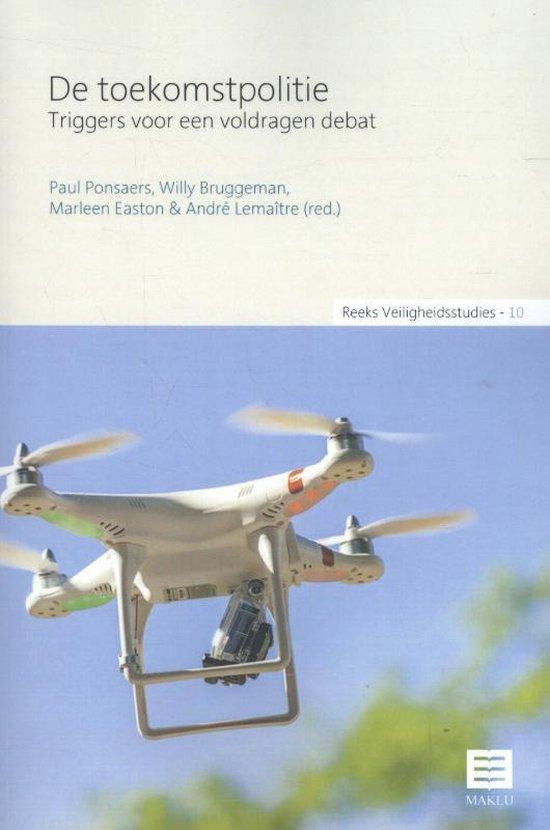
De toekomstpolitie. Triggers voor een voldragen debat (Reeks Veiligheidsstudies, nr. 10)
Bij de regeringswissel in 2014 legde de ministeriële stuurgroep haar rapport neer over de toekomst van de politie in 2025. In het verlengde hiervan namen diverse universitaire equipes en studiecentra het initiatief om het rapport onder de aandacht te brengen en kritisch door te lichten. Dit boek bevat het rapport van de stuurgroep, maar tevens een selectie van de meest indringende bijdragen aan het navolgend debat.
Er wordt ingegaan op een aantal maatschappelijke tendensen die onvermijdelijk het politiewerk in de toekomst zullen beïnvloeden, de toekomst van de politieorganisatie als zodanig en uiteraard de relatie tussen de politie en nieuwe technologieën. Het laatste deel behandelt de visietekst van de stuurgroep: ‘Een politie in verbinding. Een visie voor de politie in 2025’.
Via deze publicatie willen de editoren maatschappelijke actoren van alle gezindten uitnodigen tot een verder debat over de toekomst van de politie in België. Zij zijn de mening toegedaan dat het noodzakelijk is om op regelmatige basis een dergelijke toekomstvisie te formuleren. De politie is immers een belangrijk instituut in de samenleving en een toekomstvisie maakt het mogelijk op nieuwe trends te anticiperen. Daarnaast hopen ze dat vooral de beleidsverantwoordelijken zich over de visie zullen uitspreken, dan wel ze aanwenden om tot concrete besluitvorming te komen.
De toekomstpolitie. Triggers voor een voldragen debat (Reeks Veiligheidsstudies, nr. 10)
Bij de regeringswissel in 2014 legde de ministeriële stuurgroep haar rapport neer over de toekomst van de politie in 2025. In het verlengde hiervan namen diverse universitaire equipes en studiecentra het initiatief om het rapport onder de aandacht te brengen en kritisch door te lichten. Dit boek bevat het rapport van de stuurgroep, maar tevens een selectie van de meest indringende bijdragen aan het navolgend debat.
Er wordt ingegaan op een aantal maatschappelijke tendensen die onvermijdelijk het politiewerk in de toekomst zullen beïnvloeden, de toekomst van de politieorganisatie als zodanig en uiteraard de relatie tussen de politie en nieuwe technologieën. Het laatste deel behandelt de visietekst van de stuurgroep: ‘Een politie in verbinding. Een visie voor de politie in 2025’.
Via deze publicatie willen de editoren maatschappelijke actoren van alle gezindten uitnodigen tot een verder debat over de toekomst van de politie in België. Zij zijn de mening toegedaan dat het noodzakelijk is om op regelmatige basis een dergelijke toekomstvisie te formuleren. De politie is immers een belangrijk instituut in de samenleving en een toekomstvisie maakt het mogelijk op nieuwe trends te anticiperen. Daarnaast hopen ze dat vooral de beleidsverantwoordelijken zich over de visie zullen uitspreken, dan wel ze aanwenden om tot concrete besluitvorming te komen.
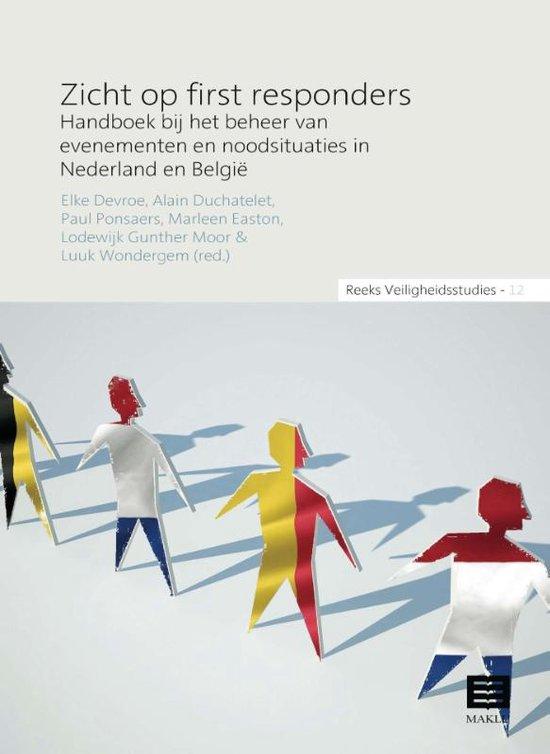
Zicht op first responders. Handboek bij het beheer van evenementen en noodsituaties in Nederland en België (Reeks Veiligheidsstudies, nr. 12)
Tot op heden werd er in de literatuur aandacht besteed aan het opstellen van de interventieplannen en de organisatie van de hierbij voorziene oefeningen. Het daadwerkelijk beheer van grootschalige evenementen en noodsituaties bleef echter nog onderbelicht. Deze reader gaat juist daarop in, en kan daarom als naslagwerk worden beschouwd voor beide landen. Zowel practici als academici leveren een bijdrage. De inhoudsopgave volgt de beleidscyclus, en meer in detail de verschillende fasen van de ketenbenadering.
Zicht op first responders. Handboek bij het beheer van evenementen en noodsituaties in Nederland en België (Reeks Veiligheidsstudies, nr. 12)
Tot op heden werd er in de literatuur aandacht besteed aan het opstellen van de interventieplannen en de organisatie van de hierbij voorziene oefeningen. Het daadwerkelijk beheer van grootschalige evenementen en noodsituaties bleef echter nog onderbelicht. Deze reader gaat juist daarop in, en kan daarom als naslagwerk worden beschouwd voor beide landen. Zowel practici als academici leveren een bijdrage. De inhoudsopgave volgt de beleidscyclus, en meer in detail de verschillende fasen van de ketenbenadering.
Outsourcing policing (CPS 2015 – 3, nr. 36)
De overheid en de politie hebben onder meer een grote rol bij het bewaken en beveiligen van personen en objecten. Diverse instanties werden opgericht naar aanleiding van de aanslagen op de Twin Towers op 11/9/2001 en private partners worden hier in toenemende mate bij betrokken. Ook op het vlak van evenementenbeveiliging, crisisbeheersing en rampenbestrijding doen zich meer en meer samenwerkingsverbanden met private partners voor.
Tot op welke hoogte heeft de politie nog zicht op zaken en kan zij haar regierol waarmaken?
Outsourcing policing (CPS 2015 – 3, nr. 36)
De overheid en de politie hebben onder meer een grote rol bij het bewaken en beveiligen van personen en objecten. Diverse instanties werden opgericht naar aanleiding van de aanslagen op de Twin Towers op 11/9/2001 en private partners worden hier in toenemende mate bij betrokken. Ook op het vlak van evenementenbeveiliging, crisisbeheersing en rampenbestrijding doen zich meer en meer samenwerkingsverbanden met private partners voor.
Tot op welke hoogte heeft de politie nog zicht op zaken en kan zij haar regierol waarmaken?