
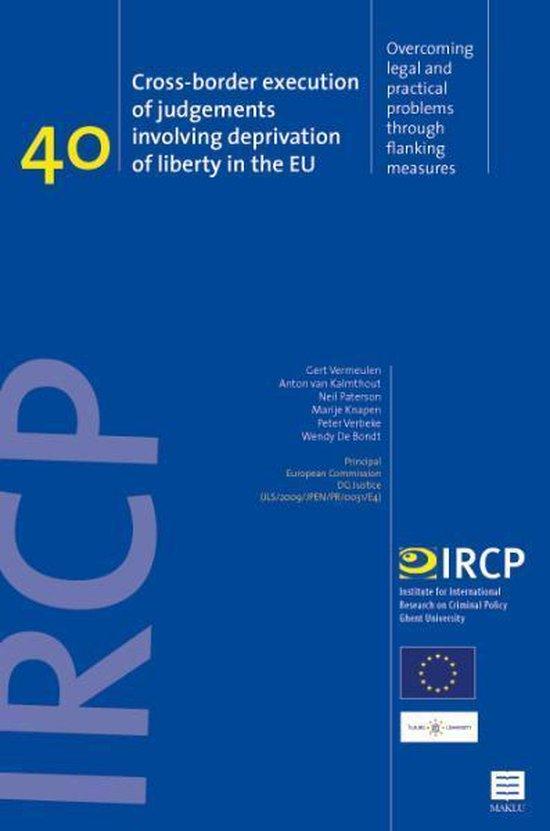
Cross-border execution of judgements involving deprivation of liberty in the EU (IRCP – series, 40)
€ 67,00
The introduction in 2008 of the Framework Decision on the application of the principle
of mutual recognition to judgements in criminal matters imposing custodial sentences
or measures involving deprivation of liberty for the purpose of their enforcement in
the European Union sparked discussions as to whether the practical operation of the
instrument would be compatible with its very objective, being the enhancement of
detained persons’ social rehabilitation prospects.
Transferring detained people back to their respective Member State of residence and/or nationality within the mutual recognition framework is somewhat precarious in light of the often substantial variety of Member States’ legal and prison systems. In this context, and following a call for tender by the European Commission, the authors conducted the biggest study to date on Member States’ material detention conditions, early/conditional release provisions and sentence execution modalities. In addition to exploring the diversity of legal frameworks, the study also assessed practitioners’ views on cross-border execution of custodial sentences in the EU.
This book contains both the EU level legal and practitioners’ analyses as well as the high level final report to the study, confirming preliminary concerns that flanking measures are urgently needed for a proper operation of the Framework Decision.
This is essential reading for EU policy makers, judicial and law enforcement authorities and for defence lawyers throughout the Union. Undoubtedly, this book will be an asset to everyone who is involved in or taking an interest in detention issues and cross-border execution of judgements involving deprivation of liberty in the EU.
Transferring detained people back to their respective Member State of residence and/or nationality within the mutual recognition framework is somewhat precarious in light of the often substantial variety of Member States’ legal and prison systems. In this context, and following a call for tender by the European Commission, the authors conducted the biggest study to date on Member States’ material detention conditions, early/conditional release provisions and sentence execution modalities. In addition to exploring the diversity of legal frameworks, the study also assessed practitioners’ views on cross-border execution of custodial sentences in the EU.
This book contains both the EU level legal and practitioners’ analyses as well as the high level final report to the study, confirming preliminary concerns that flanking measures are urgently needed for a proper operation of the Framework Decision.
This is essential reading for EU policy makers, judicial and law enforcement authorities and for defence lawyers throughout the Union. Undoubtedly, this book will be an asset to everyone who is involved in or taking an interest in detention issues and cross-border execution of judgements involving deprivation of liberty in the EU.
Cross-border execution of judgements involving deprivation of liberty in the EU (IRCP – series, 40)
€ 67,00
The introduction in 2008 of the Framework Decision on the application of the principle
of mutual recognition to judgements in criminal matters imposing custodial sentences
or measures involving deprivation of liberty for the purpose of their enforcement in
the European Union sparked discussions as to whether the practical operation of the
instrument would be compatible with its very objective, being the enhancement of
detained persons’ social rehabilitation prospects.
Transferring detained people back to their respective Member State of residence and/or nationality within the mutual recognition framework is somewhat precarious in light of the often substantial variety of Member States’ legal and prison systems. In this context, and following a call for tender by the European Commission, the authors conducted the biggest study to date on Member States’ material detention conditions, early/conditional release provisions and sentence execution modalities. In addition to exploring the diversity of legal frameworks, the study also assessed practitioners’ views on cross-border execution of custodial sentences in the EU.
This book contains both the EU level legal and practitioners’ analyses as well as the high level final report to the study, confirming preliminary concerns that flanking measures are urgently needed for a proper operation of the Framework Decision.
This is essential reading for EU policy makers, judicial and law enforcement authorities and for defence lawyers throughout the Union. Undoubtedly, this book will be an asset to everyone who is involved in or taking an interest in detention issues and cross-border execution of judgements involving deprivation of liberty in the EU.
Transferring detained people back to their respective Member State of residence and/or nationality within the mutual recognition framework is somewhat precarious in light of the often substantial variety of Member States’ legal and prison systems. In this context, and following a call for tender by the European Commission, the authors conducted the biggest study to date on Member States’ material detention conditions, early/conditional release provisions and sentence execution modalities. In addition to exploring the diversity of legal frameworks, the study also assessed practitioners’ views on cross-border execution of custodial sentences in the EU.
This book contains both the EU level legal and practitioners’ analyses as well as the high level final report to the study, confirming preliminary concerns that flanking measures are urgently needed for a proper operation of the Framework Decision.
This is essential reading for EU policy makers, judicial and law enforcement authorities and for defence lawyers throughout the Union. Undoubtedly, this book will be an asset to everyone who is involved in or taking an interest in detention issues and cross-border execution of judgements involving deprivation of liberty in the EU.