
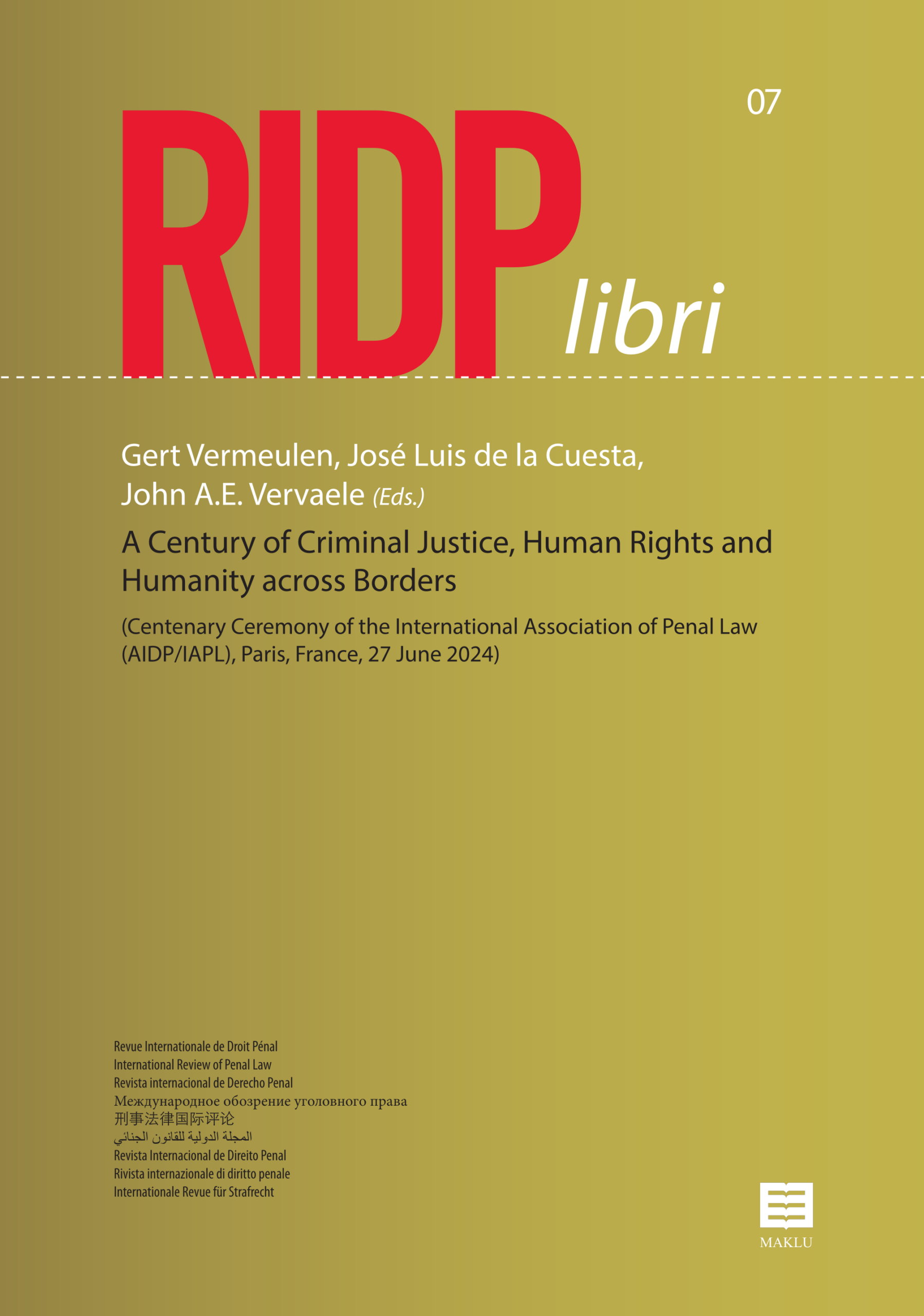

A Century of Criminal Justice, Human Rights and Humanity across Borders. (Centenary Ceremony of the International Association of Penal Law (AIDP/IAPL)) RIDP Libri 07
Gert Vermeulen is General Director Publications of the AIDP/IAPL, Editor-in-chief of the RIDP, and Senior Full Professor of European and international criminal law, sexual criminal law, and data protection law at Ghent University, Belgium. José Luis de la Cuesta is Honorary President of the AIDP/IAPL and Professor of Criminal Law at the University of the Basque Country, San Sebastian, Spain. John A.E. Vervaele is Honorary President of the AIDP/AIPL, Emeritus Professor at Utrecht University, The Netherlands, and Professor in European Criminal Law at the College of Europe, Bruges, Belgium.
A Century of Criminal Justice, Human Rights and Humanity across Borders. (Centenary Ceremony of the International Association of Penal Law (AIDP/IAPL)) RIDP Libri 07
Gert Vermeulen is General Director Publications of the AIDP/IAPL, Editor-in-chief of the RIDP, and Senior Full Professor of European and international criminal law, sexual criminal law, and data protection law at Ghent University, Belgium. José Luis de la Cuesta is Honorary President of the AIDP/IAPL and Professor of Criminal Law at the University of the Basque Country, San Sebastian, Spain. John A.E. Vervaele is Honorary President of the AIDP/AIPL, Emeritus Professor at Utrecht University, The Netherlands, and Professor in European Criminal Law at the College of Europe, Bruges, Belgium.
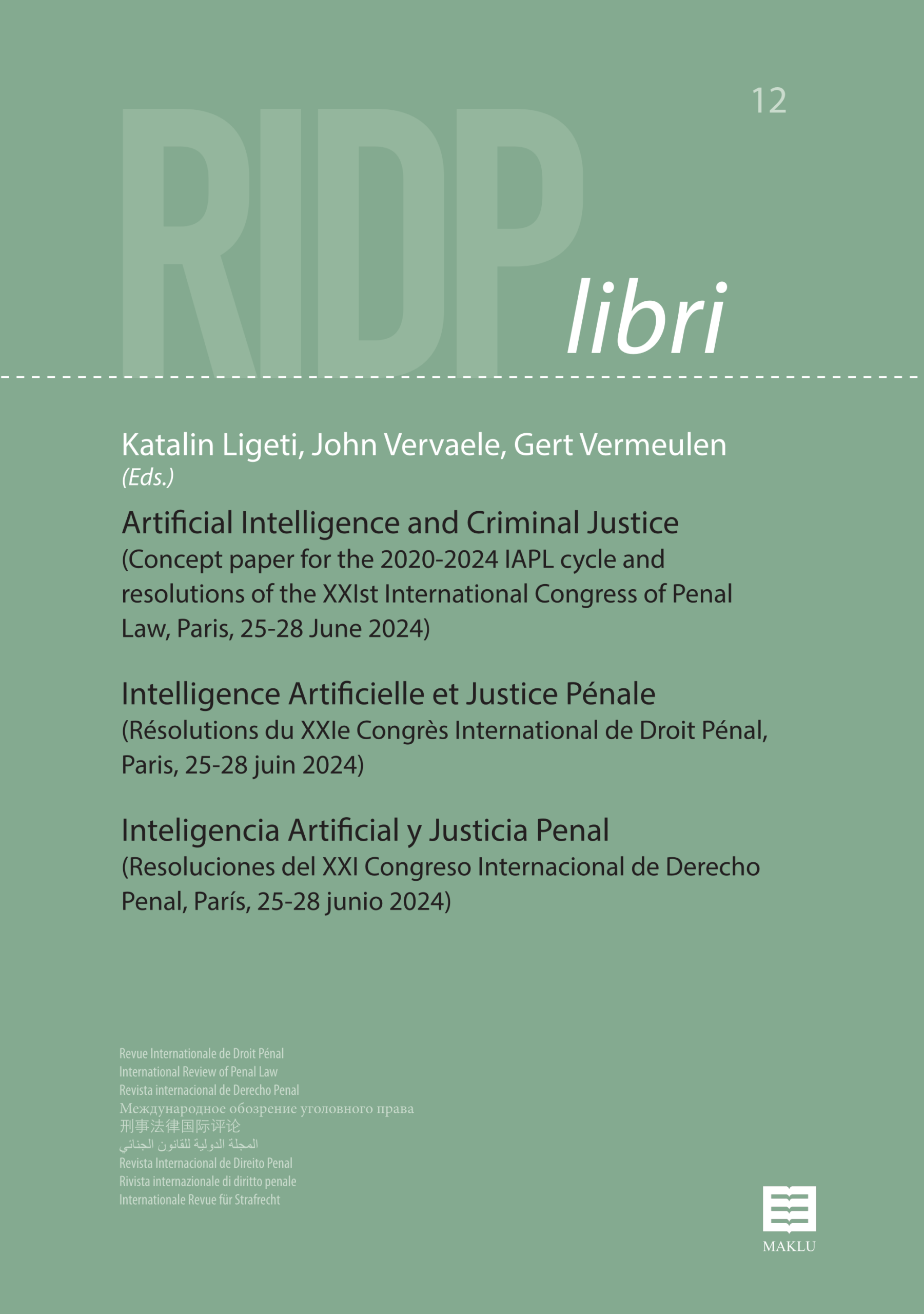
Artificial intelligence and criminal justice (Concept paper for the 2020-2024 IAPL cycle and resolutions of the XXIst International Congress of Penal Law, Paris, 25 – RIDP libri 12
Recognizing the profound impact of AI on criminal justice, the IAPL devoted its 2020-2024 scientific cycle and its concluding XXIst Congress to examining the transformative effects of AI and the legal challenges it poses for both substantive and procedural criminal law. The topic was prepared through a concept paper and explored through four international colloquia, each culminating in the adoption of a set of resolutions addressing a distinct aspect of the criminal justice system. This issue wraps up the cycle, presenting the concept paper (in English) and the trilingual version of the four sets of resolutions.
Au vu de l’impact profond de l’IA sur la justice pénale, l’AIDP a consacré son cycle scientifique 2020-2024 et son XXIe Congrès à l’étude des effets transformateurs de l’IA et des défis juridiques qu’elle pose dans le cadre du droit pénal et de la procédure pénale. Le sujet a été abordé grâce à un document de réflexion initiale et exploré par la suite lors de quatre colloques internationaux, chacun aboutissant à l’adoption d’une série de résolutions portant sur un aspect distinct du système de justice pénale. Ce numéro conclut ce cycle scientifique par la publication du document de réflexion (en anglais) et la version trilingue des quatre séries de résolutions.
Dado el profundo impacto de la IA en la justicia penal, la AIDP dedicó su ciclo científico 2020-2024 y su XXIo Congreso a examinar los efectos transformadores de la IA y los retos jurídicos que plantea tanto para el derecho penal sustantivo como para el procesal. El tema se inició con un documento conceptual y se exploró a través de cuatro coloquios internacionales, cada uno de los cuales culminó con la adopción de un conjunto de resoluciones que abordaban un aspecto distinto del sistema de justicia penal. Este número cierra este ciclo, presentando el documento conceptual (en inglés) y la versión trilingüe de los cuatro conjuntos de resoluciones.
Katalin Ligeti is President of the AIDP/IAPL and Dean of the Faculty of Law, Economics and Finance and Professor of European and International Criminal Law at the University of Luxembourg.
John A.E. Vervaele is Honorary President of the AIDP/IAPL, Emeritus Professor at Utrecht University, The Netherlands, and Professor in European Criminal Law and Human Rights at the College of Europe, Bruges, Belgium
Gert Vermeulen is General Director Publications of the AIDP/IAPL, Editor-in-chief of the RIDP, and Senior Full Professor of European and international criminal law, sexual criminal law, and data protection law at Ghent University, Belgium.
Artificial intelligence and criminal justice (Concept paper for the 2020-2024 IAPL cycle and resolutions of the XXIst International Congress of Penal Law, Paris, 25 – RIDP libri 12
Recognizing the profound impact of AI on criminal justice, the IAPL devoted its 2020-2024 scientific cycle and its concluding XXIst Congress to examining the transformative effects of AI and the legal challenges it poses for both substantive and procedural criminal law. The topic was prepared through a concept paper and explored through four international colloquia, each culminating in the adoption of a set of resolutions addressing a distinct aspect of the criminal justice system. This issue wraps up the cycle, presenting the concept paper (in English) and the trilingual version of the four sets of resolutions.
Au vu de l’impact profond de l’IA sur la justice pénale, l’AIDP a consacré son cycle scientifique 2020-2024 et son XXIe Congrès à l’étude des effets transformateurs de l’IA et des défis juridiques qu’elle pose dans le cadre du droit pénal et de la procédure pénale. Le sujet a été abordé grâce à un document de réflexion initiale et exploré par la suite lors de quatre colloques internationaux, chacun aboutissant à l’adoption d’une série de résolutions portant sur un aspect distinct du système de justice pénale. Ce numéro conclut ce cycle scientifique par la publication du document de réflexion (en anglais) et la version trilingue des quatre séries de résolutions.
Dado el profundo impacto de la IA en la justicia penal, la AIDP dedicó su ciclo científico 2020-2024 y su XXIo Congreso a examinar los efectos transformadores de la IA y los retos jurídicos que plantea tanto para el derecho penal sustantivo como para el procesal. El tema se inició con un documento conceptual y se exploró a través de cuatro coloquios internacionales, cada uno de los cuales culminó con la adopción de un conjunto de resoluciones que abordaban un aspecto distinto del sistema de justicia penal. Este número cierra este ciclo, presentando el documento conceptual (en inglés) y la versión trilingüe de los cuatro conjuntos de resoluciones.
Katalin Ligeti is President of the AIDP/IAPL and Dean of the Faculty of Law, Economics and Finance and Professor of European and International Criminal Law at the University of Luxembourg.
John A.E. Vervaele is Honorary President of the AIDP/IAPL, Emeritus Professor at Utrecht University, The Netherlands, and Professor in European Criminal Law and Human Rights at the College of Europe, Bruges, Belgium
Gert Vermeulen is General Director Publications of the AIDP/IAPL, Editor-in-chief of the RIDP, and Senior Full Professor of European and international criminal law, sexual criminal law, and data protection law at Ghent University, Belgium.
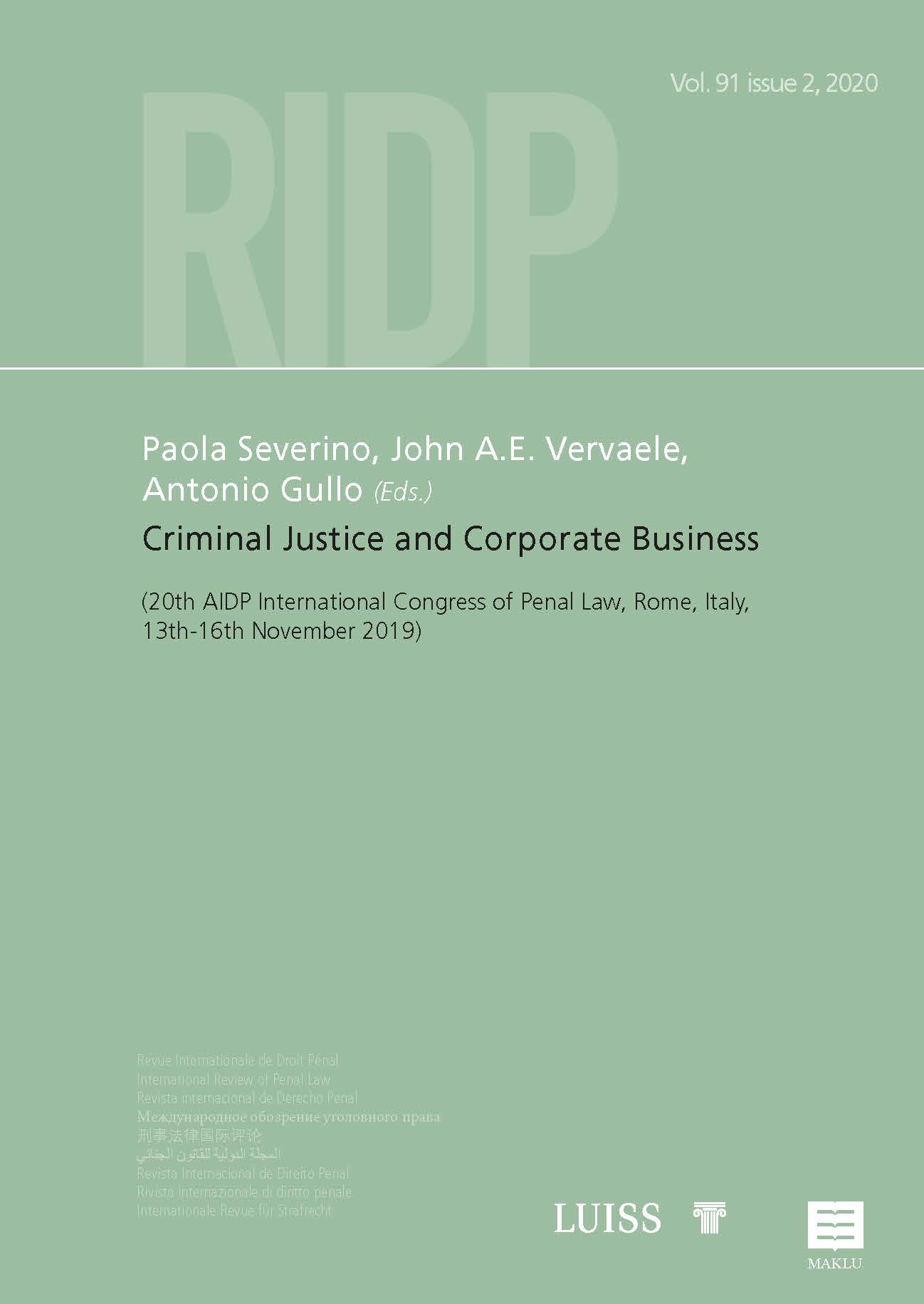
RIDP2020Vol91/iss2-Criminal justice and corporate business
As the title explains, the 2019 International Congress has focused on the relationship between criminal justice and corporate business, reflecting the work of the AIDP over the past five years on individual liability for business involvement in international crimes, food regulation and criminal law, the interplay between administrative and criminal enforcement, the prosecution of corporations for violations of international law and related jurisdictional issues.
The volume is divided into thematic sections and collects the major contributions to the XX International Congress, dealing with issues concerning corruption, financial markets and the role of criminal law; economic crime and the role of new technologies; corporate liability, business integrity and human rights protection; new perspectives related to the criminal justice and corporate business landscape. It also contains the resolutions adopted across the four International Colloquia preceding the XX international Congress.
The articles published in this issue testify to the lively and cross-cutting debate that took place during the numerous plenary and parallel sessions of the Congress and that involved representatives of academia, institutions, governments, the judiciary, and the corporate community.
Paola Severino is Vice President of the AIDP and President of the Italian AIDP National Group; Professor of Criminal Law and Vice President, Luiss University, Rome.
John A. E. Vervaele is President of the AIDP; Professor of economic and European criminal law, Utrecht Law School/ The Netherlands; Professor of European criminal law, College of Europe, Bruges/Belgium.
Antonio Gullo is Secretary General of the Italian AIDP National Group and Member of the AIDP Scientific Committee; Full Professor of Criminal Law at Luiss University, Rome.
RIDP2020Vol91/iss2-Criminal justice and corporate business
As the title explains, the 2019 International Congress has focused on the relationship between criminal justice and corporate business, reflecting the work of the AIDP over the past five years on individual liability for business involvement in international crimes, food regulation and criminal law, the interplay between administrative and criminal enforcement, the prosecution of corporations for violations of international law and related jurisdictional issues.
The volume is divided into thematic sections and collects the major contributions to the XX International Congress, dealing with issues concerning corruption, financial markets and the role of criminal law; economic crime and the role of new technologies; corporate liability, business integrity and human rights protection; new perspectives related to the criminal justice and corporate business landscape. It also contains the resolutions adopted across the four International Colloquia preceding the XX international Congress.
The articles published in this issue testify to the lively and cross-cutting debate that took place during the numerous plenary and parallel sessions of the Congress and that involved representatives of academia, institutions, governments, the judiciary, and the corporate community.
Paola Severino is Vice President of the AIDP and President of the Italian AIDP National Group; Professor of Criminal Law and Vice President, Luiss University, Rome.
John A. E. Vervaele is President of the AIDP; Professor of economic and European criminal law, Utrecht Law School/ The Netherlands; Professor of European criminal law, College of Europe, Bruges/Belgium.
Antonio Gullo is Secretary General of the Italian AIDP National Group and Member of the AIDP Scientific Committee; Full Professor of Criminal Law at Luiss University, Rome.