
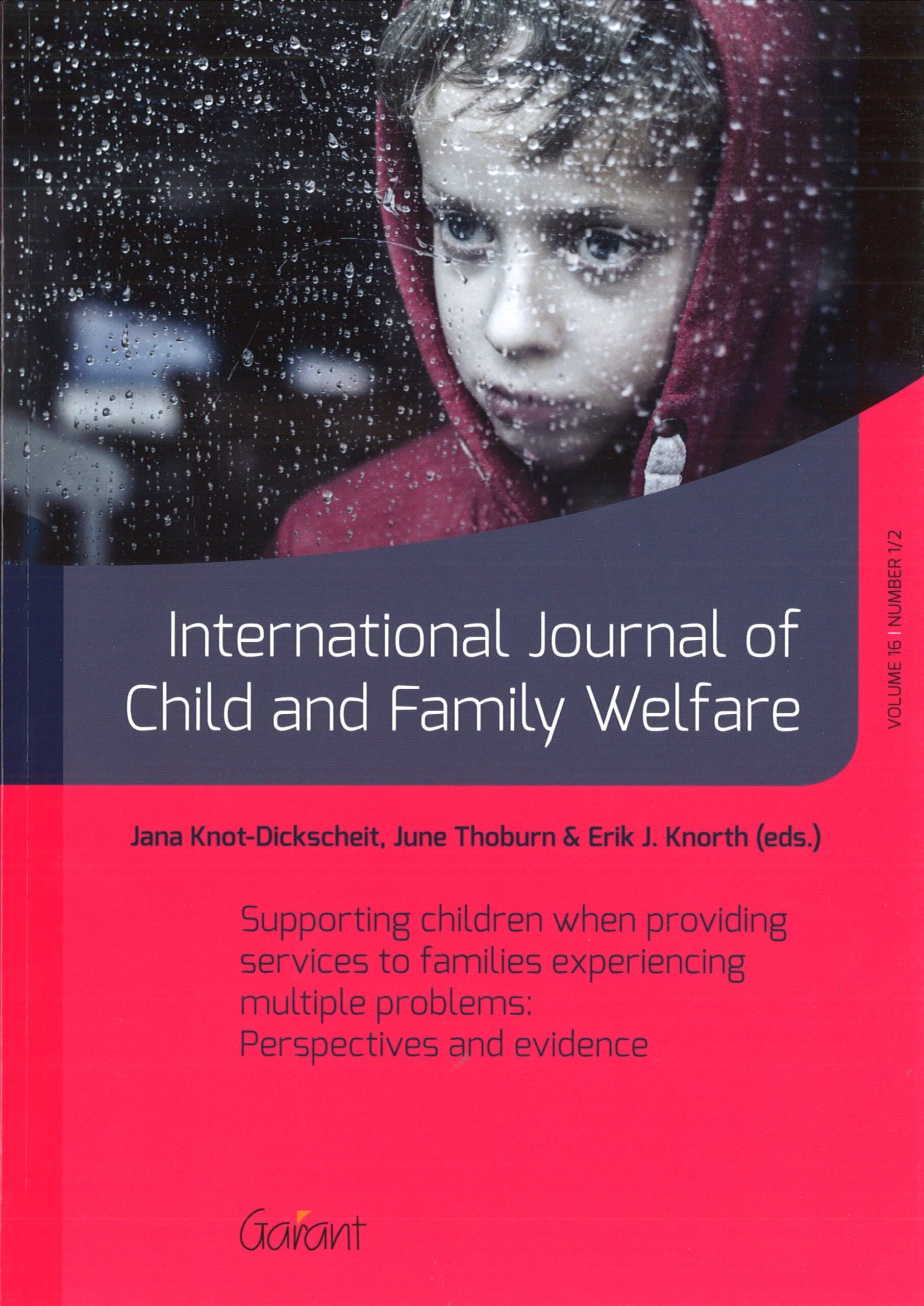
International Journal of Child and Family Welfare (IJCFW) 2015 – Jrg 16 – Nr 1/2
Supporting children when providing services to families experiencing multiple problems: Perspectives and evidence.
Recently, there has been growing interest amongst researchers, practitioners and policy-makers in approaches to understanding and ways of helping parents, children and the communities in which they live to respond to families experiencing multiple problems (FEMPs). There is a strong need for information - both descriptive in terms of the services actually offered directly to children as well as their ability to benefit from the services provided to the whole family, and also evaluative, with a focus on outcomes. Motivated by the need for practice-oriented knowledge this special issue was prepared.
The contributions have been divided into two parts; the first part focusing on perspectives on helping these families with special attention to the position and the interests of children; the second part covering empirical research on intervention programmes for FEMPs that support them in coping with daily struggles and challenges, and helping them to prevent unnecessary out-of-home placement of a child.
The (guest) editors: Jana Knot-Dickscheit, June Thoburn, Erik J. Knorth.
The authors: Erik J. Knorth, Jana Knot-Dickscheit, June Thoburn, Tim Tausendfreund, Brigid M. Daniel, Inge Busschers, Leonieke Boendermaker, Marian Brandon, Penny Sorensen, Sue Bailey, Sara Connolly, Sofia Rodrigues, Madalena Alarcão, Liliana Sousa, Anat Zeira, Cinzia Canali, Tiziano Vecchiato, Harm Damen, Jan W. Veerman
International Journal of Child and Family Welfare (IJCFW) 2015 – Jrg 16 – Nr 1/2
Supporting children when providing services to families experiencing multiple problems: Perspectives and evidence.
Recently, there has been growing interest amongst researchers, practitioners and policy-makers in approaches to understanding and ways of helping parents, children and the communities in which they live to respond to families experiencing multiple problems (FEMPs). There is a strong need for information - both descriptive in terms of the services actually offered directly to children as well as their ability to benefit from the services provided to the whole family, and also evaluative, with a focus on outcomes. Motivated by the need for practice-oriented knowledge this special issue was prepared.
The contributions have been divided into two parts; the first part focusing on perspectives on helping these families with special attention to the position and the interests of children; the second part covering empirical research on intervention programmes for FEMPs that support them in coping with daily struggles and challenges, and helping them to prevent unnecessary out-of-home placement of a child.
The (guest) editors: Jana Knot-Dickscheit, June Thoburn, Erik J. Knorth.
The authors: Erik J. Knorth, Jana Knot-Dickscheit, June Thoburn, Tim Tausendfreund, Brigid M. Daniel, Inge Busschers, Leonieke Boendermaker, Marian Brandon, Penny Sorensen, Sue Bailey, Sara Connolly, Sofia Rodrigues, Madalena Alarcão, Liliana Sousa, Anat Zeira, Cinzia Canali, Tiziano Vecchiato, Harm Damen, Jan W. Veerman