

Deviance and Crime – Social Control, Criminal Justice and Criminology in Europe (GERN Research Paper Series, nr 5)
With the inauguration of this Research Paper Series, GERN intends to monitor and disseminate cutting-edge studies into European security issues, reflecting the result of doctoral research in the framework of the GERN. The series provides an excellent platform from which to survey key emergent topics in the field. With this series the editors and authors are contributing to a better understanding of contemporary questions, presenting recent research results and scientific reflection, by devising new approaches and by re-evaluating the heritage of social sciences in this domain. It implies a new openness with regard to other disciplines and to the normative questions arising from the constructions of deviance and crime, the commission of criminal acts, its consequences and its development, as well as the application of deviance categories and the social or formal reaction to it by actors in the criminal justice system and beyond.
This is the fifth volume stemming from the annual doctoral conferences organized by the GERN in September 2016 in Dortmund, Germany. The selected theme for this Summer School was “Deviance and Crime – Social Control, Criminal Justice, and Criminology in Europe”; reflecting the variety of theoretical frameworks and methodologies covered by the current PhD theses in the field of criminal justice and deviance as well as fresh and new perspectives on deviant and criminal careers, on the history of restorative justice and on crime as the central theoretical concept in criminology.
Deviance and Crime – Social Control, Criminal Justice and Criminology in Europe (GERN Research Paper Series, nr 5)
With the inauguration of this Research Paper Series, GERN intends to monitor and disseminate cutting-edge studies into European security issues, reflecting the result of doctoral research in the framework of the GERN. The series provides an excellent platform from which to survey key emergent topics in the field. With this series the editors and authors are contributing to a better understanding of contemporary questions, presenting recent research results and scientific reflection, by devising new approaches and by re-evaluating the heritage of social sciences in this domain. It implies a new openness with regard to other disciplines and to the normative questions arising from the constructions of deviance and crime, the commission of criminal acts, its consequences and its development, as well as the application of deviance categories and the social or formal reaction to it by actors in the criminal justice system and beyond.
This is the fifth volume stemming from the annual doctoral conferences organized by the GERN in September 2016 in Dortmund, Germany. The selected theme for this Summer School was “Deviance and Crime – Social Control, Criminal Justice, and Criminology in Europe”; reflecting the variety of theoretical frameworks and methodologies covered by the current PhD theses in the field of criminal justice and deviance as well as fresh and new perspectives on deviant and criminal careers, on the history of restorative justice and on crime as the central theoretical concept in criminology.
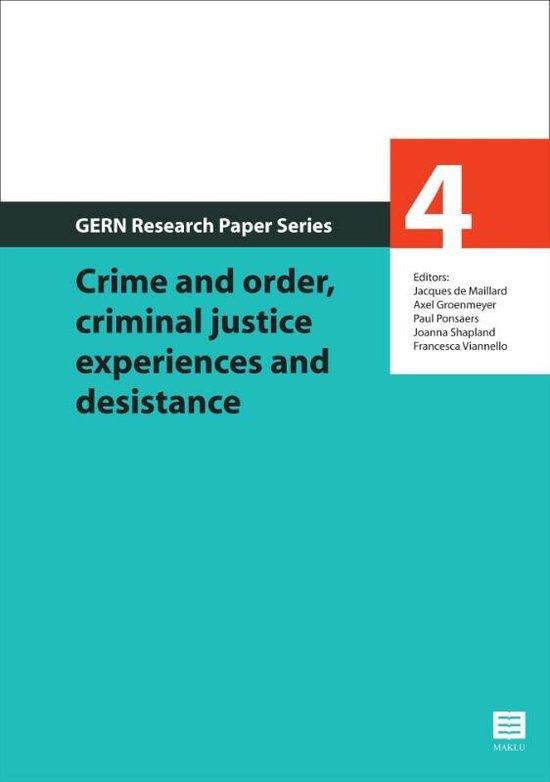
Crime and order, criminal justice experiences and desistance (GERN Research Paper Series, nr 4)
GERN (Groupement Européen de Recherches sur les Normativités) is a large con-sortium of scientific researchers in the domain of deviance and social control, more precisely studying delinquency, penal institutions, public policies of security and the importance of penal questions in society. The consortium is multidisciplinary.
Today GERN is a scientific network present in ten European countries and abroad, uniting researchers of different disciplines. Each year the GERN organizes a doctoral summer school, giving PhD students from the consortium the opportunity to present and discuss their ongoing projects and research results as well as meet young and senior researchers.
This is the fourth volume stemming from the annual doctoral conferences organized by the GERN. Last edition of the Summer School was held in September 2015 in Paris. The selected theme for this Summer School was “Crime and order, criminal justice experiences and desistance”, reflecting the variety of theoretical frameworks and methodologies covered by the current PhD theses in the field of criminal justice and deviance as well as the fresh and new perspectives on subjective experiences of the criminal justice system and trajectories of desistance.
Critical thinking differs from magic reasoning, common sense, and speculation. Scientific evidence contrasts with belief, immediate and apparent knowledge, illusion and opinion. This is particularly true for the science of crime, criminology and more generally social sciences research on criminal justice issues. With the inauguration of this Research Paper Series, GERN intends to monitor and disseminate cutting-edge studies into European security issues, reflecting the result of doctoral research in the framework of the GERN. The series provides an excellent platform from which to survey key emergent topics in the field. With this series the editors and authors are contributing to a better understanding of contemporary questions, presenting recent research results and scientific reflection, by devising new approaches and by re-evaluating the heritage of social sciences in this domain. It implies a new openness with regard to other disciplines and to the normative questions arising from the commission of crime and the formal reaction to it by actors in the criminal justice system and beyond.
Crime and order, criminal justice experiences and desistance (GERN Research Paper Series, nr 4)
GERN (Groupement Européen de Recherches sur les Normativités) is a large con-sortium of scientific researchers in the domain of deviance and social control, more precisely studying delinquency, penal institutions, public policies of security and the importance of penal questions in society. The consortium is multidisciplinary.
Today GERN is a scientific network present in ten European countries and abroad, uniting researchers of different disciplines. Each year the GERN organizes a doctoral summer school, giving PhD students from the consortium the opportunity to present and discuss their ongoing projects and research results as well as meet young and senior researchers.
This is the fourth volume stemming from the annual doctoral conferences organized by the GERN. Last edition of the Summer School was held in September 2015 in Paris. The selected theme for this Summer School was “Crime and order, criminal justice experiences and desistance”, reflecting the variety of theoretical frameworks and methodologies covered by the current PhD theses in the field of criminal justice and deviance as well as the fresh and new perspectives on subjective experiences of the criminal justice system and trajectories of desistance.
Critical thinking differs from magic reasoning, common sense, and speculation. Scientific evidence contrasts with belief, immediate and apparent knowledge, illusion and opinion. This is particularly true for the science of crime, criminology and more generally social sciences research on criminal justice issues. With the inauguration of this Research Paper Series, GERN intends to monitor and disseminate cutting-edge studies into European security issues, reflecting the result of doctoral research in the framework of the GERN. The series provides an excellent platform from which to survey key emergent topics in the field. With this series the editors and authors are contributing to a better understanding of contemporary questions, presenting recent research results and scientific reflection, by devising new approaches and by re-evaluating the heritage of social sciences in this domain. It implies a new openness with regard to other disciplines and to the normative questions arising from the commission of crime and the formal reaction to it by actors in the criminal justice system and beyond.
Criminology, Security and Justice. Methodological and epistemological issues (GERN Research Paper Series, nr 3)
This is the third volume stemming from the annual doctoral conferences organized by the GERN. Last edition of the Summer School was held in September 2014 in Porto (Portugal). The selected theme for this Summer School was ‘Criminology, Security and Justice: methodological and epistemological issues’, searching for a fruitful debate about the methodological and epistemological aspects relevant for the development of PhD thesis. Scientific research is, in its essence, critical thinking. What is critical thinking? It is a kind of thinking that differs from magic reasoning, common sense, and speculation. Scientific evidence contrasts with belief, immediate and apparent knowledge, illusion and opinion. This is valid for every knowledge domain that claims to be scientific. It is thus true for the science of crime, criminology.
With the inauguration of this Research Paper Series, GERN intends to monitor and
disseminate cutting-edge studies into European security issues, reflecting the result
of doctoral research in the framework of the GERN. The series provides an excellent
platform from which to survey key emergent topics in the field. With this
series the editors and authors are contributing to a better understanding of contemporary
questions, presenting recent research results and scientific reflection,
by devising new approaches and by re-evaluating the heritage of social sciences
in this domain. It implies a new openness with regard to other disciplines and to
the normative questions arising from the commission of crime and the formal reaction
to it by actors in the criminal justice system and beyond.
Criminology, Security and Justice. Methodological and epistemological issues (GERN Research Paper Series, nr 3)
This is the third volume stemming from the annual doctoral conferences organized by the GERN. Last edition of the Summer School was held in September 2014 in Porto (Portugal). The selected theme for this Summer School was ‘Criminology, Security and Justice: methodological and epistemological issues’, searching for a fruitful debate about the methodological and epistemological aspects relevant for the development of PhD thesis. Scientific research is, in its essence, critical thinking. What is critical thinking? It is a kind of thinking that differs from magic reasoning, common sense, and speculation. Scientific evidence contrasts with belief, immediate and apparent knowledge, illusion and opinion. This is valid for every knowledge domain that claims to be scientific. It is thus true for the science of crime, criminology.
With the inauguration of this Research Paper Series, GERN intends to monitor and
disseminate cutting-edge studies into European security issues, reflecting the result
of doctoral research in the framework of the GERN. The series provides an excellent
platform from which to survey key emergent topics in the field. With this
series the editors and authors are contributing to a better understanding of contemporary
questions, presenting recent research results and scientific reflection,
by devising new approaches and by re-evaluating the heritage of social sciences
in this domain. It implies a new openness with regard to other disciplines and to
the normative questions arising from the commission of crime and the formal reaction
to it by actors in the criminal justice system and beyond.
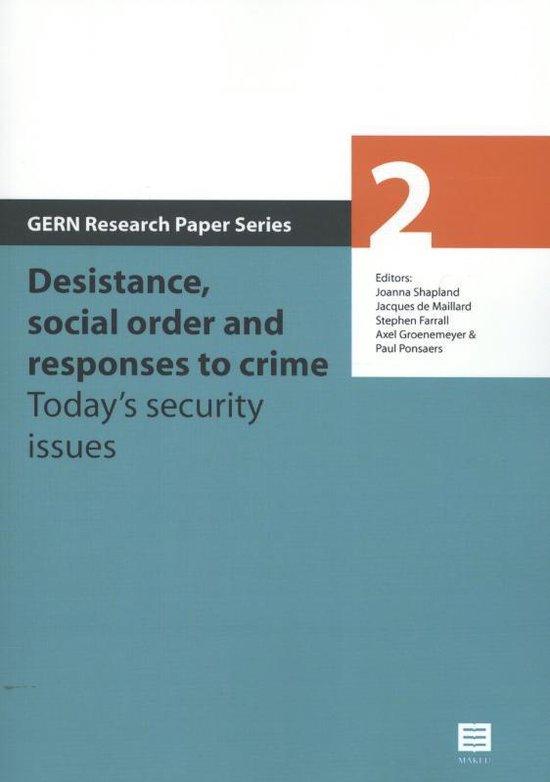
Desistance, social order and responses to crime. Today’s security issues (GERN Research Paper Series, nr 2)
This book contains a selection of papers, which were presented and discussed at the second GERN Doctoral Conference for PhD students, organised by the White Rose Consortium of the Universities of Leeds, Sheffield and York and held in September 2013 at the University of Sheffield, UK. The book is the result of intensive reflection and engagement between the authors and the editors. The essays in the book coalesce around three themes: desistance from offending; creating and recreating social order; and responses to crime and violence. It contains cutting-edge research by emerging European scholars in the field of ‘Desistance, Social Order and Responses to Crime: Today’s Security Issues’.
The second in this series of Research Papers continues the ambition of GERN to monitor and disseminate important new studies into European security issues, reflecting the result of doctoral research in the framework of GERN. This series provides an excellent platform from which to survey key emerging topics in the field. With this series the editors and authors are contributing to a better understanding of contemporary questions, presenting recent research results and scientific reflection, by devising new approaches and by re-evaluating the heritage of social sciences in this domain. It implies a new openness with regard to other disciplines and to the normative questions arising from the commission of crime and the formal reactions to it by actors in the criminal justice system and beyond.
Desistance, social order and responses to crime. Today’s security issues (GERN Research Paper Series, nr 2)
This book contains a selection of papers, which were presented and discussed at the second GERN Doctoral Conference for PhD students, organised by the White Rose Consortium of the Universities of Leeds, Sheffield and York and held in September 2013 at the University of Sheffield, UK. The book is the result of intensive reflection and engagement between the authors and the editors. The essays in the book coalesce around three themes: desistance from offending; creating and recreating social order; and responses to crime and violence. It contains cutting-edge research by emerging European scholars in the field of ‘Desistance, Social Order and Responses to Crime: Today’s Security Issues’.
The second in this series of Research Papers continues the ambition of GERN to monitor and disseminate important new studies into European security issues, reflecting the result of doctoral research in the framework of GERN. This series provides an excellent platform from which to survey key emerging topics in the field. With this series the editors and authors are contributing to a better understanding of contemporary questions, presenting recent research results and scientific reflection, by devising new approaches and by re-evaluating the heritage of social sciences in this domain. It implies a new openness with regard to other disciplines and to the normative questions arising from the commission of crime and the formal reactions to it by actors in the criminal justice system and beyond.
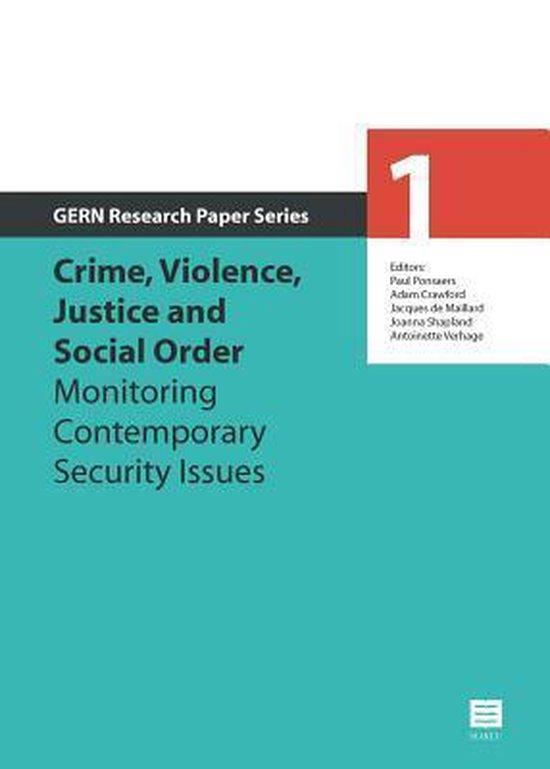
Crime, violence, justice and social order. Monitoring contemporary security issues (GERN Research Paper Series, nr 1)
This book contains a selection of papers, which were presented and discussed at the first GERN Summer School for PhD students held in September 2012 at Ghent University, Belgium.
This collection of essays is the result of an intensive reflection and engagement between the authors and the editors. The essays in the book coalesce around four overarching themes: the use and meaning of violence; policing the informal economy and tackling social disorder; methodological issues in research on crime; and contemporary penal institutions. It is a rich compilation of new work by emerging European scholars in the field of ‘Crime, Violence, Justice and Social Order’.
With the inauguration of this new Research Paper Series, GERN intends to monitor and disseminate cutting-edge studies into European security issues, reflecting the result of doctoral research in the framework of the GERN. This series provides an excellent platform from which to survey key emergent topics in the field.
With
this new series the editors and authors are contributing to a better understanding
of contemporary questions, presenting recent research results and scientific
reflection, by devising new approaches and by re-evaluating the heritage of social
sciences in this domain. It implies a new openness with regard to other disciplines
and to the normative questions arising from the commission of crime and the formal
reaction to it by actors in the criminal justice system and beyond.
Crime, violence, justice and social order. Monitoring contemporary security issues (GERN Research Paper Series, nr 1)
This book contains a selection of papers, which were presented and discussed at the first GERN Summer School for PhD students held in September 2012 at Ghent University, Belgium.
This collection of essays is the result of an intensive reflection and engagement between the authors and the editors. The essays in the book coalesce around four overarching themes: the use and meaning of violence; policing the informal economy and tackling social disorder; methodological issues in research on crime; and contemporary penal institutions. It is a rich compilation of new work by emerging European scholars in the field of ‘Crime, Violence, Justice and Social Order’.
With the inauguration of this new Research Paper Series, GERN intends to monitor and disseminate cutting-edge studies into European security issues, reflecting the result of doctoral research in the framework of the GERN. This series provides an excellent platform from which to survey key emergent topics in the field.
With
this new series the editors and authors are contributing to a better understanding
of contemporary questions, presenting recent research results and scientific
reflection, by devising new approaches and by re-evaluating the heritage of social
sciences in this domain. It implies a new openness with regard to other disciplines
and to the normative questions arising from the commission of crime and the formal
reaction to it by actors in the criminal justice system and beyond.
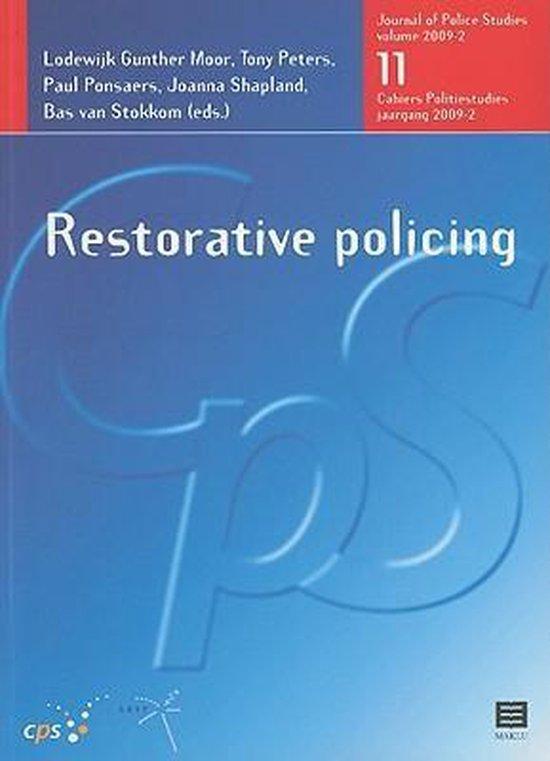
Restorative policing (CPS 2009 – 2, nr. 11)
This volume describes and conceptualises the incorporation of these restorative practices within day-to-day policing in the Low Countries, together with some practices from England and Wales. Some restorative practices involve the police responding to criminal offences, but passing the case on for mediation to other agencies. In other situations, the police are much more active within the restorative process, taking the role of mediator themselves. So police may undertake mediation, refer cases to mediation and/or signpost the possibility of mediation to the parties, depending on the situation and the schemes in place in each town and country.
Sinds Community (Oriented) Policing (COP) als officieel denkkader werd aanvaard in ons land is meer en meer het besef doorgedrongen dat de politie een brede dienstverlenende opdracht heeft ten aanzien van de bevolking. Op het kruispunt van herstelrecht en gemeenschapsgerichte politiezorg ontwikkelden zich de laatste jaren lokaal een aantal boeiende praktijken. Politiemensen spreken burgers hierbij aan om zelf in onderling overleg op zoek te gaan naar mogelijkheden tot herstel. In dit Cahier worden mogelijkheden van herstelgerichte praktijken op politieniveau verkend. Hierbij wordt gekeken naar praktijken in binnen- en buitenland en worden de resultaten van het beschikbare wetenschappelijk onderzoek onder de aandacht gebracht.
Restorative policing (CPS 2009 – 2, nr. 11)
This volume describes and conceptualises the incorporation of these restorative practices within day-to-day policing in the Low Countries, together with some practices from England and Wales. Some restorative practices involve the police responding to criminal offences, but passing the case on for mediation to other agencies. In other situations, the police are much more active within the restorative process, taking the role of mediator themselves. So police may undertake mediation, refer cases to mediation and/or signpost the possibility of mediation to the parties, depending on the situation and the schemes in place in each town and country.
Sinds Community (Oriented) Policing (COP) als officieel denkkader werd aanvaard in ons land is meer en meer het besef doorgedrongen dat de politie een brede dienstverlenende opdracht heeft ten aanzien van de bevolking. Op het kruispunt van herstelrecht en gemeenschapsgerichte politiezorg ontwikkelden zich de laatste jaren lokaal een aantal boeiende praktijken. Politiemensen spreken burgers hierbij aan om zelf in onderling overleg op zoek te gaan naar mogelijkheden tot herstel. In dit Cahier worden mogelijkheden van herstelgerichte praktijken op politieniveau verkend. Hierbij wordt gekeken naar praktijken in binnen- en buitenland en worden de resultaten van het beschikbare wetenschappelijk onderzoek onder de aandacht gebracht.