
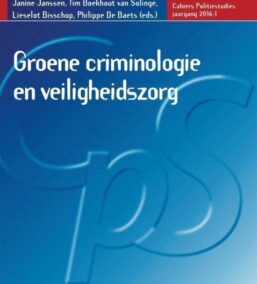
Groene criminologie en veiligheidszorg (CPS 2016 – 1, nr. 38)
Criminologie heeft lange tijd de studie van milieucriminaliteit en -regulering genegeerd. Het was Lynch die in 1990 voor het eerst wees op het belang van een kritisch criminologische studie van milieuschade; daarmee was de term ‘groene criminologie’ geboren. Milieucriminaliteit verwijst naar schade veroorzaakt door zowel individuen als bedrijven én overheden aan ecosystemen, mensen en dieren. Het hoeft daarbij niet steeds te gaan om (reeds) strafbaar gesteld gedrag.
De aandacht voor het milieu blijft echter nog beperkt, ondanks de gegroeide aandacht. Daarom stellen we in dit Cahier dit studiegebied centraal. We onderzoeken wat de groene criminaliteit betekent voor de politiewerking. Is de politie in staat om over de eigen landsgrenzen heen samen te werken en internationale vormen van groene criminaliteit het hoofd te bieden? Ook niet-politionele actoren krijgen aandacht in dit Cahier, waarbij gedacht wordt aan inspectiediensten, milieuadministraties, douanediensten en NGO’s. Ook zij betekenen voor de politie belangrijke partners in de veiligheidszorg.
Groene criminologie en veiligheidszorg (CPS 2016 – 1, nr. 38)
Criminologie heeft lange tijd de studie van milieucriminaliteit en -regulering genegeerd. Het was Lynch die in 1990 voor het eerst wees op het belang van een kritisch criminologische studie van milieuschade; daarmee was de term ‘groene criminologie’ geboren. Milieucriminaliteit verwijst naar schade veroorzaakt door zowel individuen als bedrijven én overheden aan ecosystemen, mensen en dieren. Het hoeft daarbij niet steeds te gaan om (reeds) strafbaar gesteld gedrag.
De aandacht voor het milieu blijft echter nog beperkt, ondanks de gegroeide aandacht. Daarom stellen we in dit Cahier dit studiegebied centraal. We onderzoeken wat de groene criminaliteit betekent voor de politiewerking. Is de politie in staat om over de eigen landsgrenzen heen samen te werken en internationale vormen van groene criminaliteit het hoofd te bieden? Ook niet-politionele actoren krijgen aandacht in dit Cahier, waarbij gedacht wordt aan inspectiediensten, milieuadministraties, douanediensten en NGO’s. Ook zij betekenen voor de politie belangrijke partners in de veiligheidszorg.
Gezinspedagogiek – Deel 2: Opvoedingsondersteuning
Deze uitgave is een initiatief van het Centrum voor Gezinspedagogiek van de K. U. Leuven, de Afdeling Gezin en Gedrag van de K.U. Nijmegen en het Hoger Instituut voor Gezinswetenschappen in Brussel.
Gezinspedagogiek – Deel 2: Opvoedingsondersteuning
Deze uitgave is een initiatief van het Centrum voor Gezinspedagogiek van de K. U. Leuven, de Afdeling Gezin en Gedrag van de K.U. Nijmegen en het Hoger Instituut voor Gezinswetenschappen in Brussel.
State-building in Kosovo. A plural policing perspective
This book challenges the conventional wisdom of international policing in transitional societies which seeks to strengthen the state police. It builds on a growing body of literature on the pluralization of policing in Western democracies and transitional states which contends that the state police is merely one security provider in a complex policing landscape. Through a case study of Kosovo, this book proposes possible forms of plural policing and the relationship between state-builders and non-state policing agents such as private security companies, gangs and Kanun-based policing systems.
The book provides insights in the field of (plural) policing in transitional societies and overall policing strategies used by the international community in Kosovo.
GPRC – guaranteed peer reviewed contentJelle Janssens (1981) is a criminologist (2005), holds a master in Public Management (2006) and a Ph.D. in Criminology (2013). He is a researcher at the Department of Criminology, Criminal Law and Social Law of the Faculty of Law (Ghent University) and a member of the Institute of International Research on Criminal Policy (IRCP). His research interests focus on policing in post-conflict environments, (international) criminal policy and law enforcement, community policing and plural policing.
State-building in Kosovo. A plural policing perspective
This book challenges the conventional wisdom of international policing in transitional societies which seeks to strengthen the state police. It builds on a growing body of literature on the pluralization of policing in Western democracies and transitional states which contends that the state police is merely one security provider in a complex policing landscape. Through a case study of Kosovo, this book proposes possible forms of plural policing and the relationship between state-builders and non-state policing agents such as private security companies, gangs and Kanun-based policing systems.
The book provides insights in the field of (plural) policing in transitional societies and overall policing strategies used by the international community in Kosovo.
GPRC – guaranteed peer reviewed contentJelle Janssens (1981) is a criminologist (2005), holds a master in Public Management (2006) and a Ph.D. in Criminology (2013). He is a researcher at the Department of Criminology, Criminal Law and Social Law of the Faculty of Law (Ghent University) and a member of the Institute of International Research on Criminal Policy (IRCP). His research interests focus on policing in post-conflict environments, (international) criminal policy and law enforcement, community policing and plural policing.