
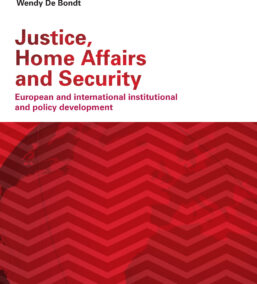
Justice, Home Affairs and Security – 4th, revised edition
€ 36,00
This book offers insight into the development of the EU in the areas of justice, home affairs and security, embedded in a broader international context. In addition to the main part, dedicated to the EU, the book features chapters on cooperation in the areas concerned at Benelux, Schengen, Council of Europe, NATO, OSCE, G7/G20, OECD and UN levels.
The chapter structure is identical for all cooperation levels addressed, discussing their actual policies after sketching their historical development and institutional structure and functioning.
For students and professionals in criminology, law and political science and for everyone interested in European and international criminal policy making this book will prove relevant or insightful.
The chapter structure is identical for all cooperation levels addressed, discussing their actual policies after sketching their historical development and institutional structure and functioning.
For students and professionals in criminology, law and political science and for everyone interested in European and international criminal policy making this book will prove relevant or insightful.
Justice, Home Affairs and Security – 4th, revised edition
€ 36,00
This book offers insight into the development of the EU in the areas of justice, home affairs and security, embedded in a broader international context. In addition to the main part, dedicated to the EU, the book features chapters on cooperation in the areas concerned at Benelux, Schengen, Council of Europe, NATO, OSCE, G7/G20, OECD and UN levels.
The chapter structure is identical for all cooperation levels addressed, discussing their actual policies after sketching their historical development and institutional structure and functioning.
For students and professionals in criminology, law and political science and for everyone interested in European and international criminal policy making this book will prove relevant or insightful.
The chapter structure is identical for all cooperation levels addressed, discussing their actual policies after sketching their historical development and institutional structure and functioning.
For students and professionals in criminology, law and political science and for everyone interested in European and international criminal policy making this book will prove relevant or insightful.
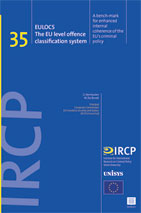
Eulocs. The EU level offence classification system. A bench-mark for enhanced internal coherence of the EU’s criminal policy (IRCP series, 35)
€ 39,00
EULOCS – the EU level offence classification system – brings together
the current EU substantive criminal law acquis, building essentially
on offence definitions referred to in legal instruments included in
the EU JHA acquis. In doing so, EULOCS clarifies the scope between
EU competence and national sovereignty with regard to defining
criminal behaviour.
With this book, EULOCS is bench-marked as a reference index for serving various needs in the broader EU criminal policy area, having the potential to significantly enhance the internal coherence thereof. The proposed reference index, with offence definitions inherent to it, fundamentally addresses the problem created by the organic elaboration and adoption of legal instruments at EU level, making reference to certain offence categories the scope or definition whereof is most often either not clarified or indicated, or left to the discretion of the individual member state(s).
Before elaborating on the creation of EULOCS, the methodology used, its main characteristics and potential further development in the coming years, this book contains a brief overview of the incoherence in the EU JHA field and a reference to the EU study to implement the Action Plan to measure crime and criminal justice, conducted for the European Commission in the course of 2008-2009, in the context of which EULOCS has been created. Most importantly, the full EULOCS with all its complementary variables and context fields has been inserted.
This book is essential reading for EU policy makers, judicial and law enforcement authorities throughout the Union and from a broader international context. It will be particularly appealing also to the research community and anyone involved in or taking an interest in justice and home affairs or criminal policy initiatives in the European Union.
With this book, EULOCS is bench-marked as a reference index for serving various needs in the broader EU criminal policy area, having the potential to significantly enhance the internal coherence thereof. The proposed reference index, with offence definitions inherent to it, fundamentally addresses the problem created by the organic elaboration and adoption of legal instruments at EU level, making reference to certain offence categories the scope or definition whereof is most often either not clarified or indicated, or left to the discretion of the individual member state(s).
Before elaborating on the creation of EULOCS, the methodology used, its main characteristics and potential further development in the coming years, this book contains a brief overview of the incoherence in the EU JHA field and a reference to the EU study to implement the Action Plan to measure crime and criminal justice, conducted for the European Commission in the course of 2008-2009, in the context of which EULOCS has been created. Most importantly, the full EULOCS with all its complementary variables and context fields has been inserted.
This book is essential reading for EU policy makers, judicial and law enforcement authorities throughout the Union and from a broader international context. It will be particularly appealing also to the research community and anyone involved in or taking an interest in justice and home affairs or criminal policy initiatives in the European Union.
Eulocs. The EU level offence classification system. A bench-mark for enhanced internal coherence of the EU’s criminal policy (IRCP series, 35)
€ 39,00
EULOCS – the EU level offence classification system – brings together
the current EU substantive criminal law acquis, building essentially
on offence definitions referred to in legal instruments included in
the EU JHA acquis. In doing so, EULOCS clarifies the scope between
EU competence and national sovereignty with regard to defining
criminal behaviour.
With this book, EULOCS is bench-marked as a reference index for serving various needs in the broader EU criminal policy area, having the potential to significantly enhance the internal coherence thereof. The proposed reference index, with offence definitions inherent to it, fundamentally addresses the problem created by the organic elaboration and adoption of legal instruments at EU level, making reference to certain offence categories the scope or definition whereof is most often either not clarified or indicated, or left to the discretion of the individual member state(s).
Before elaborating on the creation of EULOCS, the methodology used, its main characteristics and potential further development in the coming years, this book contains a brief overview of the incoherence in the EU JHA field and a reference to the EU study to implement the Action Plan to measure crime and criminal justice, conducted for the European Commission in the course of 2008-2009, in the context of which EULOCS has been created. Most importantly, the full EULOCS with all its complementary variables and context fields has been inserted.
This book is essential reading for EU policy makers, judicial and law enforcement authorities throughout the Union and from a broader international context. It will be particularly appealing also to the research community and anyone involved in or taking an interest in justice and home affairs or criminal policy initiatives in the European Union.
With this book, EULOCS is bench-marked as a reference index for serving various needs in the broader EU criminal policy area, having the potential to significantly enhance the internal coherence thereof. The proposed reference index, with offence definitions inherent to it, fundamentally addresses the problem created by the organic elaboration and adoption of legal instruments at EU level, making reference to certain offence categories the scope or definition whereof is most often either not clarified or indicated, or left to the discretion of the individual member state(s).
Before elaborating on the creation of EULOCS, the methodology used, its main characteristics and potential further development in the coming years, this book contains a brief overview of the incoherence in the EU JHA field and a reference to the EU study to implement the Action Plan to measure crime and criminal justice, conducted for the European Commission in the course of 2008-2009, in the context of which EULOCS has been created. Most importantly, the full EULOCS with all its complementary variables and context fields has been inserted.
This book is essential reading for EU policy makers, judicial and law enforcement authorities throughout the Union and from a broader international context. It will be particularly appealing also to the research community and anyone involved in or taking an interest in justice and home affairs or criminal policy initiatives in the European Union.
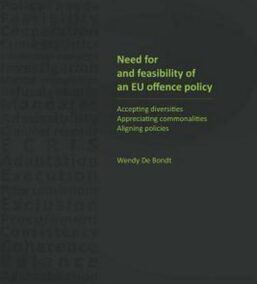
Need for and feasibility of an EU offence policy
€ 22,00
Starting from the observation that criminal law is different in each of the member states as a result of which
(1) what constitutes an offence in one member state does not necessarily constitute an offence in another member state,
(2) even where offences are equally criminalised in all member states, the sanction levels may still vary and
(3) more generally, the position of the offences in the entirety of the justice system may vary,
the question arises to what extent those so-called offence diversities are an obstacle for EU policy making and to what extent it is feasible to overcome those obstacles.
The author underpins the need for the development of an EU offence policy, using the common criminalisation acquis as a centre piece. She argues that the common criminalisation acquis can help
(1) to ensure comparability of crime statistics,
(2) to avoid redundant double criminality testing,
(3) to overcome evidence gathering difficulties,
(4) to clarify the mandates of the EU level actors,
(5) to identify the equivalent national sentence and
(6) to scope the taking account of prior convictions.
The only condition: the development of a comprehensive, consistent and well-balanced EU offence policy.
This book contains the conclusions of her publication based doctoral thesis defended at Ghent University on 22 June 2012. It is essential reading for policy makers both at national and European level in any policy field that is linked to offences.
Wendy De Bondt holds a master’s degree in law (2006) and criminology (2007) and a PhD in law (2012). She has been a member of the Institute for International Research on Criminal Policy affiliated to the Department of Penal Law and Criminology of Ghent University since 2007.
Need for and feasibility of an EU offence policy
€ 22,00
Starting from the observation that criminal law is different in each of the member states as a result of which
(1) what constitutes an offence in one member state does not necessarily constitute an offence in another member state,
(2) even where offences are equally criminalised in all member states, the sanction levels may still vary and
(3) more generally, the position of the offences in the entirety of the justice system may vary,
the question arises to what extent those so-called offence diversities are an obstacle for EU policy making and to what extent it is feasible to overcome those obstacles.
The author underpins the need for the development of an EU offence policy, using the common criminalisation acquis as a centre piece. She argues that the common criminalisation acquis can help
(1) to ensure comparability of crime statistics,
(2) to avoid redundant double criminality testing,
(3) to overcome evidence gathering difficulties,
(4) to clarify the mandates of the EU level actors,
(5) to identify the equivalent national sentence and
(6) to scope the taking account of prior convictions.
The only condition: the development of a comprehensive, consistent and well-balanced EU offence policy.
This book contains the conclusions of her publication based doctoral thesis defended at Ghent University on 22 June 2012. It is essential reading for policy makers both at national and European level in any policy field that is linked to offences.
Wendy De Bondt holds a master’s degree in law (2006) and criminology (2007) and a PhD in law (2012). She has been a member of the Institute for International Research on Criminal Policy affiliated to the Department of Penal Law and Criminology of Ghent University since 2007.
Material detention conditions, execution of custodial sentences and prisoner transfer in the EU Member States (IRCP-series, vol. 41)
€ 150,00
The introduction in 2008 of the Framework Decision on the application of the principle of mutual recognition to judgements in criminal matters imposing custodial sentences or measures involving deprivation of liberty for the purpose of their enforcement in the European Union sparked discussions as to whether the practical operation of the instrument would be compatible with its very objective, being the enhancement of detained persons’ social rehabilitation prospects.
Transferring detained people back to their respective Member State of residence and/or nationality within the mutual recognition framework is somewhat precarious in light of the often substantial variety of Member States’ legal and prison systems. In this context, and following a call for tender by the European Commission, the authors conducted the biggest study to date on Member States’ material detention conditions, early/conditional release provisions and sentence execution modalities. In addition to exploring the diversity of legal frameworks, the study also assessed practitioners’ views on cross border execution of custodial sentences in the EU.
This book contains the individual Member State reports resulting from the legal and practitioners’ analyses, backed by additional information drawn from monitoring and evaluation conducted at Council of Europe (Committee for the Prevention of Torture) and United Nation levels.
This is essential reading for EU policy makers, judicial and law enforcement authorities and for defence lawyers throughout the Union. Undoubtedly, this book will be an asset to everyone who is involved in or taking an interest in detention issues and cross border execution of judgements involving deprivation of liberty in the EU.
Transferring detained people back to their respective Member State of residence and/or nationality within the mutual recognition framework is somewhat precarious in light of the often substantial variety of Member States’ legal and prison systems. In this context, and following a call for tender by the European Commission, the authors conducted the biggest study to date on Member States’ material detention conditions, early/conditional release provisions and sentence execution modalities. In addition to exploring the diversity of legal frameworks, the study also assessed practitioners’ views on cross border execution of custodial sentences in the EU.
This book contains the individual Member State reports resulting from the legal and practitioners’ analyses, backed by additional information drawn from monitoring and evaluation conducted at Council of Europe (Committee for the Prevention of Torture) and United Nation levels.
This is essential reading for EU policy makers, judicial and law enforcement authorities and for defence lawyers throughout the Union. Undoubtedly, this book will be an asset to everyone who is involved in or taking an interest in detention issues and cross border execution of judgements involving deprivation of liberty in the EU.
Material detention conditions, execution of custodial sentences and prisoner transfer in the EU Member States (IRCP-series, vol. 41)
€ 150,00
The introduction in 2008 of the Framework Decision on the application of the principle of mutual recognition to judgements in criminal matters imposing custodial sentences or measures involving deprivation of liberty for the purpose of their enforcement in the European Union sparked discussions as to whether the practical operation of the instrument would be compatible with its very objective, being the enhancement of detained persons’ social rehabilitation prospects.
Transferring detained people back to their respective Member State of residence and/or nationality within the mutual recognition framework is somewhat precarious in light of the often substantial variety of Member States’ legal and prison systems. In this context, and following a call for tender by the European Commission, the authors conducted the biggest study to date on Member States’ material detention conditions, early/conditional release provisions and sentence execution modalities. In addition to exploring the diversity of legal frameworks, the study also assessed practitioners’ views on cross border execution of custodial sentences in the EU.
This book contains the individual Member State reports resulting from the legal and practitioners’ analyses, backed by additional information drawn from monitoring and evaluation conducted at Council of Europe (Committee for the Prevention of Torture) and United Nation levels.
This is essential reading for EU policy makers, judicial and law enforcement authorities and for defence lawyers throughout the Union. Undoubtedly, this book will be an asset to everyone who is involved in or taking an interest in detention issues and cross border execution of judgements involving deprivation of liberty in the EU.
Transferring detained people back to their respective Member State of residence and/or nationality within the mutual recognition framework is somewhat precarious in light of the often substantial variety of Member States’ legal and prison systems. In this context, and following a call for tender by the European Commission, the authors conducted the biggest study to date on Member States’ material detention conditions, early/conditional release provisions and sentence execution modalities. In addition to exploring the diversity of legal frameworks, the study also assessed practitioners’ views on cross border execution of custodial sentences in the EU.
This book contains the individual Member State reports resulting from the legal and practitioners’ analyses, backed by additional information drawn from monitoring and evaluation conducted at Council of Europe (Committee for the Prevention of Torture) and United Nation levels.
This is essential reading for EU policy makers, judicial and law enforcement authorities and for defence lawyers throughout the Union. Undoubtedly, this book will be an asset to everyone who is involved in or taking an interest in detention issues and cross border execution of judgements involving deprivation of liberty in the EU.

EU cross-border gathering and use of evidence in criminal matters (IRCP-reeks, nr. 37)
€ 56,00
The European Council set out the 2007 specific program on ‘Criminal Justice’ as part of
the General Program on Fundamental Rights and Justice. The concrete objectives of the
program include the promotion of the principle of mutual recognition and mutual trust,
eliminating obstacles created by disparities between member states judicial systems and
improving knowledge of member states legal and judicial systems in criminal matters
and the exchange and dissemination of good practice.
As part of this program, the European Commission awarded a contract to the Institute of International Research on Criminal Policy to conduct the study this book comprises the results of.
The initial aim of the study was to obtain up to date information on the national laws of the EU member states on the gathering and handling of evidence and to analyse that information in the light of recent developments in legislation governing cross-border transmission of evidence, in particular the 2008 European Evidence Warrant. In addition, it was the intention of the European Commission to initiate preparatory work on a legal instrument that would expand the scope of application of the European Evidence Warrant in order to further replace the existing regime of mutual legal assistance within the EU by a mechanism based on the mutual recognition principle. As a result, the study was broadened as to also assess whether or not a mutual recognition-based EU mutual legal assistance regime is desirable and feasible.
Whereas the Green Paper on obtaining evidence in criminal matters (issued in 2009 by the European Commission) raises general questions on the matter, this book provides an in-depth and full-scale overview of the current situation relating to cross-border gathering, obtaining and admissibility of evidence in criminal matters between the EU member states, as well as clear-cut future legal and policy options.
This book is essential reading for EU policy makers, judicial and law enforcement authorities throughout the EU and from a broader international context. It will be particularly appealing also to the research community and anyone involved in or taking an interest in criminal policy initiatives in the EU.
As part of this program, the European Commission awarded a contract to the Institute of International Research on Criminal Policy to conduct the study this book comprises the results of.
The initial aim of the study was to obtain up to date information on the national laws of the EU member states on the gathering and handling of evidence and to analyse that information in the light of recent developments in legislation governing cross-border transmission of evidence, in particular the 2008 European Evidence Warrant. In addition, it was the intention of the European Commission to initiate preparatory work on a legal instrument that would expand the scope of application of the European Evidence Warrant in order to further replace the existing regime of mutual legal assistance within the EU by a mechanism based on the mutual recognition principle. As a result, the study was broadened as to also assess whether or not a mutual recognition-based EU mutual legal assistance regime is desirable and feasible.
Whereas the Green Paper on obtaining evidence in criminal matters (issued in 2009 by the European Commission) raises general questions on the matter, this book provides an in-depth and full-scale overview of the current situation relating to cross-border gathering, obtaining and admissibility of evidence in criminal matters between the EU member states, as well as clear-cut future legal and policy options.
This book is essential reading for EU policy makers, judicial and law enforcement authorities throughout the EU and from a broader international context. It will be particularly appealing also to the research community and anyone involved in or taking an interest in criminal policy initiatives in the EU.
EU cross-border gathering and use of evidence in criminal matters (IRCP-reeks, nr. 37)
€ 56,00
The European Council set out the 2007 specific program on ‘Criminal Justice’ as part of
the General Program on Fundamental Rights and Justice. The concrete objectives of the
program include the promotion of the principle of mutual recognition and mutual trust,
eliminating obstacles created by disparities between member states judicial systems and
improving knowledge of member states legal and judicial systems in criminal matters
and the exchange and dissemination of good practice.
As part of this program, the European Commission awarded a contract to the Institute of International Research on Criminal Policy to conduct the study this book comprises the results of.
The initial aim of the study was to obtain up to date information on the national laws of the EU member states on the gathering and handling of evidence and to analyse that information in the light of recent developments in legislation governing cross-border transmission of evidence, in particular the 2008 European Evidence Warrant. In addition, it was the intention of the European Commission to initiate preparatory work on a legal instrument that would expand the scope of application of the European Evidence Warrant in order to further replace the existing regime of mutual legal assistance within the EU by a mechanism based on the mutual recognition principle. As a result, the study was broadened as to also assess whether or not a mutual recognition-based EU mutual legal assistance regime is desirable and feasible.
Whereas the Green Paper on obtaining evidence in criminal matters (issued in 2009 by the European Commission) raises general questions on the matter, this book provides an in-depth and full-scale overview of the current situation relating to cross-border gathering, obtaining and admissibility of evidence in criminal matters between the EU member states, as well as clear-cut future legal and policy options.
This book is essential reading for EU policy makers, judicial and law enforcement authorities throughout the EU and from a broader international context. It will be particularly appealing also to the research community and anyone involved in or taking an interest in criminal policy initiatives in the EU.
As part of this program, the European Commission awarded a contract to the Institute of International Research on Criminal Policy to conduct the study this book comprises the results of.
The initial aim of the study was to obtain up to date information on the national laws of the EU member states on the gathering and handling of evidence and to analyse that information in the light of recent developments in legislation governing cross-border transmission of evidence, in particular the 2008 European Evidence Warrant. In addition, it was the intention of the European Commission to initiate preparatory work on a legal instrument that would expand the scope of application of the European Evidence Warrant in order to further replace the existing regime of mutual legal assistance within the EU by a mechanism based on the mutual recognition principle. As a result, the study was broadened as to also assess whether or not a mutual recognition-based EU mutual legal assistance regime is desirable and feasible.
Whereas the Green Paper on obtaining evidence in criminal matters (issued in 2009 by the European Commission) raises general questions on the matter, this book provides an in-depth and full-scale overview of the current situation relating to cross-border gathering, obtaining and admissibility of evidence in criminal matters between the EU member states, as well as clear-cut future legal and policy options.
This book is essential reading for EU policy makers, judicial and law enforcement authorities throughout the EU and from a broader international context. It will be particularly appealing also to the research community and anyone involved in or taking an interest in criminal policy initiatives in the EU.