
Toezicht op detentie: tekst en context (IRCP-series, vol. 46)
€ 25,00
Het hedendaagse landschap aan toezichtmechanismen is uitermate complex en volop in beweging. Meer gevestigde toezichtorganen, zoals het Europese antifoltercomité (CPT), kregen recent het gezelschap van nieuwere spelers op het terrein, zoals het VN-antifoltercomité (SPT) en de zogenaamde nationale preventiemechanismen (NPM). Binnen de Belgische landsgrenzen is een waaier aan gespecialiseerde toezichtorganen actief die zich met wisselend succes toespitsen op gevangenissen, politiecellen, vreemdelingencentra, e.d.m.
Hoe functioneren die organen in de praktijk en op welke wijze verhouden ze zich tot elkaar?
Is het huidige toezicht in Europa toereikend of moet de controle nog opgevoerd worden?
Welke rol speelt de EU in dit ganse verhaal?
Toezicht op detentie biedt de lezer een up-to-date overzicht van het hedendaagse toezichtlandschap en bediscussieert een aantal van de hete hangijzers waarmee actoren op dit terrein heden ten dage worden geconfronteerd.
Hoe functioneren die organen in de praktijk en op welke wijze verhouden ze zich tot elkaar?
Is het huidige toezicht in Europa toereikend of moet de controle nog opgevoerd worden?
Welke rol speelt de EU in dit ganse verhaal?
Toezicht op detentie biedt de lezer een up-to-date overzicht van het hedendaagse toezichtlandschap en bediscussieert een aantal van de hete hangijzers waarmee actoren op dit terrein heden ten dage worden geconfronteerd.
Toezicht op detentie: tekst en context (IRCP-series, vol. 46)
€ 25,00
Het hedendaagse landschap aan toezichtmechanismen is uitermate complex en volop in beweging. Meer gevestigde toezichtorganen, zoals het Europese antifoltercomité (CPT), kregen recent het gezelschap van nieuwere spelers op het terrein, zoals het VN-antifoltercomité (SPT) en de zogenaamde nationale preventiemechanismen (NPM). Binnen de Belgische landsgrenzen is een waaier aan gespecialiseerde toezichtorganen actief die zich met wisselend succes toespitsen op gevangenissen, politiecellen, vreemdelingencentra, e.d.m.
Hoe functioneren die organen in de praktijk en op welke wijze verhouden ze zich tot elkaar?
Is het huidige toezicht in Europa toereikend of moet de controle nog opgevoerd worden?
Welke rol speelt de EU in dit ganse verhaal?
Toezicht op detentie biedt de lezer een up-to-date overzicht van het hedendaagse toezichtlandschap en bediscussieert een aantal van de hete hangijzers waarmee actoren op dit terrein heden ten dage worden geconfronteerd.
Hoe functioneren die organen in de praktijk en op welke wijze verhouden ze zich tot elkaar?
Is het huidige toezicht in Europa toereikend of moet de controle nog opgevoerd worden?
Welke rol speelt de EU in dit ganse verhaal?
Toezicht op detentie biedt de lezer een up-to-date overzicht van het hedendaagse toezichtlandschap en bediscussieert een aantal van de hete hangijzers waarmee actoren op dit terrein heden ten dage worden geconfronteerd.
Geen voorraad
The disqualification triad (IRCP-series, vol. 45)
€ 68,00
In the past decades the EU has made little progress with respect to disqualifications as a sanction mechanism. The complex nature of this specific sanction
mechanism has caused policy initiatives to be postponed time after time.
In answer to a call from the European Commission, the authors have conducted a comparative legal analysis in the EU 27 and looked into the practical experiences with disqualifications from a domestic and a cross-border perspective. To that end, academics, policy makers and practitioners in the member states have been consulted.
Analysis reveals a wide variety in the typology of disqualifications as a sanction measure, persons to whom the disqualifications can be imposed and authorities involved. Furthermore, there are considerable differences with respect to the inclusion of disqualifications in the national criminal records databases. Linked thereto, information on foreign disqualifications is scarce and rarely used in practice.
To ensure a comprehensive and consistent policy approach, the authors have come up with a so-called disqualification triad, comprising (1) unified EU-wide disqualifications, (2) mutual recognition of disqualifications and (3) EU-wide equivalent effect of disqualifications. The functioning of the disqualification triad was further elaborated in three case studies, being public procurement disqualifications, disqualifications from working with children and driving disqualifications.
This book is essential reading for both EU and national policy makers as well as for researchers and practitioners involved.
In answer to a call from the European Commission, the authors have conducted a comparative legal analysis in the EU 27 and looked into the practical experiences with disqualifications from a domestic and a cross-border perspective. To that end, academics, policy makers and practitioners in the member states have been consulted.
Analysis reveals a wide variety in the typology of disqualifications as a sanction measure, persons to whom the disqualifications can be imposed and authorities involved. Furthermore, there are considerable differences with respect to the inclusion of disqualifications in the national criminal records databases. Linked thereto, information on foreign disqualifications is scarce and rarely used in practice.
To ensure a comprehensive and consistent policy approach, the authors have come up with a so-called disqualification triad, comprising (1) unified EU-wide disqualifications, (2) mutual recognition of disqualifications and (3) EU-wide equivalent effect of disqualifications. The functioning of the disqualification triad was further elaborated in three case studies, being public procurement disqualifications, disqualifications from working with children and driving disqualifications.
This book is essential reading for both EU and national policy makers as well as for researchers and practitioners involved.
Geen voorraad
The disqualification triad (IRCP-series, vol. 45)
€ 68,00
In the past decades the EU has made little progress with respect to disqualifications as a sanction mechanism. The complex nature of this specific sanction
mechanism has caused policy initiatives to be postponed time after time.
In answer to a call from the European Commission, the authors have conducted a comparative legal analysis in the EU 27 and looked into the practical experiences with disqualifications from a domestic and a cross-border perspective. To that end, academics, policy makers and practitioners in the member states have been consulted.
Analysis reveals a wide variety in the typology of disqualifications as a sanction measure, persons to whom the disqualifications can be imposed and authorities involved. Furthermore, there are considerable differences with respect to the inclusion of disqualifications in the national criminal records databases. Linked thereto, information on foreign disqualifications is scarce and rarely used in practice.
To ensure a comprehensive and consistent policy approach, the authors have come up with a so-called disqualification triad, comprising (1) unified EU-wide disqualifications, (2) mutual recognition of disqualifications and (3) EU-wide equivalent effect of disqualifications. The functioning of the disqualification triad was further elaborated in three case studies, being public procurement disqualifications, disqualifications from working with children and driving disqualifications.
This book is essential reading for both EU and national policy makers as well as for researchers and practitioners involved.
In answer to a call from the European Commission, the authors have conducted a comparative legal analysis in the EU 27 and looked into the practical experiences with disqualifications from a domestic and a cross-border perspective. To that end, academics, policy makers and practitioners in the member states have been consulted.
Analysis reveals a wide variety in the typology of disqualifications as a sanction measure, persons to whom the disqualifications can be imposed and authorities involved. Furthermore, there are considerable differences with respect to the inclusion of disqualifications in the national criminal records databases. Linked thereto, information on foreign disqualifications is scarce and rarely used in practice.
To ensure a comprehensive and consistent policy approach, the authors have come up with a so-called disqualification triad, comprising (1) unified EU-wide disqualifications, (2) mutual recognition of disqualifications and (3) EU-wide equivalent effect of disqualifications. The functioning of the disqualification triad was further elaborated in three case studies, being public procurement disqualifications, disqualifications from working with children and driving disqualifications.
This book is essential reading for both EU and national policy makers as well as for researchers and practitioners involved.
Geen voorraad
Rethinking international cooperation in criminal matters in the EU (IRCP-series, vol. 42)
€ 128,50
International cooperation in criminal matters in the European Union has grown exponentially over the past few decades. Importantly, there is a wide variety of authorities involved therein, rendering the traditional distinction between police and judicial cooperation outdated. Furthermore, its rapid growth exposed this policy field to inconsistencies and incoherence. Additionally despite the wave of new legislation, important lacunae can be identified, setting important challenges for the future. The combination of these issues clarifies the title of this book: there is a pressing need to rethink international cooperation in criminal matters.
In answer to a call from the European Commission, the authors have designed a comprehensive methodological framework to review the entirety of international cooperation in criminal matters, combining desktop reviews, expert consultations, member state questionnaires and focus group meetings in each of the member states to obtain a comprehensive overview of the currently experienced obstacles and future policy options that are both needed and feasible. Over 150 individuals contributed to the study, with different background, including academics, lawyers, policy makers, police, customs, intelligence services, prosecution, judiciary, correctional authorities, Ministries of Justice and Home Affairs.
This book provides an overview of the research findings and the recommendations formulated. They include but are not limited to(1) a helicopter view on cooperation with criminal justice finality,
(2) a clear demarcation of the role of the judicial authorities,
(3) a comprehensive review of refusal grounds, including proportionality and capacity concerns,
(4) an assessment of gaps in the current body of instruments regulating international cooperation in criminal matters and possible remedies thereto,
(5) a well-considered further development of Eurojust and
(6) ensuring EU wide effect of mere domestic actions.
Essential reading for both EU policy makers and for all practitioners involved, this book represents the first overall analysis of the entirety of international cooperation in criminal matters in the EU. An analysis aiming at moving beyond actors, bringing logic back, footed in reality.
In answer to a call from the European Commission, the authors have designed a comprehensive methodological framework to review the entirety of international cooperation in criminal matters, combining desktop reviews, expert consultations, member state questionnaires and focus group meetings in each of the member states to obtain a comprehensive overview of the currently experienced obstacles and future policy options that are both needed and feasible. Over 150 individuals contributed to the study, with different background, including academics, lawyers, policy makers, police, customs, intelligence services, prosecution, judiciary, correctional authorities, Ministries of Justice and Home Affairs.
This book provides an overview of the research findings and the recommendations formulated. They include but are not limited to
Essential reading for both EU policy makers and for all practitioners involved, this book represents the first overall analysis of the entirety of international cooperation in criminal matters in the EU. An analysis aiming at moving beyond actors, bringing logic back, footed in reality.
Geen voorraad
Rethinking international cooperation in criminal matters in the EU (IRCP-series, vol. 42)
€ 128,50
International cooperation in criminal matters in the European Union has grown exponentially over the past few decades. Importantly, there is a wide variety of authorities involved therein, rendering the traditional distinction between police and judicial cooperation outdated. Furthermore, its rapid growth exposed this policy field to inconsistencies and incoherence. Additionally despite the wave of new legislation, important lacunae can be identified, setting important challenges for the future. The combination of these issues clarifies the title of this book: there is a pressing need to rethink international cooperation in criminal matters.
In answer to a call from the European Commission, the authors have designed a comprehensive methodological framework to review the entirety of international cooperation in criminal matters, combining desktop reviews, expert consultations, member state questionnaires and focus group meetings in each of the member states to obtain a comprehensive overview of the currently experienced obstacles and future policy options that are both needed and feasible. Over 150 individuals contributed to the study, with different background, including academics, lawyers, policy makers, police, customs, intelligence services, prosecution, judiciary, correctional authorities, Ministries of Justice and Home Affairs.
This book provides an overview of the research findings and the recommendations formulated. They include but are not limited to(1) a helicopter view on cooperation with criminal justice finality,
(2) a clear demarcation of the role of the judicial authorities,
(3) a comprehensive review of refusal grounds, including proportionality and capacity concerns,
(4) an assessment of gaps in the current body of instruments regulating international cooperation in criminal matters and possible remedies thereto,
(5) a well-considered further development of Eurojust and
(6) ensuring EU wide effect of mere domestic actions.
Essential reading for both EU policy makers and for all practitioners involved, this book represents the first overall analysis of the entirety of international cooperation in criminal matters in the EU. An analysis aiming at moving beyond actors, bringing logic back, footed in reality.
In answer to a call from the European Commission, the authors have designed a comprehensive methodological framework to review the entirety of international cooperation in criminal matters, combining desktop reviews, expert consultations, member state questionnaires and focus group meetings in each of the member states to obtain a comprehensive overview of the currently experienced obstacles and future policy options that are both needed and feasible. Over 150 individuals contributed to the study, with different background, including academics, lawyers, policy makers, police, customs, intelligence services, prosecution, judiciary, correctional authorities, Ministries of Justice and Home Affairs.
This book provides an overview of the research findings and the recommendations formulated. They include but are not limited to
Essential reading for both EU policy makers and for all practitioners involved, this book represents the first overall analysis of the entirety of international cooperation in criminal matters in the EU. An analysis aiming at moving beyond actors, bringing logic back, footed in reality.

Free Gathering and movement of evidence in criminal matters in the EU. Thinking beyond borders, striving for balance, in search of coherence
€ 17,00
The landscape of cross-border evidence gathering in criminal matters in the EU has become blurred. Non-traditional actors, such as administrative authorities and intelligence services, have joined traditional judicial and law enforcement authorities in a domain which used to be looked upon as predominantly judicial cooperation territory. Criminal justice and administrative finalities run the risk of being constantly mixed up. This creates problems in light of the separation of powers, adequate legal and procedural protection in criminal matters and data protection.
Gert Vermeulen believes that restoring the balance requires stepping away from traditional authority-based thinking and policy-making. He suggests to embrace ‘criminal justice finality’ as the key normative marker for EU cross-border intelligence, information and evidence gathering and exchange in criminal matters. The traditional distinction between judicial and police cooperation in criminal matters can no longer be upheld, he concludes. He argues that the distinction is largely artificial, creates confusion and produces inconsistencies, thus hindering the establishment and further development of a coherent EU criminal law policy.
Vermeulen also challenges the envisaged roll-out of the mutual recognition principle in the context of cross-border evidence gathering. He is in particular concerned that it would prompt an inacceptable burden upon criminal justice systems either financially or in terms of operational capacity. In order to systemically prevent admissibility problems of cross-border evidence in courts throughout the EU, he finally pleas for a free movement regime for evidence, based on common minimum procedural standards according to which it must have been gathered.
Prof. dr. Gert Vermeulen is professor of international and European criminal law at Ghent University, director of the Institute for International Research on Criminal Policy (IRCP) and extraordinary professor of evidence law at Maastricht University.
Gert Vermeulen believes that restoring the balance requires stepping away from traditional authority-based thinking and policy-making. He suggests to embrace ‘criminal justice finality’ as the key normative marker for EU cross-border intelligence, information and evidence gathering and exchange in criminal matters. The traditional distinction between judicial and police cooperation in criminal matters can no longer be upheld, he concludes. He argues that the distinction is largely artificial, creates confusion and produces inconsistencies, thus hindering the establishment and further development of a coherent EU criminal law policy.
Vermeulen also challenges the envisaged roll-out of the mutual recognition principle in the context of cross-border evidence gathering. He is in particular concerned that it would prompt an inacceptable burden upon criminal justice systems either financially or in terms of operational capacity. In order to systemically prevent admissibility problems of cross-border evidence in courts throughout the EU, he finally pleas for a free movement regime for evidence, based on common minimum procedural standards according to which it must have been gathered.
Prof. dr. Gert Vermeulen is professor of international and European criminal law at Ghent University, director of the Institute for International Research on Criminal Policy (IRCP) and extraordinary professor of evidence law at Maastricht University.
Free Gathering and movement of evidence in criminal matters in the EU. Thinking beyond borders, striving for balance, in search of coherence
€ 17,00
The landscape of cross-border evidence gathering in criminal matters in the EU has become blurred. Non-traditional actors, such as administrative authorities and intelligence services, have joined traditional judicial and law enforcement authorities in a domain which used to be looked upon as predominantly judicial cooperation territory. Criminal justice and administrative finalities run the risk of being constantly mixed up. This creates problems in light of the separation of powers, adequate legal and procedural protection in criminal matters and data protection.
Gert Vermeulen believes that restoring the balance requires stepping away from traditional authority-based thinking and policy-making. He suggests to embrace ‘criminal justice finality’ as the key normative marker for EU cross-border intelligence, information and evidence gathering and exchange in criminal matters. The traditional distinction between judicial and police cooperation in criminal matters can no longer be upheld, he concludes. He argues that the distinction is largely artificial, creates confusion and produces inconsistencies, thus hindering the establishment and further development of a coherent EU criminal law policy.
Vermeulen also challenges the envisaged roll-out of the mutual recognition principle in the context of cross-border evidence gathering. He is in particular concerned that it would prompt an inacceptable burden upon criminal justice systems either financially or in terms of operational capacity. In order to systemically prevent admissibility problems of cross-border evidence in courts throughout the EU, he finally pleas for a free movement regime for evidence, based on common minimum procedural standards according to which it must have been gathered.
Prof. dr. Gert Vermeulen is professor of international and European criminal law at Ghent University, director of the Institute for International Research on Criminal Policy (IRCP) and extraordinary professor of evidence law at Maastricht University.
Gert Vermeulen believes that restoring the balance requires stepping away from traditional authority-based thinking and policy-making. He suggests to embrace ‘criminal justice finality’ as the key normative marker for EU cross-border intelligence, information and evidence gathering and exchange in criminal matters. The traditional distinction between judicial and police cooperation in criminal matters can no longer be upheld, he concludes. He argues that the distinction is largely artificial, creates confusion and produces inconsistencies, thus hindering the establishment and further development of a coherent EU criminal law policy.
Vermeulen also challenges the envisaged roll-out of the mutual recognition principle in the context of cross-border evidence gathering. He is in particular concerned that it would prompt an inacceptable burden upon criminal justice systems either financially or in terms of operational capacity. In order to systemically prevent admissibility problems of cross-border evidence in courts throughout the EU, he finally pleas for a free movement regime for evidence, based on common minimum procedural standards according to which it must have been gathered.
Prof. dr. Gert Vermeulen is professor of international and European criminal law at Ghent University, director of the Institute for International Research on Criminal Policy (IRCP) and extraordinary professor of evidence law at Maastricht University.
Cross-border execution of judgements involving deprivation of liberty in the EU (IRCP – series, 40)
€ 67,00
The introduction in 2008 of the Framework Decision on the application of the principle
of mutual recognition to judgements in criminal matters imposing custodial sentences
or measures involving deprivation of liberty for the purpose of their enforcement in
the European Union sparked discussions as to whether the practical operation of the
instrument would be compatible with its very objective, being the enhancement of
detained persons’ social rehabilitation prospects.
Transferring detained people back to their respective Member State of residence and/or nationality within the mutual recognition framework is somewhat precarious in light of the often substantial variety of Member States’ legal and prison systems. In this context, and following a call for tender by the European Commission, the authors conducted the biggest study to date on Member States’ material detention conditions, early/conditional release provisions and sentence execution modalities. In addition to exploring the diversity of legal frameworks, the study also assessed practitioners’ views on cross-border execution of custodial sentences in the EU.
This book contains both the EU level legal and practitioners’ analyses as well as the high level final report to the study, confirming preliminary concerns that flanking measures are urgently needed for a proper operation of the Framework Decision.
This is essential reading for EU policy makers, judicial and law enforcement authorities and for defence lawyers throughout the Union. Undoubtedly, this book will be an asset to everyone who is involved in or taking an interest in detention issues and cross-border execution of judgements involving deprivation of liberty in the EU.
Transferring detained people back to their respective Member State of residence and/or nationality within the mutual recognition framework is somewhat precarious in light of the often substantial variety of Member States’ legal and prison systems. In this context, and following a call for tender by the European Commission, the authors conducted the biggest study to date on Member States’ material detention conditions, early/conditional release provisions and sentence execution modalities. In addition to exploring the diversity of legal frameworks, the study also assessed practitioners’ views on cross-border execution of custodial sentences in the EU.
This book contains both the EU level legal and practitioners’ analyses as well as the high level final report to the study, confirming preliminary concerns that flanking measures are urgently needed for a proper operation of the Framework Decision.
This is essential reading for EU policy makers, judicial and law enforcement authorities and for defence lawyers throughout the Union. Undoubtedly, this book will be an asset to everyone who is involved in or taking an interest in detention issues and cross-border execution of judgements involving deprivation of liberty in the EU.
Cross-border execution of judgements involving deprivation of liberty in the EU (IRCP – series, 40)
€ 67,00
The introduction in 2008 of the Framework Decision on the application of the principle
of mutual recognition to judgements in criminal matters imposing custodial sentences
or measures involving deprivation of liberty for the purpose of their enforcement in
the European Union sparked discussions as to whether the practical operation of the
instrument would be compatible with its very objective, being the enhancement of
detained persons’ social rehabilitation prospects.
Transferring detained people back to their respective Member State of residence and/or nationality within the mutual recognition framework is somewhat precarious in light of the often substantial variety of Member States’ legal and prison systems. In this context, and following a call for tender by the European Commission, the authors conducted the biggest study to date on Member States’ material detention conditions, early/conditional release provisions and sentence execution modalities. In addition to exploring the diversity of legal frameworks, the study also assessed practitioners’ views on cross-border execution of custodial sentences in the EU.
This book contains both the EU level legal and practitioners’ analyses as well as the high level final report to the study, confirming preliminary concerns that flanking measures are urgently needed for a proper operation of the Framework Decision.
This is essential reading for EU policy makers, judicial and law enforcement authorities and for defence lawyers throughout the Union. Undoubtedly, this book will be an asset to everyone who is involved in or taking an interest in detention issues and cross-border execution of judgements involving deprivation of liberty in the EU.
Transferring detained people back to their respective Member State of residence and/or nationality within the mutual recognition framework is somewhat precarious in light of the often substantial variety of Member States’ legal and prison systems. In this context, and following a call for tender by the European Commission, the authors conducted the biggest study to date on Member States’ material detention conditions, early/conditional release provisions and sentence execution modalities. In addition to exploring the diversity of legal frameworks, the study also assessed practitioners’ views on cross-border execution of custodial sentences in the EU.
This book contains both the EU level legal and practitioners’ analyses as well as the high level final report to the study, confirming preliminary concerns that flanking measures are urgently needed for a proper operation of the Framework Decision.
This is essential reading for EU policy makers, judicial and law enforcement authorities and for defence lawyers throughout the Union. Undoubtedly, this book will be an asset to everyone who is involved in or taking an interest in detention issues and cross-border execution of judgements involving deprivation of liberty in the EU.
The Montrasec demo. A bench-mark for member state and EUautomated data collection and reporting on trafficking in human beings and sexual exploitation of children (IRCP-Series, vol. 36)
€ 46,00
Recent European Union policy discussions have again highlighted the urgent need
for consistent recording and analysis of data relating to trafficking in human beings.
Without such a framework, the Union’s ability to assess the scale and nature of the
problem and, consequently, to formulate effective policy responses is severely impaired.
MONTRASEC – a model for monitoring trafficking in human beings, sexually exploited
and missing children – demonstrates that real progress can be made in addressing these
long standing difficulties.
Building on the work undertaken in the previous SIAMSECT research, a practical IT-tool has been developed by which the three phenomena can be described, interpreted and analysed in an integrated and multidisciplinary fashion. The IT tool also provides National Rapporteurs or similar mechanisms with enhanced and uniform reporting capacity. Recognising the European Union’s emerging policy line, the MONTRASEC IT tool provides a building block by which the European Commission or a future European Monitoring Centre on THB can make horizontal comparison between the reports of the member states.
This book describes how a workable IT tool with contents based on international legal instruments and definitions concerning the three phenomena, has been designed and tested by a range of operational agencies in two separate EU member states. Critical questions relating to compliance with both member state and European data protection and privacy legislation are addressed alongside the need to ensure the highest possible levels of security for sensitive personal data relating to both victims and authors. Furthermore, a CD is attached to this book, containing a live demonstration of all the features and functions of the MONTRASEC IT tool.
“The MONTRASEC demo” shows that it is actually possible to move beyond theoretical discussions concerning data collection to a point where agencies operating in the field are prepared to work within a unified and consistent data collection regime, inputting “live” data which can thereafter be analysed at member state and European Union level.
This book is essential reading for EU policy makers, judicial and law enforcement authorities and organisations working in the fields of trafficking in human beings, sexually exploited and missing children both in the European Union and in a broader international context. It will also appeal to the research community and anyone with an interest in justice and home affairs or criminal policy initiatives in the European Union.
Building on the work undertaken in the previous SIAMSECT research, a practical IT-tool has been developed by which the three phenomena can be described, interpreted and analysed in an integrated and multidisciplinary fashion. The IT tool also provides National Rapporteurs or similar mechanisms with enhanced and uniform reporting capacity. Recognising the European Union’s emerging policy line, the MONTRASEC IT tool provides a building block by which the European Commission or a future European Monitoring Centre on THB can make horizontal comparison between the reports of the member states.
This book describes how a workable IT tool with contents based on international legal instruments and definitions concerning the three phenomena, has been designed and tested by a range of operational agencies in two separate EU member states. Critical questions relating to compliance with both member state and European data protection and privacy legislation are addressed alongside the need to ensure the highest possible levels of security for sensitive personal data relating to both victims and authors. Furthermore, a CD is attached to this book, containing a live demonstration of all the features and functions of the MONTRASEC IT tool.
“The MONTRASEC demo” shows that it is actually possible to move beyond theoretical discussions concerning data collection to a point where agencies operating in the field are prepared to work within a unified and consistent data collection regime, inputting “live” data which can thereafter be analysed at member state and European Union level.
This book is essential reading for EU policy makers, judicial and law enforcement authorities and organisations working in the fields of trafficking in human beings, sexually exploited and missing children both in the European Union and in a broader international context. It will also appeal to the research community and anyone with an interest in justice and home affairs or criminal policy initiatives in the European Union.
The Montrasec demo. A bench-mark for member state and EUautomated data collection and reporting on trafficking in human beings and sexual exploitation of children (IRCP-Series, vol. 36)
€ 46,00
Recent European Union policy discussions have again highlighted the urgent need
for consistent recording and analysis of data relating to trafficking in human beings.
Without such a framework, the Union’s ability to assess the scale and nature of the
problem and, consequently, to formulate effective policy responses is severely impaired.
MONTRASEC – a model for monitoring trafficking in human beings, sexually exploited
and missing children – demonstrates that real progress can be made in addressing these
long standing difficulties.
Building on the work undertaken in the previous SIAMSECT research, a practical IT-tool has been developed by which the three phenomena can be described, interpreted and analysed in an integrated and multidisciplinary fashion. The IT tool also provides National Rapporteurs or similar mechanisms with enhanced and uniform reporting capacity. Recognising the European Union’s emerging policy line, the MONTRASEC IT tool provides a building block by which the European Commission or a future European Monitoring Centre on THB can make horizontal comparison between the reports of the member states.
This book describes how a workable IT tool with contents based on international legal instruments and definitions concerning the three phenomena, has been designed and tested by a range of operational agencies in two separate EU member states. Critical questions relating to compliance with both member state and European data protection and privacy legislation are addressed alongside the need to ensure the highest possible levels of security for sensitive personal data relating to both victims and authors. Furthermore, a CD is attached to this book, containing a live demonstration of all the features and functions of the MONTRASEC IT tool.
“The MONTRASEC demo” shows that it is actually possible to move beyond theoretical discussions concerning data collection to a point where agencies operating in the field are prepared to work within a unified and consistent data collection regime, inputting “live” data which can thereafter be analysed at member state and European Union level.
This book is essential reading for EU policy makers, judicial and law enforcement authorities and organisations working in the fields of trafficking in human beings, sexually exploited and missing children both in the European Union and in a broader international context. It will also appeal to the research community and anyone with an interest in justice and home affairs or criminal policy initiatives in the European Union.
Building on the work undertaken in the previous SIAMSECT research, a practical IT-tool has been developed by which the three phenomena can be described, interpreted and analysed in an integrated and multidisciplinary fashion. The IT tool also provides National Rapporteurs or similar mechanisms with enhanced and uniform reporting capacity. Recognising the European Union’s emerging policy line, the MONTRASEC IT tool provides a building block by which the European Commission or a future European Monitoring Centre on THB can make horizontal comparison between the reports of the member states.
This book describes how a workable IT tool with contents based on international legal instruments and definitions concerning the three phenomena, has been designed and tested by a range of operational agencies in two separate EU member states. Critical questions relating to compliance with both member state and European data protection and privacy legislation are addressed alongside the need to ensure the highest possible levels of security for sensitive personal data relating to both victims and authors. Furthermore, a CD is attached to this book, containing a live demonstration of all the features and functions of the MONTRASEC IT tool.
“The MONTRASEC demo” shows that it is actually possible to move beyond theoretical discussions concerning data collection to a point where agencies operating in the field are prepared to work within a unified and consistent data collection regime, inputting “live” data which can thereafter be analysed at member state and European Union level.
This book is essential reading for EU policy makers, judicial and law enforcement authorities and organisations working in the fields of trafficking in human beings, sexually exploited and missing children both in the European Union and in a broader international context. It will also appeal to the research community and anyone with an interest in justice and home affairs or criminal policy initiatives in the European Union.
Strafrechtshandhaving in België en Nederland. Uitgave ter gelegenheid van het eredoctoraat toegekend door de Universiteit Gent aan prof. Dr. Cyrille Fijnaut
€ 60,00
De Universiteit Gent reikte op 10 december 2009 een institutioneel eredoctoraat uit aan de Nederlandse criminoloog en hoogleraar Cyrille Fijnaut.
Het eredoctoraat is een waardering voor de maatschappelijke impact van het werk van professor Fijnaut en de geregelde en intense samenwerkingsverbanden met de UGent, in het bijzonder in de vakgebieden criminologie en strafrecht en in het domein van de geschiedenis van het recht. Voorafgaand aan deze uitreiking vond de Belgisch-Nederlandse conferentie plaats over rechtshandhaving in beide landen. Deze uitgave bundelt de verschillende bijdragen van deze conferentie.
Het eredoctoraat is een waardering voor de maatschappelijke impact van het werk van professor Fijnaut en de geregelde en intense samenwerkingsverbanden met de UGent, in het bijzonder in de vakgebieden criminologie en strafrecht en in het domein van de geschiedenis van het recht. Voorafgaand aan deze uitreiking vond de Belgisch-Nederlandse conferentie plaats over rechtshandhaving in beide landen. Deze uitgave bundelt de verschillende bijdragen van deze conferentie.
Strafrechtshandhaving in België en Nederland. Uitgave ter gelegenheid van het eredoctoraat toegekend door de Universiteit Gent aan prof. Dr. Cyrille Fijnaut
€ 60,00
De Universiteit Gent reikte op 10 december 2009 een institutioneel eredoctoraat uit aan de Nederlandse criminoloog en hoogleraar Cyrille Fijnaut.
Het eredoctoraat is een waardering voor de maatschappelijke impact van het werk van professor Fijnaut en de geregelde en intense samenwerkingsverbanden met de UGent, in het bijzonder in de vakgebieden criminologie en strafrecht en in het domein van de geschiedenis van het recht. Voorafgaand aan deze uitreiking vond de Belgisch-Nederlandse conferentie plaats over rechtshandhaving in beide landen. Deze uitgave bundelt de verschillende bijdragen van deze conferentie.
Het eredoctoraat is een waardering voor de maatschappelijke impact van het werk van professor Fijnaut en de geregelde en intense samenwerkingsverbanden met de UGent, in het bijzonder in de vakgebieden criminologie en strafrecht en in het domein van de geschiedenis van het recht. Voorafgaand aan deze uitreiking vond de Belgisch-Nederlandse conferentie plaats over rechtshandhaving in beide landen. Deze uitgave bundelt de verschillende bijdragen van deze conferentie.
Van pionier naar onmisbaar. Over 30 jaar Panopticon. (Libri 1) (Reeks Panopticon Libri, nr. 1)
€ 75,00
Het voorliggende boek vormt het ambitieuze sluitstuk van het jubileumjaar 30 jaar Panopticon. Deze uitgave is uiteraard verbonden met het tijdschrift, wat duidelijk blijkt uit het feit dat de thema’s die hierin aan bod komen net dezelfde zijn als de deelredacties van Panopticon. Dezelfde breedte die Panopticon bestrijkt, en het tot een uniek tijdschrift maakt, kan dus ook worden teruggevonden in dit boek. Meer bepaald komen aan bod: Opsporing en politie; Vervolging, berechting en magistratuur; Deskundigenonderzoek; Rechtshulp en advocatuur; Strafuitvoering en justitiële hulpverlening; Recht en geestelijke gezondheidszorg; Maatschappelijke dienstverlening; Jeugdbescherming en bijzondere jeugdzorg; Criminologie en strafrechtstheorie; Internationaal en Europees strafrecht; Vreemdelingen; Criminografie en methodologie; Mensenrechten.
Het boek kan gelezen worden als een mooie, vaak persoonsgebonden, reflectie over de evoluties die zich met betrekking tot de desbetreffende thema’s hebben voorgedaan gedurende de laatste dertig jaar. Zowel ervaren stemmen zijn hierbij te horen, als ook stemmen van personen die recenter het werkveld betraden. De veelheid en variatie aan perspectieven die dit met zich meebrengt, zorgt ervoor dat dit een erg rijk en gevuld boek is, soms een naslagwerk of zelfs een exhaustief overzicht, maar vaker een persoonlijk perspectief en een bron van inspiratie.
Het boek kan gelezen worden als een mooie, vaak persoonsgebonden, reflectie over de evoluties die zich met betrekking tot de desbetreffende thema’s hebben voorgedaan gedurende de laatste dertig jaar. Zowel ervaren stemmen zijn hierbij te horen, als ook stemmen van personen die recenter het werkveld betraden. De veelheid en variatie aan perspectieven die dit met zich meebrengt, zorgt ervoor dat dit een erg rijk en gevuld boek is, soms een naslagwerk of zelfs een exhaustief overzicht, maar vaker een persoonlijk perspectief en een bron van inspiratie.
Van pionier naar onmisbaar. Over 30 jaar Panopticon. (Libri 1) (Reeks Panopticon Libri, nr. 1)
€ 75,00
Het voorliggende boek vormt het ambitieuze sluitstuk van het jubileumjaar 30 jaar Panopticon. Deze uitgave is uiteraard verbonden met het tijdschrift, wat duidelijk blijkt uit het feit dat de thema’s die hierin aan bod komen net dezelfde zijn als de deelredacties van Panopticon. Dezelfde breedte die Panopticon bestrijkt, en het tot een uniek tijdschrift maakt, kan dus ook worden teruggevonden in dit boek. Meer bepaald komen aan bod: Opsporing en politie; Vervolging, berechting en magistratuur; Deskundigenonderzoek; Rechtshulp en advocatuur; Strafuitvoering en justitiële hulpverlening; Recht en geestelijke gezondheidszorg; Maatschappelijke dienstverlening; Jeugdbescherming en bijzondere jeugdzorg; Criminologie en strafrechtstheorie; Internationaal en Europees strafrecht; Vreemdelingen; Criminografie en methodologie; Mensenrechten.
Het boek kan gelezen worden als een mooie, vaak persoonsgebonden, reflectie over de evoluties die zich met betrekking tot de desbetreffende thema’s hebben voorgedaan gedurende de laatste dertig jaar. Zowel ervaren stemmen zijn hierbij te horen, als ook stemmen van personen die recenter het werkveld betraden. De veelheid en variatie aan perspectieven die dit met zich meebrengt, zorgt ervoor dat dit een erg rijk en gevuld boek is, soms een naslagwerk of zelfs een exhaustief overzicht, maar vaker een persoonlijk perspectief en een bron van inspiratie.
Het boek kan gelezen worden als een mooie, vaak persoonsgebonden, reflectie over de evoluties die zich met betrekking tot de desbetreffende thema’s hebben voorgedaan gedurende de laatste dertig jaar. Zowel ervaren stemmen zijn hierbij te horen, als ook stemmen van personen die recenter het werkveld betraden. De veelheid en variatie aan perspectieven die dit met zich meebrengt, zorgt ervoor dat dit een erg rijk en gevuld boek is, soms een naslagwerk of zelfs een exhaustief overzicht, maar vaker een persoonlijk perspectief en een bron van inspiratie.
Developing an EU level offence classification system. EU study to implement the Action Plan to measure crime and criminal justice (IRCP series, 34)
€ 39,00
One of the main deficiencies in the EU area of freedom, security and
justice, is the lack of cross-country comparable data on crime and
criminal justice. The importance of progress in this domain, especially
in the context of the identification of best practices in the fight against
crime, has been identified on several occasions. The main difficulty
lies in the comparability of data, or in other words the guarantee that
exchanged data is understood in the same way by all actors.
In March 2007, the European Commission, DG JLS, launched a call for tender for a “Study on the development of an EU level offence classification system and an assessment of its feasibility to supporting the implementation of the Action Plan to develop an EU strategy to measure crime and criminal justice” – The Crime Statistics Project (CSP). This book contains the fi nal report of that Project, conducted by Unisys Belgium and IRCP in the course of 2008-2009.
In the context of the project, EULOCS – the EU level offence classification system – was created. Its aim is not to become yet another compelling system that requires Member States to further harmonise domestic criminal law or to adjust national data models, but to be a reference index that could serve the different needs in the wider area of justice and home affairs. According to its authors, the area of justice and home affairs could benefi t from using EULOCS as a bench-mark, increasing the internal coherence of EU’s criminal policy.
This book is essential reading for EU policy makers, judicial and law enforcement authorities throughout the Union and from a broader international context. Undoubtedly, this book will be an asset to everyone who is involved in or taking an interest in the production of meaningful and comparable data on crime and criminal justice in Europe.
In March 2007, the European Commission, DG JLS, launched a call for tender for a “Study on the development of an EU level offence classification system and an assessment of its feasibility to supporting the implementation of the Action Plan to develop an EU strategy to measure crime and criminal justice” – The Crime Statistics Project (CSP). This book contains the fi nal report of that Project, conducted by Unisys Belgium and IRCP in the course of 2008-2009.
In the context of the project, EULOCS – the EU level offence classification system – was created. Its aim is not to become yet another compelling system that requires Member States to further harmonise domestic criminal law or to adjust national data models, but to be a reference index that could serve the different needs in the wider area of justice and home affairs. According to its authors, the area of justice and home affairs could benefi t from using EULOCS as a bench-mark, increasing the internal coherence of EU’s criminal policy.
This book is essential reading for EU policy makers, judicial and law enforcement authorities throughout the Union and from a broader international context. Undoubtedly, this book will be an asset to everyone who is involved in or taking an interest in the production of meaningful and comparable data on crime and criminal justice in Europe.
Developing an EU level offence classification system. EU study to implement the Action Plan to measure crime and criminal justice (IRCP series, 34)
€ 39,00
One of the main deficiencies in the EU area of freedom, security and
justice, is the lack of cross-country comparable data on crime and
criminal justice. The importance of progress in this domain, especially
in the context of the identification of best practices in the fight against
crime, has been identified on several occasions. The main difficulty
lies in the comparability of data, or in other words the guarantee that
exchanged data is understood in the same way by all actors.
In March 2007, the European Commission, DG JLS, launched a call for tender for a “Study on the development of an EU level offence classification system and an assessment of its feasibility to supporting the implementation of the Action Plan to develop an EU strategy to measure crime and criminal justice” – The Crime Statistics Project (CSP). This book contains the fi nal report of that Project, conducted by Unisys Belgium and IRCP in the course of 2008-2009.
In the context of the project, EULOCS – the EU level offence classification system – was created. Its aim is not to become yet another compelling system that requires Member States to further harmonise domestic criminal law or to adjust national data models, but to be a reference index that could serve the different needs in the wider area of justice and home affairs. According to its authors, the area of justice and home affairs could benefi t from using EULOCS as a bench-mark, increasing the internal coherence of EU’s criminal policy.
This book is essential reading for EU policy makers, judicial and law enforcement authorities throughout the Union and from a broader international context. Undoubtedly, this book will be an asset to everyone who is involved in or taking an interest in the production of meaningful and comparable data on crime and criminal justice in Europe.
In March 2007, the European Commission, DG JLS, launched a call for tender for a “Study on the development of an EU level offence classification system and an assessment of its feasibility to supporting the implementation of the Action Plan to develop an EU strategy to measure crime and criminal justice” – The Crime Statistics Project (CSP). This book contains the fi nal report of that Project, conducted by Unisys Belgium and IRCP in the course of 2008-2009.
In the context of the project, EULOCS – the EU level offence classification system – was created. Its aim is not to become yet another compelling system that requires Member States to further harmonise domestic criminal law or to adjust national data models, but to be a reference index that could serve the different needs in the wider area of justice and home affairs. According to its authors, the area of justice and home affairs could benefi t from using EULOCS as a bench-mark, increasing the internal coherence of EU’s criminal policy.
This book is essential reading for EU policy makers, judicial and law enforcement authorities throughout the Union and from a broader international context. Undoubtedly, this book will be an asset to everyone who is involved in or taking an interest in the production of meaningful and comparable data on crime and criminal justice in Europe.
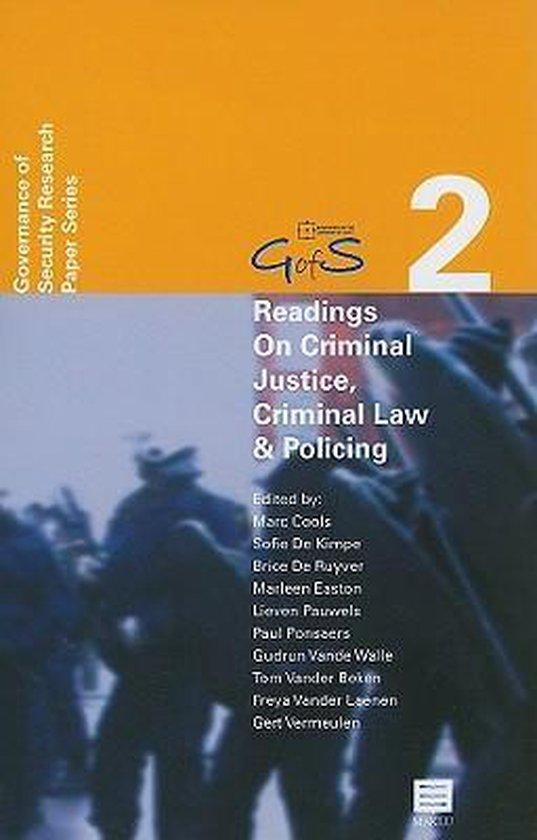
Readings on Criminal Justice, Criminal Law & Policing ((GofS) – Governance of Security Research Paper Series, Vol. 2)
€ 66,00
In nowadays'' globalized society an international exchange of ideas and views is indispensable within the field of social sciences, including criminology and criminal justice studies. The Research Group Governance of Security wants to foster contemporary international discourses on issues of crime and crime control. Therefore, in 2008 Gofs started a Research Paper Series, combining theoretical and empirical articles on issues reflecting the research activities of Gofs. This research group is collaboration between Ghent University and Ghent University College in Belgium.
Gofs is concentrating its research around the study of administrative and judicial policy that has been developed with respect to new issues of crime and insecurity.
This Series will appear annually comprising current perspectives especially on policing, law and regulation, governance initiatives on the European level, financial and economic crimes, drugs and drug related issues, research methods in the study of crime and crime control, new criminal phenomena, and theoretical criminology, written by members of the Research Group Governance of Security.
Maklu Quality Label: The Series contains articles that have been submitted to international double blind peer review by internationally renowned scholars.
Gofs is concentrating its research around the study of administrative and judicial policy that has been developed with respect to new issues of crime and insecurity.
This Series will appear annually comprising current perspectives especially on policing, law and regulation, governance initiatives on the European level, financial and economic crimes, drugs and drug related issues, research methods in the study of crime and crime control, new criminal phenomena, and theoretical criminology, written by members of the Research Group Governance of Security.
Maklu Quality Label: The Series contains articles that have been submitted to international double blind peer review by internationally renowned scholars.
Readings on Criminal Justice, Criminal Law & Policing ((GofS) – Governance of Security Research Paper Series, Vol. 2)
€ 66,00
In nowadays'' globalized society an international exchange of ideas and views is indispensable within the field of social sciences, including criminology and criminal justice studies. The Research Group Governance of Security wants to foster contemporary international discourses on issues of crime and crime control. Therefore, in 2008 Gofs started a Research Paper Series, combining theoretical and empirical articles on issues reflecting the research activities of Gofs. This research group is collaboration between Ghent University and Ghent University College in Belgium.
Gofs is concentrating its research around the study of administrative and judicial policy that has been developed with respect to new issues of crime and insecurity.
This Series will appear annually comprising current perspectives especially on policing, law and regulation, governance initiatives on the European level, financial and economic crimes, drugs and drug related issues, research methods in the study of crime and crime control, new criminal phenomena, and theoretical criminology, written by members of the Research Group Governance of Security.
Maklu Quality Label: The Series contains articles that have been submitted to international double blind peer review by internationally renowned scholars.
Gofs is concentrating its research around the study of administrative and judicial policy that has been developed with respect to new issues of crime and insecurity.
This Series will appear annually comprising current perspectives especially on policing, law and regulation, governance initiatives on the European level, financial and economic crimes, drugs and drug related issues, research methods in the study of crime and crime control, new criminal phenomena, and theoretical criminology, written by members of the Research Group Governance of Security.
Maklu Quality Label: The Series contains articles that have been submitted to international double blind peer review by internationally renowned scholars.
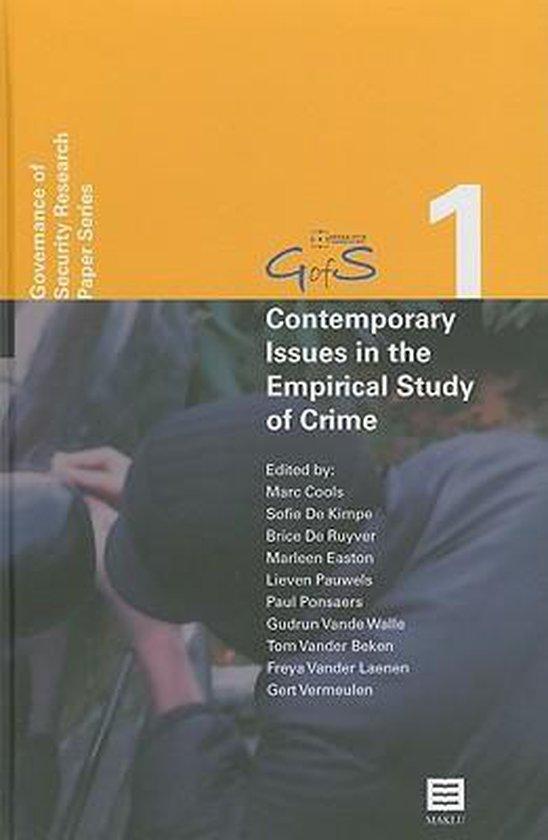
Contemporary Issues in the Empirical Study of Crime ((GofS) – Governance of Security Research Paper Series, Vol. 1)
€ 66,00
In nowadays'' globalized society an international exchange of ideas and views is indispensable within the field of social sciences, including criminology and criminal justice studies. The Research Group Governance of Security wants to foster contemporary international discourses on issues of crime and crime control. Therefore, in 2008 Gofs started a Research Paper Series, combining theoretical and empirical articles on issues reflecting the research activities of Gofs. This research group is collaboration between Ghent University and Ghent University College in Belgium.
Gofs is concentrating its research around the study of administrative and judicial policy that has been developed with respect to new issues of crime and insecurity.
This Series will appear annually comprising current perspectives especially on policing, law and regulation, governance initiatives on the European level, financial and economic crimes, drugs and drug related issues, research methods in the study of crime and crime control, new criminal phenomena, and theoretical criminology, written by members of the Research Group Governance of Security.
Maklu Quality Label: The Series contains articles that have been submitted to international double blind peer review by internationally renowned scholars.
Gofs is concentrating its research around the study of administrative and judicial policy that has been developed with respect to new issues of crime and insecurity.
This Series will appear annually comprising current perspectives especially on policing, law and regulation, governance initiatives on the European level, financial and economic crimes, drugs and drug related issues, research methods in the study of crime and crime control, new criminal phenomena, and theoretical criminology, written by members of the Research Group Governance of Security.
Maklu Quality Label: The Series contains articles that have been submitted to international double blind peer review by internationally renowned scholars.
Contemporary Issues in the Empirical Study of Crime ((GofS) – Governance of Security Research Paper Series, Vol. 1)
€ 66,00
In nowadays'' globalized society an international exchange of ideas and views is indispensable within the field of social sciences, including criminology and criminal justice studies. The Research Group Governance of Security wants to foster contemporary international discourses on issues of crime and crime control. Therefore, in 2008 Gofs started a Research Paper Series, combining theoretical and empirical articles on issues reflecting the research activities of Gofs. This research group is collaboration between Ghent University and Ghent University College in Belgium.
Gofs is concentrating its research around the study of administrative and judicial policy that has been developed with respect to new issues of crime and insecurity.
This Series will appear annually comprising current perspectives especially on policing, law and regulation, governance initiatives on the European level, financial and economic crimes, drugs and drug related issues, research methods in the study of crime and crime control, new criminal phenomena, and theoretical criminology, written by members of the Research Group Governance of Security.
Maklu Quality Label: The Series contains articles that have been submitted to international double blind peer review by internationally renowned scholars.
Gofs is concentrating its research around the study of administrative and judicial policy that has been developed with respect to new issues of crime and insecurity.
This Series will appear annually comprising current perspectives especially on policing, law and regulation, governance initiatives on the European level, financial and economic crimes, drugs and drug related issues, research methods in the study of crime and crime control, new criminal phenomena, and theoretical criminology, written by members of the Research Group Governance of Security.
Maklu Quality Label: The Series contains articles that have been submitted to international double blind peer review by internationally renowned scholars.
Strafbare overlast door jongerengroepen in het kader van openbaar vervoer. Fenomeen, dadergroep, onveiligheidsbeleving, beleidsevaluatie en -aanbevelingen (IRCP series, 27)
€ 52,50
Zowel maatschappelijk als politioneel staat de problematiek van (strafbare) overlast in het kader van openbaar vervoer, gepleegd door jongerengroepen of zogenaamde jeugdbendes, in de kijker.
Dit boek is het resultaat van een sociologisch-criminologische studie ter zake, verricht in opdracht van de federale overheidsdienst Binnenlandse Zaken. Op basis van een meer accurate beeldvorming inzake omvang en aard van overlast in het kader van openbaar vervoer, een analyse van de kenmerken en achtergronden van de veroorzakers ervan en een meting van de impact ervan op de onveiligheidsbeleving van reizigers en werknemers, formuleren de auteurs aanbevelingen voor een efficiëntere en meer adequate aanpak van het fenomeen door de diverse betrokken actoren.
Ongetwijfeld zal dit boek eenieder interesseren die professioneel of anders is begaan met deze problematiek.
Prof. Dr. Gert Vermeulen doceert criminologie aan de Universiteit Gent. Hij is ook voorzitter van het IRCP.
Eveline De Wree is Master in de criminologie en Master in European Criminology and Criminal Justice Systems
Jenneke Christiaens is docent aan de Universiteit Gent, Vakgroep Strafrecht en Criminologie.
Dit boek is het resultaat van een sociologisch-criminologische studie ter zake, verricht in opdracht van de federale overheidsdienst Binnenlandse Zaken. Op basis van een meer accurate beeldvorming inzake omvang en aard van overlast in het kader van openbaar vervoer, een analyse van de kenmerken en achtergronden van de veroorzakers ervan en een meting van de impact ervan op de onveiligheidsbeleving van reizigers en werknemers, formuleren de auteurs aanbevelingen voor een efficiëntere en meer adequate aanpak van het fenomeen door de diverse betrokken actoren.
Ongetwijfeld zal dit boek eenieder interesseren die professioneel of anders is begaan met deze problematiek.
Prof. Dr. Gert Vermeulen doceert criminologie aan de Universiteit Gent. Hij is ook voorzitter van het IRCP.
Eveline De Wree is Master in de criminologie en Master in European Criminology and Criminal Justice Systems
Jenneke Christiaens is docent aan de Universiteit Gent, Vakgroep Strafrecht en Criminologie.
Strafbare overlast door jongerengroepen in het kader van openbaar vervoer. Fenomeen, dadergroep, onveiligheidsbeleving, beleidsevaluatie en -aanbevelingen (IRCP series, 27)
€ 52,50
Zowel maatschappelijk als politioneel staat de problematiek van (strafbare) overlast in het kader van openbaar vervoer, gepleegd door jongerengroepen of zogenaamde jeugdbendes, in de kijker.
Dit boek is het resultaat van een sociologisch-criminologische studie ter zake, verricht in opdracht van de federale overheidsdienst Binnenlandse Zaken. Op basis van een meer accurate beeldvorming inzake omvang en aard van overlast in het kader van openbaar vervoer, een analyse van de kenmerken en achtergronden van de veroorzakers ervan en een meting van de impact ervan op de onveiligheidsbeleving van reizigers en werknemers, formuleren de auteurs aanbevelingen voor een efficiëntere en meer adequate aanpak van het fenomeen door de diverse betrokken actoren.
Ongetwijfeld zal dit boek eenieder interesseren die professioneel of anders is begaan met deze problematiek.
Prof. Dr. Gert Vermeulen doceert criminologie aan de Universiteit Gent. Hij is ook voorzitter van het IRCP.
Eveline De Wree is Master in de criminologie en Master in European Criminology and Criminal Justice Systems
Jenneke Christiaens is docent aan de Universiteit Gent, Vakgroep Strafrecht en Criminologie.
Dit boek is het resultaat van een sociologisch-criminologische studie ter zake, verricht in opdracht van de federale overheidsdienst Binnenlandse Zaken. Op basis van een meer accurate beeldvorming inzake omvang en aard van overlast in het kader van openbaar vervoer, een analyse van de kenmerken en achtergronden van de veroorzakers ervan en een meting van de impact ervan op de onveiligheidsbeleving van reizigers en werknemers, formuleren de auteurs aanbevelingen voor een efficiëntere en meer adequate aanpak van het fenomeen door de diverse betrokken actoren.
Ongetwijfeld zal dit boek eenieder interesseren die professioneel of anders is begaan met deze problematiek.
Prof. Dr. Gert Vermeulen doceert criminologie aan de Universiteit Gent. Hij is ook voorzitter van het IRCP.
Eveline De Wree is Master in de criminologie en Master in European Criminology and Criminal Justice Systems
Jenneke Christiaens is docent aan de Universiteit Gent, Vakgroep Strafrecht en Criminologie.