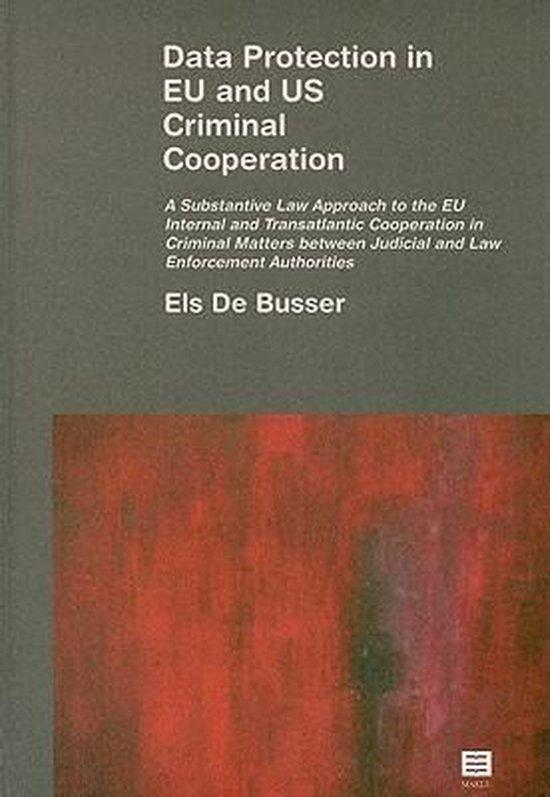
Data protection in EU and US Criminal Cooperation
Winner of the 2014 Siracusa Prize for Young Penalists
In this book three specific elements are joined in one research for the first
time. The protection of personal data in criminal matters as a first element
is studied in two relationships: the cooperation in criminal matters between
judicial and law enforcement authorities of the European Union member
states (including Europol and Eurojust) on the one hand and the cooperation
in criminal matters between the judicial and law enforcement authorities of
the European Union (including Europol and Eurojust) and the United States of
America on the other hand. This book offers answers to the central question
whether the European Union complies with her own standards of data
protection in these internal relations and in the transatlantic cooperation in
criminal matters.
The new framework decision on data protection in criminal matters that
entered into force early 2009 is a significant element in this research
alongside the agreement concluded between the European Union and the
United States on mutual assistance in criminal matters of which the entry
into force is equally planned for 2009.
The current circumstances are thus the perfect background for this research
that also reflects on the policy proposals of the European Union on justice
and home affairs for the period of 2010-2014.
Els De Busser is doctor at law, currently affiliated to the Department of
Penal Law and Criminology, Institute for International Research on Criminal
Policy (IRCP), Ghent University (Belgium). This publication is the result of her
doctoral thesis.
Data protection in EU and US Criminal Cooperation
Winner of the 2014 Siracusa Prize for Young Penalists
In this book three specific elements are joined in one research for the first
time. The protection of personal data in criminal matters as a first element
is studied in two relationships: the cooperation in criminal matters between
judicial and law enforcement authorities of the European Union member
states (including Europol and Eurojust) on the one hand and the cooperation
in criminal matters between the judicial and law enforcement authorities of
the European Union (including Europol and Eurojust) and the United States of
America on the other hand. This book offers answers to the central question
whether the European Union complies with her own standards of data
protection in these internal relations and in the transatlantic cooperation in
criminal matters.
The new framework decision on data protection in criminal matters that
entered into force early 2009 is a significant element in this research
alongside the agreement concluded between the European Union and the
United States on mutual assistance in criminal matters of which the entry
into force is equally planned for 2009.
The current circumstances are thus the perfect background for this research
that also reflects on the policy proposals of the European Union on justice
and home affairs for the period of 2010-2014.
Els De Busser is doctor at law, currently affiliated to the Department of
Penal Law and Criminology, Institute for International Research on Criminal
Policy (IRCP), Ghent University (Belgium). This publication is the result of her
doctoral thesis.