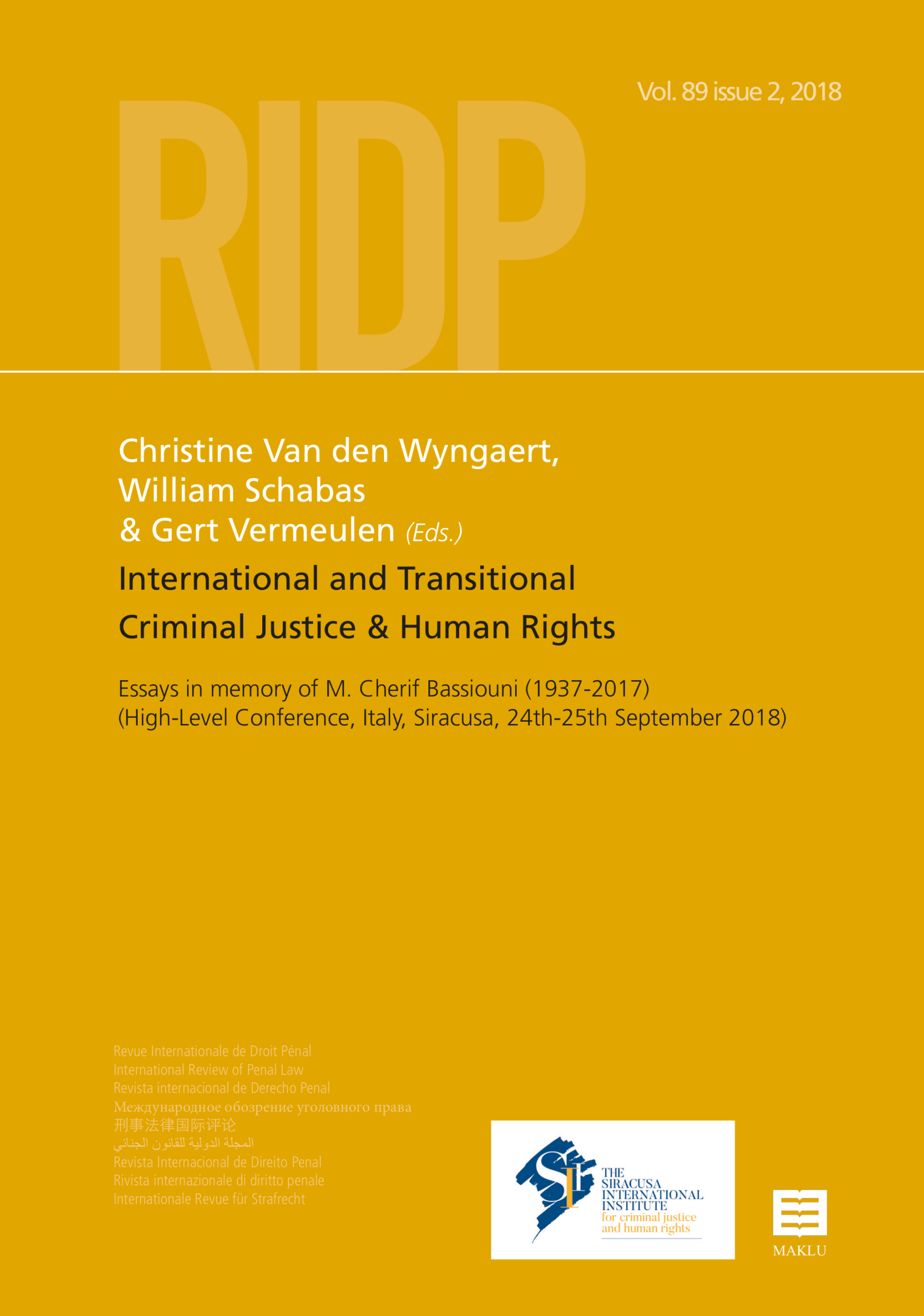
RIDP2018Vol89/issue2- International and Transitional Criminal Justice & Human Rights Essays
€ 40,00
A quarter-century ago, the ‘short twentieth century’ came to an end, marked by the fall of the Berlin Wall and the breakup of Yugoslavia and the Soviet Union. International criminal justice awakened from its post-Nuremberg hibernation. In the ensuing decades, a multitude of international criminal tribunals was established as well as unprecedented initiatives at the national and regional levels. This movement for justice and accountability transformed the protection of human rights.
Cherif Bassiouni was at the centre of this process from its beginning until his passing, in September 2017, and has been absolutely instrumental in its origins. From the beginning of his career, he brought oxygen to the embers of the post-Second World War initiatives. He linked them to more contemporary issues, such as the struggle against apartheid in South Africa and the campaign for new standards and instruments to address issues such as torture. Through the International Institute for Higher Studies in Criminal Sciences, now renamed the Siracusa International Institute for Criminal Justice and Human Rights, Cherif Bassiouni regularly assembled experts, practitioners, international officials and public intellectuals in the promotion of law and policy. He was also President of the International Association of Penal Law (IAPL-AIDP) for fifteen years.
In September 2018, colleagues and friends of Cherif Bassiouni assembled for a high-level academic conference in Siracusa, organised around themes central in his massive oeuvre: international and transitional criminal justice and human rights. The chapters in this humble volume provide a written record of the conference, in recognition, honour and memory of his legacy.
Christine Van den Wyngaert is Emeritus Professor of Law at the University of Antwerp, Belgium, Judge at the Kosovo Specialist Chambers and former Judge at the International Criminal Court, the International Criminal Tribunal for the Former Yugoslavia and the International Court of Justice (Judge ad hoc).
William Schabas is Professor of International Law at Middlesex University London, UK, and Professor of International Criminal Law and Human Rights at Leiden University, The Netherlands.
Gert Vermeulen is Professor of European and international Criminal Law and Data Protection Law, Director of the Institute for International Research on Criminal Policy (IRCP) and Director of the Knowledge and Research Platform on Privacy, Information Exchange, Law Enforcement and Surveillance (PIXLES) at Ghent University, Belgium. He is also General Director Publications of the AIDP and Editor-in-Chief of the RIDP.
Cherif Bassiouni was at the centre of this process from its beginning until his passing, in September 2017, and has been absolutely instrumental in its origins. From the beginning of his career, he brought oxygen to the embers of the post-Second World War initiatives. He linked them to more contemporary issues, such as the struggle against apartheid in South Africa and the campaign for new standards and instruments to address issues such as torture. Through the International Institute for Higher Studies in Criminal Sciences, now renamed the Siracusa International Institute for Criminal Justice and Human Rights, Cherif Bassiouni regularly assembled experts, practitioners, international officials and public intellectuals in the promotion of law and policy. He was also President of the International Association of Penal Law (IAPL-AIDP) for fifteen years.
In September 2018, colleagues and friends of Cherif Bassiouni assembled for a high-level academic conference in Siracusa, organised around themes central in his massive oeuvre: international and transitional criminal justice and human rights. The chapters in this humble volume provide a written record of the conference, in recognition, honour and memory of his legacy.
Christine Van den Wyngaert is Emeritus Professor of Law at the University of Antwerp, Belgium, Judge at the Kosovo Specialist Chambers and former Judge at the International Criminal Court, the International Criminal Tribunal for the Former Yugoslavia and the International Court of Justice (Judge ad hoc).
William Schabas is Professor of International Law at Middlesex University London, UK, and Professor of International Criminal Law and Human Rights at Leiden University, The Netherlands.
Gert Vermeulen is Professor of European and international Criminal Law and Data Protection Law, Director of the Institute for International Research on Criminal Policy (IRCP) and Director of the Knowledge and Research Platform on Privacy, Information Exchange, Law Enforcement and Surveillance (PIXLES) at Ghent University, Belgium. He is also General Director Publications of the AIDP and Editor-in-Chief of the RIDP.
RIDP2018Vol89/issue2- International and Transitional Criminal Justice & Human Rights Essays
€ 40,00
A quarter-century ago, the ‘short twentieth century’ came to an end, marked by the fall of the Berlin Wall and the breakup of Yugoslavia and the Soviet Union. International criminal justice awakened from its post-Nuremberg hibernation. In the ensuing decades, a multitude of international criminal tribunals was established as well as unprecedented initiatives at the national and regional levels. This movement for justice and accountability transformed the protection of human rights.
Cherif Bassiouni was at the centre of this process from its beginning until his passing, in September 2017, and has been absolutely instrumental in its origins. From the beginning of his career, he brought oxygen to the embers of the post-Second World War initiatives. He linked them to more contemporary issues, such as the struggle against apartheid in South Africa and the campaign for new standards and instruments to address issues such as torture. Through the International Institute for Higher Studies in Criminal Sciences, now renamed the Siracusa International Institute for Criminal Justice and Human Rights, Cherif Bassiouni regularly assembled experts, practitioners, international officials and public intellectuals in the promotion of law and policy. He was also President of the International Association of Penal Law (IAPL-AIDP) for fifteen years.
In September 2018, colleagues and friends of Cherif Bassiouni assembled for a high-level academic conference in Siracusa, organised around themes central in his massive oeuvre: international and transitional criminal justice and human rights. The chapters in this humble volume provide a written record of the conference, in recognition, honour and memory of his legacy.
Christine Van den Wyngaert is Emeritus Professor of Law at the University of Antwerp, Belgium, Judge at the Kosovo Specialist Chambers and former Judge at the International Criminal Court, the International Criminal Tribunal for the Former Yugoslavia and the International Court of Justice (Judge ad hoc).
William Schabas is Professor of International Law at Middlesex University London, UK, and Professor of International Criminal Law and Human Rights at Leiden University, The Netherlands.
Gert Vermeulen is Professor of European and international Criminal Law and Data Protection Law, Director of the Institute for International Research on Criminal Policy (IRCP) and Director of the Knowledge and Research Platform on Privacy, Information Exchange, Law Enforcement and Surveillance (PIXLES) at Ghent University, Belgium. He is also General Director Publications of the AIDP and Editor-in-Chief of the RIDP.
Cherif Bassiouni was at the centre of this process from its beginning until his passing, in September 2017, and has been absolutely instrumental in its origins. From the beginning of his career, he brought oxygen to the embers of the post-Second World War initiatives. He linked them to more contemporary issues, such as the struggle against apartheid in South Africa and the campaign for new standards and instruments to address issues such as torture. Through the International Institute for Higher Studies in Criminal Sciences, now renamed the Siracusa International Institute for Criminal Justice and Human Rights, Cherif Bassiouni regularly assembled experts, practitioners, international officials and public intellectuals in the promotion of law and policy. He was also President of the International Association of Penal Law (IAPL-AIDP) for fifteen years.
In September 2018, colleagues and friends of Cherif Bassiouni assembled for a high-level academic conference in Siracusa, organised around themes central in his massive oeuvre: international and transitional criminal justice and human rights. The chapters in this humble volume provide a written record of the conference, in recognition, honour and memory of his legacy.
Christine Van den Wyngaert is Emeritus Professor of Law at the University of Antwerp, Belgium, Judge at the Kosovo Specialist Chambers and former Judge at the International Criminal Court, the International Criminal Tribunal for the Former Yugoslavia and the International Court of Justice (Judge ad hoc).
William Schabas is Professor of International Law at Middlesex University London, UK, and Professor of International Criminal Law and Human Rights at Leiden University, The Netherlands.
Gert Vermeulen is Professor of European and international Criminal Law and Data Protection Law, Director of the Institute for International Research on Criminal Policy (IRCP) and Director of the Knowledge and Research Platform on Privacy, Information Exchange, Law Enforcement and Surveillance (PIXLES) at Ghent University, Belgium. He is also General Director Publications of the AIDP and Editor-in-Chief of the RIDP.