
Finding the best place for prosecution. European study on jurisdiction criteria
Finding the best place for prosecution. European study on jurisdiction criteria

Naar een vrijwillige opschaling van de lokale politie (Reeks Politiestudies, nr. 9)
Dit boek bevat twee rapporten die elk op hun eigen manier de weg wijzen bij zo’n zoektocht: enerzijds een doorgedreven oefening om de volledige provincie Limburg te voorzien van robuuste fusie-PZ’s, anderzijds een rapport dat weergeeft hoe een aantal korpsen in Vlaams-Brabant zijn tewerk gegaan bij het objectiveren en valideren van hun fusiepoging.
Deze publicatie zal ongetwijfeld bijdragen tot het opschalen van de lokale zones tot robuustere entiteiten, die toch voldoende voeling houden met het lokaal bestuursniveau. Want, daarover lijkt intussen iedereen het eens, vrijwillige fusies mogen niet leiden tot al te grote geografische omschrijvingen die de lokale hartslag nog onvoldoende voelen kloppen in het hoofdkantoor van de zone. Gemeenschapsgerichte politie mag en moet fors zijn, maar mag zich niet te ver verwijderen van het gemeentelijk bestuursniveau.
Naar een vrijwillige opschaling van de lokale politie (Reeks Politiestudies, nr. 9)
Dit boek bevat twee rapporten die elk op hun eigen manier de weg wijzen bij zo’n zoektocht: enerzijds een doorgedreven oefening om de volledige provincie Limburg te voorzien van robuuste fusie-PZ’s, anderzijds een rapport dat weergeeft hoe een aantal korpsen in Vlaams-Brabant zijn tewerk gegaan bij het objectiveren en valideren van hun fusiepoging.
Deze publicatie zal ongetwijfeld bijdragen tot het opschalen van de lokale zones tot robuustere entiteiten, die toch voldoende voeling houden met het lokaal bestuursniveau. Want, daarover lijkt intussen iedereen het eens, vrijwillige fusies mogen niet leiden tot al te grote geografische omschrijvingen die de lokale hartslag nog onvoldoende voelen kloppen in het hoofdkantoor van de zone. Gemeenschapsgerichte politie mag en moet fors zijn, maar mag zich niet te ver verwijderen van het gemeentelijk bestuursniveau.
European criminal justice and policy ((GofS) – Governance of Security Research Paper Series, Vol. 7)
Volume 6 focuses on Social conflicts, citizens and policing. Its table of contents is provided below the brief description of the papers comprised in the current book, which constitutes Volume 7, dealing with European criminal justice and policy. Reviewing the policy (background) with respect to different phases in the criminal justice chain, the contributions range from looking into the extension of criminalization in the sphere of trafficking in human beings and labour exploitation to the operability of cross-border execution of sentences involving deprivation of liberty.
Most contributions look into the need to develop a conceptual framework to support future policy making, pointing to the lack thereof with respect to liability of legal persons, ne bis in idem as an EU principle, cross-border effect of disqualifications and cooperation with private security actors.
One contribution looks into the public expenditure in different phases of the criminal justice chain, based on a case study on the public expenditure of Belgian drug policy. Finally, one contribution analyses the specific European and Chinese interrogation rules from a historical and comparative perspective to provide a solid context for the current situation and support future legal reforms.
European criminal justice and policy ((GofS) – Governance of Security Research Paper Series, Vol. 7)
Volume 6 focuses on Social conflicts, citizens and policing. Its table of contents is provided below the brief description of the papers comprised in the current book, which constitutes Volume 7, dealing with European criminal justice and policy. Reviewing the policy (background) with respect to different phases in the criminal justice chain, the contributions range from looking into the extension of criminalization in the sphere of trafficking in human beings and labour exploitation to the operability of cross-border execution of sentences involving deprivation of liberty.
Most contributions look into the need to develop a conceptual framework to support future policy making, pointing to the lack thereof with respect to liability of legal persons, ne bis in idem as an EU principle, cross-border effect of disqualifications and cooperation with private security actors.
One contribution looks into the public expenditure in different phases of the criminal justice chain, based on a case study on the public expenditure of Belgian drug policy. Finally, one contribution analyses the specific European and Chinese interrogation rules from a historical and comparative perspective to provide a solid context for the current situation and support future legal reforms.
Social conflicts, citizens and policing ((GofS) – Governance of Security Research Paper Series, Vol. 6)
After no less than five entirely double blind peer reviewed volumes in the GofS Research Paper Series have been released in 2009, 2010 and 2011 the editorial board is proud to issue again a set of two more volumes comprising original and new research papers that have been proofed by international peers
Volume 6, providing new empirical data, theories and analyses on Social Conflicts, Citizens and Policing.
Some articles in Volume 6 focus on the current manifestation of specific socially and/or legally criminalised social conflicts as being radicalisation and informal economy. Some other articles discuss new actors that are involved in governance of security in order to support the conventional actors. The authors refer specifically to citizens and private companies. A last set of articles presents the results of perception studies on trust, punitiveness and the electronic monitoring at home. The participation of students or convicts to scientific research enables a critical reflection on governance of security.
Volume 7 focuses on topical issues in European criminal justice and policy.
(read more)
Social conflicts, citizens and policing ((GofS) – Governance of Security Research Paper Series, Vol. 6)
After no less than five entirely double blind peer reviewed volumes in the GofS Research Paper Series have been released in 2009, 2010 and 2011 the editorial board is proud to issue again a set of two more volumes comprising original and new research papers that have been proofed by international peers
Volume 6, providing new empirical data, theories and analyses on Social Conflicts, Citizens and Policing.
Some articles in Volume 6 focus on the current manifestation of specific socially and/or legally criminalised social conflicts as being radicalisation and informal economy. Some other articles discuss new actors that are involved in governance of security in order to support the conventional actors. The authors refer specifically to citizens and private companies. A last set of articles presents the results of perception studies on trust, punitiveness and the electronic monitoring at home. The participation of students or convicts to scientific research enables a critical reflection on governance of security.
Volume 7 focuses on topical issues in European criminal justice and policy.
(read more)
EU Criminal Justice, Financial & Economic Crime: new perspectives (Governance of Security Research Paper Series, Vol. 5 )
The new volume, even though addressing a wider variety of topical issues, focuses on European criminal justice and financial and economic crime.
The first cluster of four articles concern European criminal justice matters, in particular relating to EU mutual recognition (conceptualization, unwanted effects in the context of prisoner transfer and sentence execution, and impact for cross-border gathering and use of forensic expert evidence) and concluding with an article on interrogational fairness standards.
A second cluster of five articles addresses financial and economic crime subjects, ranging from informal economy (among street children) to formal/informal economy (vulnerability of the hotel and catering industry to crime) and white collar crime phenomena like (transnational) environmental crime, fraud and corruption.
A last cluster groups a variety of selected, topical issues (juvenile offending and mental disorders, desistance theories and sexually transmitted infections).
The Gofs Research Paper Series aims at disseminating the results of research conducted in the GofS Research Unit (Ghent, Belgium). Full research reports are published in the Gofs Research Report Series.
EU Criminal Justice, Financial & Economic Crime: new perspectives (Governance of Security Research Paper Series, Vol. 5 )
The new volume, even though addressing a wider variety of topical issues, focuses on European criminal justice and financial and economic crime.
The first cluster of four articles concern European criminal justice matters, in particular relating to EU mutual recognition (conceptualization, unwanted effects in the context of prisoner transfer and sentence execution, and impact for cross-border gathering and use of forensic expert evidence) and concluding with an article on interrogational fairness standards.
A second cluster of five articles addresses financial and economic crime subjects, ranging from informal economy (among street children) to formal/informal economy (vulnerability of the hotel and catering industry to crime) and white collar crime phenomena like (transnational) environmental crime, fraud and corruption.
A last cluster groups a variety of selected, topical issues (juvenile offending and mental disorders, desistance theories and sexually transmitted infections).
The Gofs Research Paper Series aims at disseminating the results of research conducted in the GofS Research Unit (Ghent, Belgium). Full research reports are published in the Gofs Research Report Series.
Strafrechtshandhaving in België en Nederland. Uitgave ter gelegenheid van het eredoctoraat toegekend door de Universiteit Gent aan prof. Dr. Cyrille Fijnaut
Het eredoctoraat is een waardering voor de maatschappelijke impact van het werk van professor Fijnaut en de geregelde en intense samenwerkingsverbanden met de UGent, in het bijzonder in de vakgebieden criminologie en strafrecht en in het domein van de geschiedenis van het recht. Voorafgaand aan deze uitreiking vond de Belgisch-Nederlandse conferentie plaats over rechtshandhaving in beide landen. Deze uitgave bundelt de verschillende bijdragen van deze conferentie.
Strafrechtshandhaving in België en Nederland. Uitgave ter gelegenheid van het eredoctoraat toegekend door de Universiteit Gent aan prof. Dr. Cyrille Fijnaut
Het eredoctoraat is een waardering voor de maatschappelijke impact van het werk van professor Fijnaut en de geregelde en intense samenwerkingsverbanden met de UGent, in het bijzonder in de vakgebieden criminologie en strafrecht en in het domein van de geschiedenis van het recht. Voorafgaand aan deze uitreiking vond de Belgisch-Nederlandse conferentie plaats over rechtshandhaving in beide landen. Deze uitgave bundelt de verschillende bijdragen van deze conferentie.
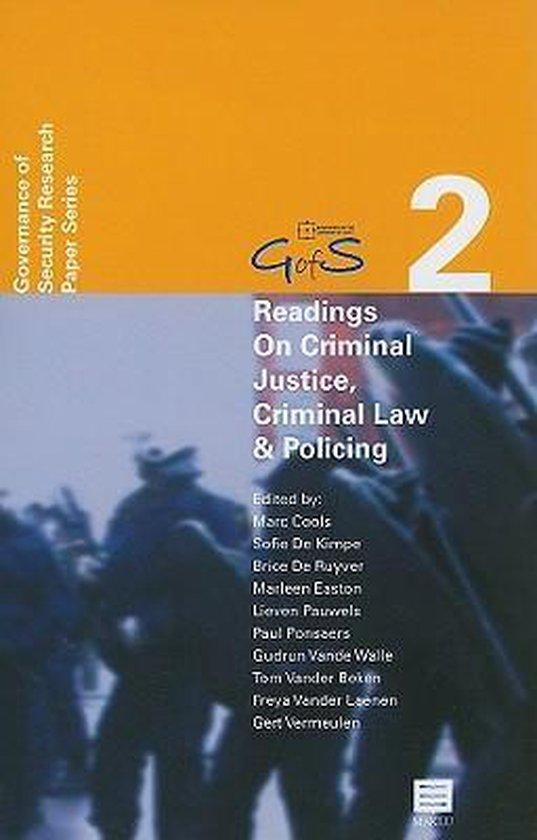
Readings on Criminal Justice, Criminal Law & Policing ((GofS) – Governance of Security Research Paper Series, Vol. 2)
Gofs is concentrating its research around the study of administrative and judicial policy that has been developed with respect to new issues of crime and insecurity.
This Series will appear annually comprising current perspectives especially on policing, law and regulation, governance initiatives on the European level, financial and economic crimes, drugs and drug related issues, research methods in the study of crime and crime control, new criminal phenomena, and theoretical criminology, written by members of the Research Group Governance of Security.
Maklu Quality Label: The Series contains articles that have been submitted to international double blind peer review by internationally renowned scholars.
Readings on Criminal Justice, Criminal Law & Policing ((GofS) – Governance of Security Research Paper Series, Vol. 2)
Gofs is concentrating its research around the study of administrative and judicial policy that has been developed with respect to new issues of crime and insecurity.
This Series will appear annually comprising current perspectives especially on policing, law and regulation, governance initiatives on the European level, financial and economic crimes, drugs and drug related issues, research methods in the study of crime and crime control, new criminal phenomena, and theoretical criminology, written by members of the Research Group Governance of Security.
Maklu Quality Label: The Series contains articles that have been submitted to international double blind peer review by internationally renowned scholars.
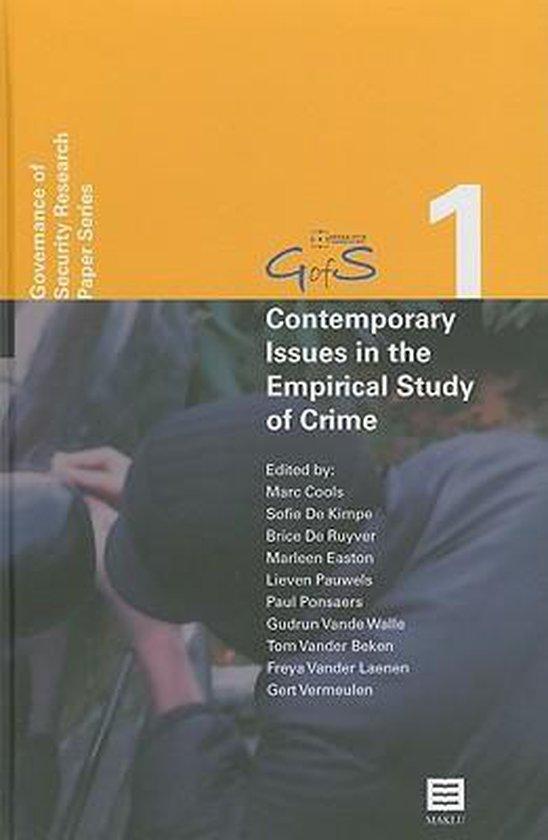
Contemporary Issues in the Empirical Study of Crime ((GofS) – Governance of Security Research Paper Series, Vol. 1)
Gofs is concentrating its research around the study of administrative and judicial policy that has been developed with respect to new issues of crime and insecurity.
This Series will appear annually comprising current perspectives especially on policing, law and regulation, governance initiatives on the European level, financial and economic crimes, drugs and drug related issues, research methods in the study of crime and crime control, new criminal phenomena, and theoretical criminology, written by members of the Research Group Governance of Security.
Maklu Quality Label: The Series contains articles that have been submitted to international double blind peer review by internationally renowned scholars.
Contemporary Issues in the Empirical Study of Crime ((GofS) – Governance of Security Research Paper Series, Vol. 1)
Gofs is concentrating its research around the study of administrative and judicial policy that has been developed with respect to new issues of crime and insecurity.
This Series will appear annually comprising current perspectives especially on policing, law and regulation, governance initiatives on the European level, financial and economic crimes, drugs and drug related issues, research methods in the study of crime and crime control, new criminal phenomena, and theoretical criminology, written by members of the Research Group Governance of Security.
Maklu Quality Label: The Series contains articles that have been submitted to international double blind peer review by internationally renowned scholars.
Een brug tussen justitie en drughulpverlening. Een evaluatie van het proefzorgproject (Reeks Dienst voor het Strafrechtelijk beleid, nr. 29)
De doelstelling van Proefzorg bestaat erin het parket, reeds op het echelon van opsporing en vervolging, voldoende armslag te geven om de delinquent – die bekent feiten te hebben gepleegd en bij wie een verslavingsverschijnsel of ziekte aan de grondslag van de feiten ligt – vlot, efficiënt en adequaat naar de hulpverlening te kunnen sluizen.
In België bestaan er op alle echelons van de strafrechtsbedeling verschillende modaliteiten waarbij middelengebruikers naar de hulpverlening kunnen doorverwezen worden.
Niettemin bestaat er op het niveau van de opsporing en de vervolging een leemte om middelengebruikers door te verwijzen. Proefzorg tracht deze lacune in te vullen.
Samen met de start van Proefzorg werd een wetenschappelijke evaluatie opgezet en uitgevoerd in een samenwerkingsverband tussen de Dienst voor het Strafrechtelijk beleid en het ‘Institute for international Research on Criminal Policy’ (IRCP) van de Universiteit Gent.
Deze evaluatie werd uitgevoerd in 2005-2007 en bevat twee complementaire luiken: een kwantitatieve gegevensverwerking en een kwalitatieve analyse. Deze twee luiken werden samengebracht tot een globale evaluatie, zodat een zo neutraal, evenwichtig én volledig mogelijk beeld kan gevormd worden over de effectiviteit van het project.
Een brug tussen justitie en drughulpverlening. Een evaluatie van het proefzorgproject (Reeks Dienst voor het Strafrechtelijk beleid, nr. 29)
De doelstelling van Proefzorg bestaat erin het parket, reeds op het echelon van opsporing en vervolging, voldoende armslag te geven om de delinquent – die bekent feiten te hebben gepleegd en bij wie een verslavingsverschijnsel of ziekte aan de grondslag van de feiten ligt – vlot, efficiënt en adequaat naar de hulpverlening te kunnen sluizen.
In België bestaan er op alle echelons van de strafrechtsbedeling verschillende modaliteiten waarbij middelengebruikers naar de hulpverlening kunnen doorverwezen worden.
Niettemin bestaat er op het niveau van de opsporing en de vervolging een leemte om middelengebruikers door te verwijzen. Proefzorg tracht deze lacune in te vullen.
Samen met de start van Proefzorg werd een wetenschappelijke evaluatie opgezet en uitgevoerd in een samenwerkingsverband tussen de Dienst voor het Strafrechtelijk beleid en het ‘Institute for international Research on Criminal Policy’ (IRCP) van de Universiteit Gent.
Deze evaluatie werd uitgevoerd in 2005-2007 en bevat twee complementaire luiken: een kwantitatieve gegevensverwerking en een kwalitatieve analyse. Deze twee luiken werden samengebracht tot een globale evaluatie, zodat een zo neutraal, evenwichtig én volledig mogelijk beeld kan gevormd worden over de effectiviteit van het project.
Grensoverschrijdend drugstoerisme. Nieuwe uitdagingen voor de Euregio’s (IRCP-reeks)
Deze drugsfenomenen hebben gevolgen voor drie landen (België, Nederland en Frankrijk) en de twee vermelde Euregio’s. De rijke samenwerkingstraditie in de beide Euregio’s biedt echter perspectieven tot onderlinge dwarsverbindingen op verschillende vlakken: beleidsmatig, bestuurlijk, preventief, hulpverlening, justitieel en politioneel.
Twee fenomenen behoren in het bijzonder tot dit grensoverschrijdend drugstoerisme. Enerzijds is er het drugstoerisme vanuit België en Frankrijk, dat verbonden is aan de Nederlandse coffeeshops. Anderzijds is er het relatief recente fenomeen van de illegale drugspanden. Dit laatste fenomeen heeft zich sinds het begin van deze eeuw vanuit Nederland naar een aantal Belgische grootsteden verplaatst.
Om de samenwerking en de beleidsafstemming rond het grensoverschrijdend drugstoerisme te optimaliseren, organiseerden de provincies Oost- en West-Vlaanderen en Zeeland, op 26 mei 2006 een symposium, in samenwerking met IRCP (Institute for International Research on Criminal Policy), de Oost-Vlaamse Politieacademie en VZW Drugbeleid 2000. Op basis van empirisch onderzoek over coffeeshoptoeristen en drugspanden, en met vier paneldiscussies werden de mogelijkheden en strategieën op vlak van het bestuur, beleid, politie, justitie en preventie/hulpverlening behandeld.
Dit boek vormt de neerslag van het symposium. De inhoud blijft brandend actueel voor beleidsmakers, politiemensen, justitiemensen, preventiewerkers en hulpverleners die in hun praktijk te maken krijgen met het fenomeen van grensoverschrijdend drugstoerisme.
Grensoverschrijdend drugstoerisme. Nieuwe uitdagingen voor de Euregio’s (IRCP-reeks)
Deze drugsfenomenen hebben gevolgen voor drie landen (België, Nederland en Frankrijk) en de twee vermelde Euregio’s. De rijke samenwerkingstraditie in de beide Euregio’s biedt echter perspectieven tot onderlinge dwarsverbindingen op verschillende vlakken: beleidsmatig, bestuurlijk, preventief, hulpverlening, justitieel en politioneel.
Twee fenomenen behoren in het bijzonder tot dit grensoverschrijdend drugstoerisme. Enerzijds is er het drugstoerisme vanuit België en Frankrijk, dat verbonden is aan de Nederlandse coffeeshops. Anderzijds is er het relatief recente fenomeen van de illegale drugspanden. Dit laatste fenomeen heeft zich sinds het begin van deze eeuw vanuit Nederland naar een aantal Belgische grootsteden verplaatst.
Om de samenwerking en de beleidsafstemming rond het grensoverschrijdend drugstoerisme te optimaliseren, organiseerden de provincies Oost- en West-Vlaanderen en Zeeland, op 26 mei 2006 een symposium, in samenwerking met IRCP (Institute for International Research on Criminal Policy), de Oost-Vlaamse Politieacademie en VZW Drugbeleid 2000. Op basis van empirisch onderzoek over coffeeshoptoeristen en drugspanden, en met vier paneldiscussies werden de mogelijkheden en strategieën op vlak van het bestuur, beleid, politie, justitie en preventie/hulpverlening behandeld.
Dit boek vormt de neerslag van het symposium. De inhoud blijft brandend actueel voor beleidsmakers, politiemensen, justitiemensen, preventiewerkers en hulpverleners die in hun praktijk te maken krijgen met het fenomeen van grensoverschrijdend drugstoerisme.