
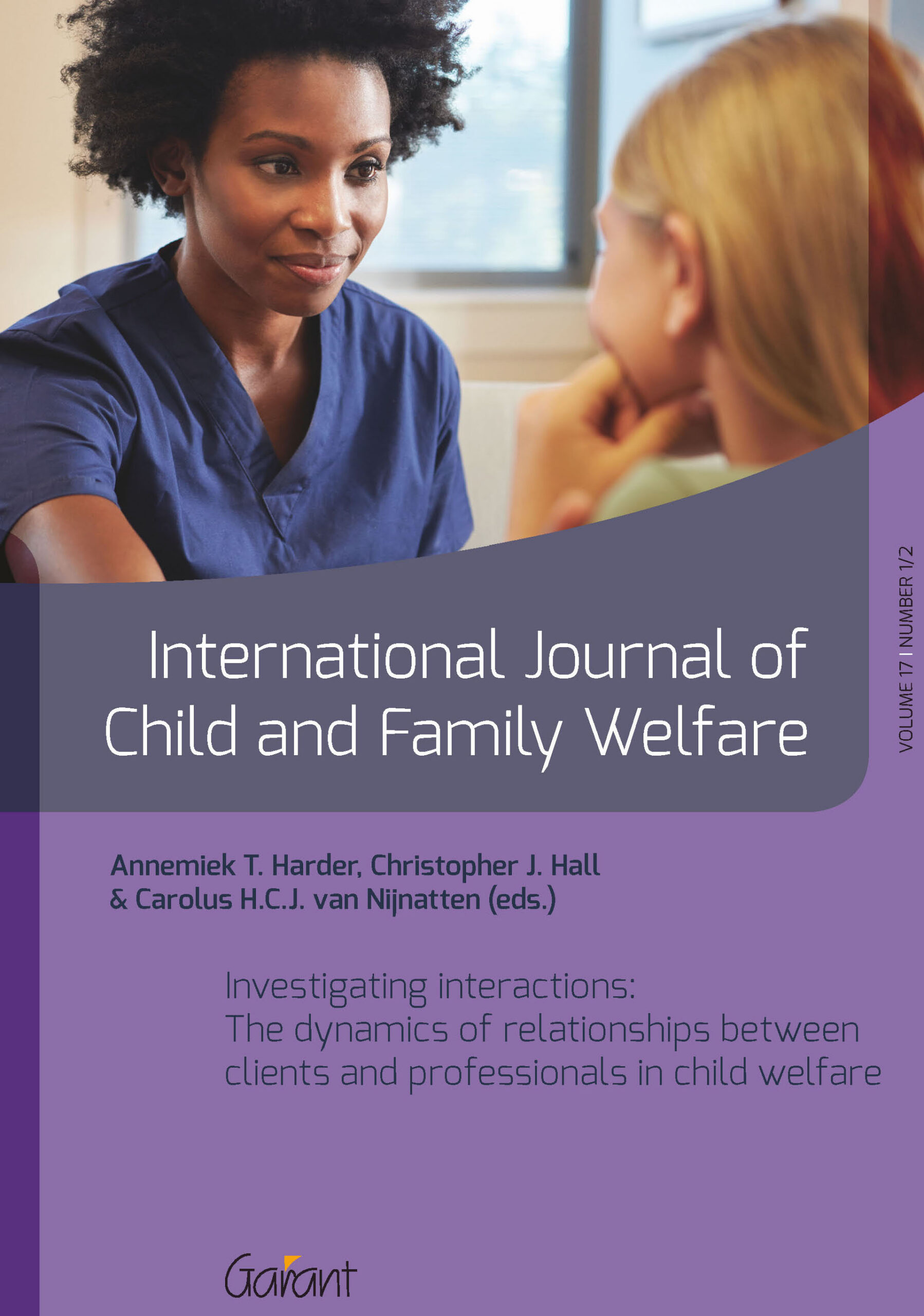
International Journal of Child and Family Welfare (IJCFW) 2016 – Jrg 17 – Nr 1/2
Investigating interactions: The dynamics of relationships between clients and professionals in child welfare
The effectiveness of interventions has become an important object of scientific study in child welfare and often a prerequisite for funding of child welfare programmes.
Many studies on the effectiveness of interventions aimed at supporting families at risk and behavioural change of youth have suggested that features of the relationship between professional and client, and the characteristics of the professional, are decisive for the interventions effectiveness. There are, however, few studies of what is important in terms of relational skills, personal characteristics or communication strategies. In this special issue, we focus on the dynamics of relationships between child welfare workers and clients (i.e. young people and/or their parents) by using direct observation and close analysis of naturally occurring processes.
The contributions to this special issue have a bottom up and a top down approach in analysing relationships. The first part uses a bottom up approach and reports on conversations between youth and family treatment parents in treatment homes. Using a top down approach, the second part specifically focuses on Motivational Interviewing skills of care professionals in their interactions with youth. The third part covers the interactions between parents and professionals in the context of child protection using a bottom up approach.
The (guest) editors: Annemiek T. Harder, Christopher J. Hall & Carolus H.C.J. van Nijnatten
The authors: Annemiek T. Harder, Christopher J. Hall, Carolus H.C.J. van Nijnatten, Ellen Schep, Tom Koole, Martine Noordegraaf, Charlotte E. Whittaker, Donald Forrester, Michael Killian, Rebecca K. Jones, Annika Eenshuistra, Neeltje L. van Zonneveld, Tessa Verhallen, Stef Slembrouck, Steve Kirkwood, Juliet Koprowska & Erik J. Knorth
International Journal of Child and Family Welfare (IJCFW) 2016 – Jrg 17 – Nr 1/2
Investigating interactions: The dynamics of relationships between clients and professionals in child welfare
The effectiveness of interventions has become an important object of scientific study in child welfare and often a prerequisite for funding of child welfare programmes.
Many studies on the effectiveness of interventions aimed at supporting families at risk and behavioural change of youth have suggested that features of the relationship between professional and client, and the characteristics of the professional, are decisive for the interventions effectiveness. There are, however, few studies of what is important in terms of relational skills, personal characteristics or communication strategies. In this special issue, we focus on the dynamics of relationships between child welfare workers and clients (i.e. young people and/or their parents) by using direct observation and close analysis of naturally occurring processes.
The contributions to this special issue have a bottom up and a top down approach in analysing relationships. The first part uses a bottom up approach and reports on conversations between youth and family treatment parents in treatment homes. Using a top down approach, the second part specifically focuses on Motivational Interviewing skills of care professionals in their interactions with youth. The third part covers the interactions between parents and professionals in the context of child protection using a bottom up approach.
The (guest) editors: Annemiek T. Harder, Christopher J. Hall & Carolus H.C.J. van Nijnatten
The authors: Annemiek T. Harder, Christopher J. Hall, Carolus H.C.J. van Nijnatten, Ellen Schep, Tom Koole, Martine Noordegraaf, Charlotte E. Whittaker, Donald Forrester, Michael Killian, Rebecca K. Jones, Annika Eenshuistra, Neeltje L. van Zonneveld, Tessa Verhallen, Stef Slembrouck, Steve Kirkwood, Juliet Koprowska & Erik J. Knorth
International Journal of Child and Family Welfare (IJCFW) 2014 – Jrg 15 – Nr 1/2
Inside the black box: Experiences and perspectives of young people and professionals in residential youth care
The metaphor of the black box has often been used in recent years to refer to characteristics of residential care that - although of pivotal importance - are not sufficiently transparent or known. Considering its importance for positive outcomes and the lack of research on this topic within the context of residential care, the current special issue focuses on the components that facilitate change in behaviour and well-being of youth in residential care through an explicit orientation towards the perspectives and experiences of young people and professionals. This form of study can be called voices research . The included studies present insights on the aspects of the residential youth care process that are important for the development and well-being of the youth in care and, therefore, the outcomes of care.
Topics that will be addressed include the youth-adult relationship in residential care; the adolescents perceptions of participation in secure care; the experience of pain in secure care; clients and professionals perspectives on the quality of care; the threats to the therapeutic milieu aspects of residential care; and the discovered benefits of workers in-service training according to positive parenting practice models.
The (guest) editors: Annemiek T. Harder, Erik J. Knorth & James P. Anglin
The authors: Erik J. Knorth, Annemiek T. Harder, James P. Anglin, Charles V. Izzo, Bridgette N. Aumand, Brian M. Cash, Lisa A. McCabe, Martha J. Holden, Moyouri Bhattacharjee, Sónia Rodrigues, Jorge F. del Valle, Maria Barbosa-Ducharne, Leon Fulcher, Aliese Moran, Mijntje D.C. ten Brummelaar, Lisanne Gerrits, Wendy J. Post, Margrite E. Kalverboer, Tamara A. Pultrum, Hans Grietens, Isabel S. Silva & Maria F. Gaspar
International Journal of Child and Family Welfare (IJCFW) 2014 – Jrg 15 – Nr 1/2
Inside the black box: Experiences and perspectives of young people and professionals in residential youth care
The metaphor of the black box has often been used in recent years to refer to characteristics of residential care that - although of pivotal importance - are not sufficiently transparent or known. Considering its importance for positive outcomes and the lack of research on this topic within the context of residential care, the current special issue focuses on the components that facilitate change in behaviour and well-being of youth in residential care through an explicit orientation towards the perspectives and experiences of young people and professionals. This form of study can be called voices research . The included studies present insights on the aspects of the residential youth care process that are important for the development and well-being of the youth in care and, therefore, the outcomes of care.
Topics that will be addressed include the youth-adult relationship in residential care; the adolescents perceptions of participation in secure care; the experience of pain in secure care; clients and professionals perspectives on the quality of care; the threats to the therapeutic milieu aspects of residential care; and the discovered benefits of workers in-service training according to positive parenting practice models.
The (guest) editors: Annemiek T. Harder, Erik J. Knorth & James P. Anglin
The authors: Erik J. Knorth, Annemiek T. Harder, James P. Anglin, Charles V. Izzo, Bridgette N. Aumand, Brian M. Cash, Lisa A. McCabe, Martha J. Holden, Moyouri Bhattacharjee, Sónia Rodrigues, Jorge F. del Valle, Maria Barbosa-Ducharne, Leon Fulcher, Aliese Moran, Mijntje D.C. ten Brummelaar, Lisanne Gerrits, Wendy J. Post, Margrite E. Kalverboer, Tamara A. Pultrum, Hans Grietens, Isabel S. Silva & Maria F. Gaspar